

Two weeks notice is a custom, not a federal rule. At an hourly job, the real stakes are rehire status and the reference a manager gives when the next employer calls.
Three templates follow: an email, a text and a one-paragraph letter. After them come a four-line script for the conversation, what to do if you’re sent home early, and a last-day checklist built around uniforms, final pay and pay stubs.
Do you have to give two weeks notice at an hourly job?
Usually no law makes you. The Department of Labor’s termination page doesn’t list any notice requirement for workers who quit. What binds a worker is a contract, a union agreement or a handbook rule, so read that paperwork first.
Most US jobs are at-will, which means either side can end the arrangement without a set notice period unless a signed agreement says otherwise. The same DOL page says that outside discrimination, whistleblower and similar protections, a termination is subject only to a private contract or a labor contract. Some states add their own rules, so check the state rules too.
So what does two weeks buy? A manager who watched you work out your final shifts is also more likely to say yes when a reference call comes. Picture the reference call: a hiring manager at the next job phones the old store, and the voice on the other end remembers either a solid last week or an empty locker on a Tuesday morning.
There’s one clear exception. If staying means harassment or an unsafe floor, safety matters more than a reference. Send a short written notice with the last day, keep a copy, and go.
Before you quit: two things to try first
Is it the pay or the schedule that has you leaving? Sometimes one conversation moves both. Our guide on asking for a raise at an hourly job has the wording. For more control over the schedule and a bigger paycheck, shift lead responsibilities lays out what the step up involves. If what you need is a day off rather than a new job, see how to call out of work.
How do you put in two weeks notice: in person, by email or by text?
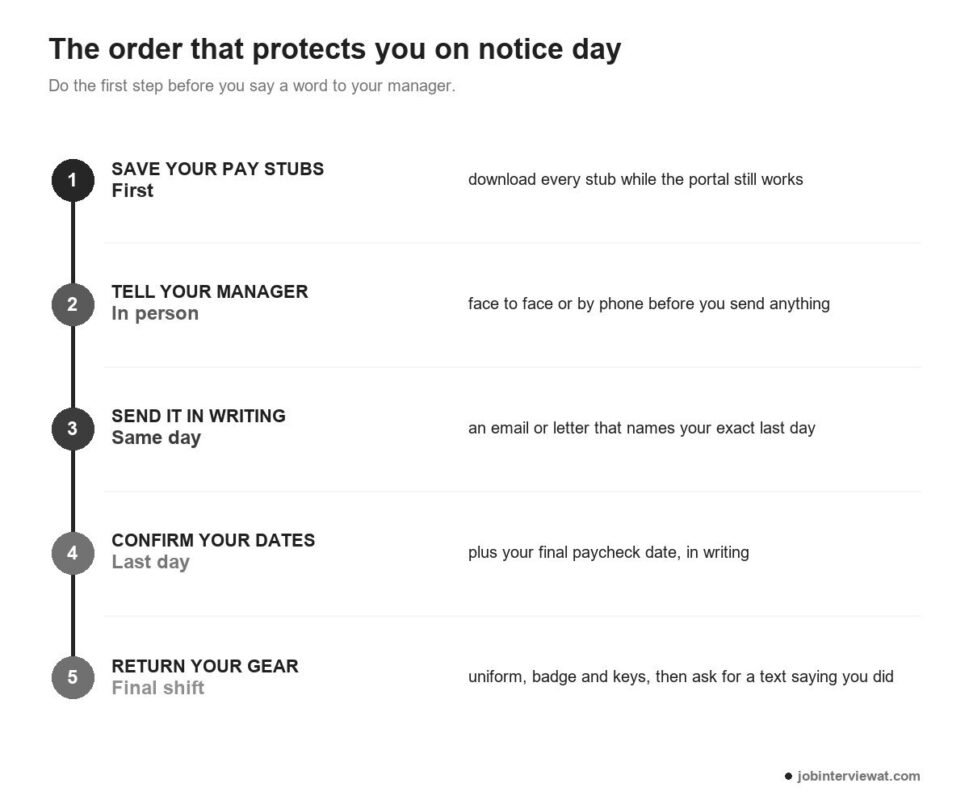
Tell your manager face to face or by phone first, then send the same words in writing the same day. Email is the usual written copy. A text is fine when texting is already how your store handles call-outs and shift swaps.
- In person: best when the manager works the same floor. Pick a quiet moment before the shift starts, not the middle of a rush.
- Email: gives a dated record, which matters if anyone later disputes the last day.
- Text: acceptable when it’s the channel your manager answers fastest, and it works as a backup when they’re off for a few days. Follow it with an email if one is on file.
Not sure which to pick? Use whatever your manager answers fastest, and name the exact last day.
A four-line script for the conversation
- “Do you have five minutes before we open?”
- “I’ve accepted another job, and my last day will be [Last day].”
- “I’ll work every shift I’m scheduled for until then, and I’m happy to help train whoever takes my hours.”
- “Can I send you the same thing by email so it’s on file?”
No reason is owed beyond that. If the manager asks where you’re going, a short answer is enough, and “I’d rather not say yet” is also fine.
What if they send you home the day you give notice?
Some employers end the job right after hearing you’re leaving, so nothing guarantees a full two weeks. Worried about losing the paycheck? Plan as if the first day could be the last: save pay stubs and contacts and clear the locker before speaking.
“I put my 2 weeks in yesterday and got let go this morning. This is the second time this has happened. Before anyone says anything my first jump was after 8 years at a company and this one was a little short of a year. I thought I was being a professional as possible”
– r/jobs, April 2026 (45 upvotes)
“Happened to a friend of mine too. Some companies just walk you out the second you give notice. It’s pretty much a gamble every time honestly.”
– r/jobs, April 2026 (28 upvotes)
If it happens, ask for two things in writing: the official last day and the final paycheck date.
Pay for scheduled shifts missed after being sent home depends on the state and the employer’s policy, so ask payroll instead of assuming. Keep whatever they send, including the text that says to go home.
Whether an early dismissal affects unemployment benefits is a separate question. The Department of Labor’s termination page says each state runs its own unemployment program and decides eligibility under state law, so contact the state unemployment office before assuming either way.
Three copy-paste two weeks notice templates
Wondering how long a notice should be? One short paragraph is plenty. Each sample below uses the same format: a greeting, one sentence saying you’re resigning from a named job, an exact last day, an offer to work your scheduled shifts, and a thank-you. Swap in the actual date instead of writing “two weeks from today,” because the date is what everyone will check.
Short email
Subject: Two weeks notice from [Full name]
Hi [Manager name],
As we talked about today, I’m resigning from my job as [Job title] at [Store or location]. My last day will be [Last day].
I’ll work all of my scheduled shifts until then, and I’m glad to help train a replacement. Thank you for the hours and for the chance to work here.
[Full name]
Text message
Hi [Manager name], it’s [Full name]. I’m giving two weeks notice. My last day will be [Last day], and I’ll cover all my scheduled shifts until then. Can we find five minutes this week to talk through the handoff? Thank you for the opportunity.
One-paragraph formal letter
[Date]
Dear [Manager name],
Please accept this letter as my formal notice of resignation from my position as [Job title] at [Store or location]. My last day of work will be [Last day]. I will work my scheduled shifts through that date, return my uniform, badge and keys on my final day, and help train anyone who picks up my hours. Thank you for the opportunity to work here.
Sincerely,
[Full name]
Print the letter, hand it over after speaking, and keep a photo.
Leave out complaints and reasons. Anything put in writing can end up in a personnel file, and a hot line written on a bad night is hard to take back.
What goes on your last-day checklist?
An hourly last-day checklist has six items: pay stubs saved before access ends, final paycheck timing, unused PTO, uniform and keys returned, contact details swapped with future references, and a copy of the notice. Do the first one before handing in the letter. To see how many PTO hours you’ll have banked by your last day, use our PTO accrual calculator.
- Pay stubs: Download every stub while the portal still works. Our Walmart pay stub walkthrough notes that the store login shuts off on the last day, and former associates use a separate portal. Other employers set their own rules, so look now rather than later.
- Final paycheck: The Department of Labor’s Last Paycheck page says federal law doesn’t require an employer to hand over a final paycheck immediately, and that some states do require it. Look up the state’s rule and ask payroll for the date in writing.
- Unused PTO: The Department of Labor’s vacation leave page says the Fair Labor Standards Act doesn’t require payment for time not worked, and that vacation benefits are a matter of agreement between employer and employee. Check the handbook, and the state’s rules, before counting on a payout.
- Uniform, badge and keys: Return them on the final shift and ask for a text or signature saying it’s done.
- Contacts: Swap numbers with the one or two coworkers or leads who’d vouch, and ask the manager directly whether they’ll be a reference.
- Your own record: Keep a dated copy of the notice and every message about the last day.
What do you tell the next employer about why you left?
Not sure what to say? Give one calm reason that points forward, such as steadier hours, a shorter commute or more responsibility, and then stop talking. The “Why did you leave your last job?” question is number 3 on our list of the most common interview questions and answers.
Say this: “My hours kept changing and I needed something steadier, so I gave two weeks and left on good terms.” Don’t say this: “My manager was a nightmare.” A clean exit makes the first version easy to say honestly, and a reference call can back it up. When a form asks for it, our guide to the reason for leaving on a job application has short wording for each situation, and why did you leave your last job covers the interview version.
Two weeks notice questions
Do you have to give two weeks notice?
No federal rule makes you, but a contract, union agreement or handbook might, so read those first. Without one, two weeks is a courtesy that can help with your reference and a future rehire. Check the state’s rules if unsure.
Can an employer refuse your two weeks notice?
An employer can accept your notice and still end the job immediately, and some do. Ask for the last day and final pay date in writing so the situation is clear.
How do you write a two weeks notice letter?
State that you’re resigning, name the job, give the exact last day, offer to work your scheduled shifts, and thank them in one sentence. Keep it to a single paragraph and leave out complaints. The formal letter above fits that format.
Can you give two weeks notice by text or email?
Yes. Email gives a dated record, and a text works when it’s how the manager already handles shifts. Tell them in person or by phone first when possible, then send the written copy.