

Write the true category in a few neutral words: “Laid off; position eliminated,” “Resigned to accept a full-time role,” “Seasonal position ended,” or “Terminated; happy to discuss in interview.” Leave blame, feelings and backstory out of the box, and don’t write “resigned” or “laid off” if you were fired.
A reason for leaving on job application forms gets read in seconds, right next to your dates. The screener wants to know whether the job ended cleanly and whether your story will match what they hear later. A short, true label answers both, and the interview is where you add the explanation.
What the Reason for Leaving Box Is Checking
The box is a category, not a cover letter. When I screened applications as a corporate interviewer, I read that line for one thing: whether the ending sounded settled or still open. “Contract completed” sounds settled. “Left due to management issues” sounds open, because it invites a follow-up you can’t manage on paper.
Even five words tell a reviewer whether the exit was voluntary, whether the problem is behind you, and whether you talk about a past employer calmly. Nothing in that field needs proving. Its only job is to avoid raising a question the interview answer can’t close.
Short stints draw the closest look. When I helped rework Walmart’s recruiting, job-hopping was one of the problems we worked on. In my experience, a run of brief jobs with blank or vague reasons is the pattern a screener notices first. A clear label on each one, even “Seasonal position ended,” takes that worry off the table.
Reason for Leaving on Job Application Forms: Examples by Situation
Find your situation in the first column. The middle column is wording you can paste as written or trim to fit the field. The last column is what tends to cost you a callback.
| Situation | Write this | Avoid |
|---|---|---|
| Better job or growth | Accepted a role with more responsibility | “Bored” or “no future there” |
| More pay or hours | Left for full-time hours / higher-paying role | “Underpaid” |
| Moved away | Relocated to [city] | Leaving it blank |
| School or schedule | Returned to school / schedule conflict with classes | “Couldn’t keep up” |
| Seasonal or contract | Seasonal position ended / contract completed | “Quit” when the job simply ended |
| Laid off | Laid off; position eliminated | “Terminated” (it means fired) |
| Fired | Terminated; can discuss in interview | “Resigned” or “laid off” |
| Quit without notice | Resigned | “Walked out on a toxic boss” |
| Health or family | Family caregiving / medical leave, now resolved | Diagnosis details |
| Still employed | Currently employed / seeking a larger role | Complaints about your manager |
Two rows trip people up more than the rest. “Laid off” and “terminated” aren’t interchangeable. A layoff means the position or headcount was cut. A termination is about you. Pick the one that’s true, even when the other would look nicer.
“Personal reasons” is fine for health or family exits, but on its own it can read like a dodge. Add one neutral word of context, such as “Personal reasons; family relocation,” and it stops sounding like you’re hiding something.
Fired, Terminated, or Let Go
If you were fired, name the category and keep the reason neutral. Being let go stings, and the box can feel like it’s asking you to confess. It isn’t. It’s asking for a label you can repeat later without changing it.
Any of these work, depending on what happened:
- “Terminated; performance did not meet expectations”
- “Let go; role was not the right fit”
- “Released during probationary period”
- “Discharged; happy to discuss in interview”
Why not just write “laid off” and move on? Because that swap turns a manageable firing into a credibility problem. If a reference, a background form or a direct question later says otherwise, the mismatch becomes the story. Nobody remembers why you were let go.
If you believe the firing was unfair or unlawful, the application is the wrong place to say so. A hiring manager answering someone who had been fired and was taking legal action wrote this in r/resumes in January 2026 (3 upvotes):
“The uncomfortable truth is that explicitly mentioning discrimination in an application can make some employers nervous. Fair or not, legal language sometimes gets interpreted as “risk,” even when it shouldn’t.”
– r/resumes, January 2026 (3 upvotes)
Another reply in that thread pointed out that “reduction in force” implies a layoff, which is a different thing from being fired. Neutral and true beats both the legal framing and the cover story. This is hiring-side guidance, not legal advice. If you have a pending claim, ask an employment attorney how to word your separation.
Quit Without Notice or Left on Bad Terms
Quitting without notice is still a resignation, so the box says “Resigned.” The missing notice isn’t a reason for leaving; it’s how you left. If an interviewer asks, give one sentence on why you left that day and one on what you’d do differently, then stop.
Left because a manager made the job miserable? Write the reason you’d give that manager’s boss: “Resigned; seeking a better team fit” or “Resigned to pursue a different role.” Skip “toxic,” “hostile” and anyone’s name. Those words may be accurate, but on a form they read as a conflict that could follow you to the next team.
If you’re about to leave a job now, a short written notice keeps this row clean on your next application. These two weeks notice templates for hourly jobs cover the wording.
What Can a Former Employer Verify?
A former employer’s verification often confirms dates and job title, not your reason. The University of Houston’s HR page lists hire date, termination date, total time with the company and job title among the fields The Work Number verifies. Drexel University’s HR page says neither it nor The Work Number can disclose reasons for separation.
That’s set employer by employer, not a national rule. Some companies say more on a phone call, and a former manager you list as a reference can share whatever they remember. One commenter who said they worked in HR for over 10 years described their policy in r/jobsearchhacks in August 2026 (6 upvotes):
“Most employers have a policy regarding employment verifications and they only give out dates of employment. This is not always the case, but I worked in HR for over 10 years and this was always our policy as well as the policies for the outside employment verifications that I did.”
– r/jobsearchhacks, August 2026 (6 upvotes)
A formal background check is a separate channel with its own rules. The EEOC and FTC’s joint guidance for job applicants (issued March 2014) says employers may ask about your employment history. They must get your written permission before ordering a report from a background screening company. Before rejecting you because of that report, they must give you a copy and a notice of your rights. So it’s written consent first, and you see the report before a decision based on it.
What does that mean for your box? Verification rarely proves your reason, but it can prove your dates. So a date that doesn’t match your application is the more likely thing to be caught, not soft wording.
When the Form Asks Directly About Being Fired
A direct yes/no question changes the rules. A free-text box lets you choose neutral words; a question like “Have you been fired?” needs a true yes or no, and the definition printed on that form is the one that counts.
The federal Declaration for Federal Employment, OPM Optional Form 306 (revised October 2019), shows how wide that definition can be. Question 12 covers the last 5 years and asks whether you have:
- “been fired from any job for any reason”
- quit “after being told that you would be fired”
- left a job “by mutual agreement because of specific problems”
A yes asks for the date, an explanation, the reason for leaving and the employer’s name and address.
Read that wording twice. Someone who resigned right before a planned termination, or signed a negotiated exit after a performance problem, answers yes on this form. That holds even if “Resigned” was accurate on a private-sector application. The same form warns that a false statement “may be grounds for not hiring you, or for firing you after you begin work.” It also cites possible fine or imprisonment under title 18, section 1001 of the U.S. Code.
Private employers write their own questions, so match each answer to the exact words in front of you. Answer it truthfully, then put your neutral line in the explanation field: “Yes. Let go after missing sales targets; since then, working in roles with clearer metrics.”
How Long Should Your Answer Be?
Your answer should be a few words, or one short clause at most. The reason-for-leaving field is a label that sits beside your dates. A paragraph there tends to read as defensive and gives the reviewer more to question before you ever get a call.
Say this: “Relocated to Denver.” Not this: “Spouse accepted a job in Denver, and after a lot of family discussion, moving seemed like the right decision at the time.” The second version is honest too. It just spends the reviewer’s attention on details that don’t help you.
Can you leave the field blank? If it’s optional, yes, but a blank next to a short tenure invites the exact question you were avoiding. A required field won’t let you skip it, so write the shortest true label and move on.
Saying the Same Thing in the Interview
The box earns you the conversation, and the interview answer expands the same category. Keep the label and add what happened, what changed since, and why this role fits. A full walkthrough of answering “why did you leave your last job” has sample answers for each exit type. The question also turns up among the most common interview questions.
Don’t swing to the other extreme and give a canned line with nothing behind it. One commenter in r/careeradvice, replying in October 2026 to someone asking how to explain a firing (16 upvotes), described how a vague answer lands with a careful interviewer:
“If someone gave me that “safe” answer in an interview I would interpret it as avoiding the question. I’d argue that is less safe with a competent and attentive interviewer.”
– r/careeradvice, October 2026 (16 upvotes)
The honest version often does better than people expect. In an r/jobhunting thread from March 2026, a candidate who quit without an offer because their role was drifting into marketing asked how to explain it. A commenter who said they work in HR replied that the plain explanation was “perfectly fine” and genuine (34 upvotes).
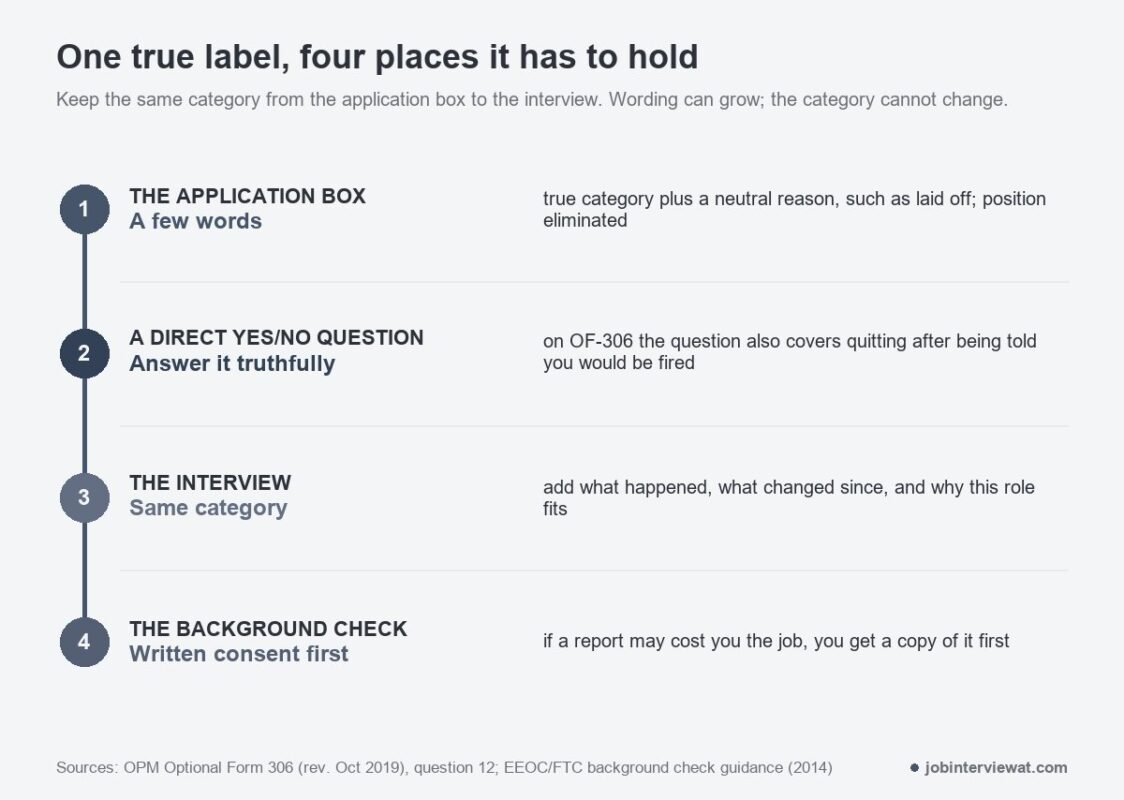
Before you submit, read your reason-for-leaving box, your resume dates and the interview answer you plan to give side by side. If all three name the same category, the application is done.
FAQ
What should I put for reason for leaving on job application forms?
Put the true category in a few neutral words, such as “Resigned for a full-time role,” “Laid off; position eliminated” or “Contract completed.” The best reason for leaving on job application forms is the shortest one that’s still accurate.
Can I leave reason for leaving blank?
You can leave an optional reason-for-leaving field blank, but a blank often prompts the same question in a phone screen. A short neutral label like “Relocated” or “Seasonal position ended” is the safer choice.
What do I write if I was fired?
If you were fired, write the true category with a neutral reason, such as “Terminated; role was not the right fit” or “Discharged; happy to discuss in interview.” Don’t write “resigned” or “laid off,” and keep blame out of it.
Is ‘personal reasons’ a good reason for leaving?
“Personal reasons” is acceptable for health or family exits, but it can read as evasive on its own. Add a few words of neutral context, like “Personal reasons; family relocation,” so the reviewer isn’t left guessing.
How do I explain quitting a job without notice?
On the application, a job you quit without notice is listed as “Resigned.” In the interview, give one sentence on why you left that day and one on what you’d do differently, without criticizing the employer.