

The best answer to “why did you leave your last job” is short, true and pointed forward. Give one plain sentence on what happened, one sentence on what you took from it, and one or two sentences on why this job fits what you want next. Say it calmly, then stop talking.
The same structure handles “why are you leaving your current job,” the version you hear while still employed. Being fired, a layoff, a bad manager and a stay of a few weeks all fit those three parts. Each needs different words. Each also draws a different follow-up question from the person across the table.
What the interviewer is checking
The interviewer wants to know whether the reason you left will follow you to their team. If you left over pay, they wonder whether a slightly better offer would pull you away again. If you clashed with a manager, they picture you next to theirs.
So what are they really listening for? Mostly how you talk about the people you left. I heard that pattern from the hiring side at Bank of America, Wells Fargo and Walmart. A calm, specific answer signals someone who can get through a hard conversation. A long story full of blame sounds like the story the next employer will hear about itself.
Three smaller checks run at the same time:
- Consistency: the reason and dates match your resume, your application form and what a reference might say.
- Ownership: you describe what happened without making everyone else the cause.
- Fit: the next step you describe is something this job actually offers.
Short stays get extra attention. Job-hopping was one of the problems I worked on while helping reengineer Walmart’s recruitment for nearly three years. When a resume shows several moves in a short span, expect a second question about how long you plan to stay.
A three-part answer that survives the follow-up
Keep each part short. Recruiting firm Robert Walters, in a June 2025 guide on explaining reasons for leaving a job, tells candidates to “be brief” and to keep the explanation to one or two sentences, and the three parts stay close to that limit.
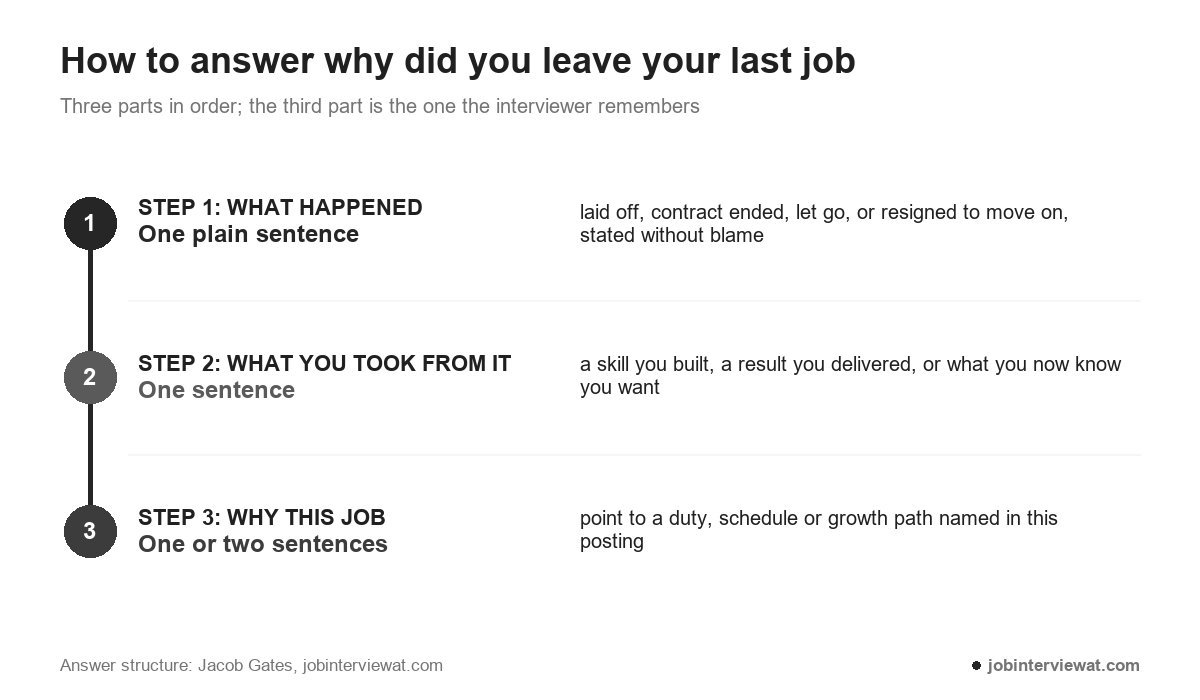
What happened takes one plain sentence of fact. You were laid off, the contract ended, you moved closer to family, or you were let go. Use the plainest true wording you have. A fuzzy line such as “it was time for a change” invites exactly the probing you hoped to skip.
What you took from it gets one sentence that shows the experience moved you forward. That can be a skill you built, a result you delivered, or a sharper sense of what you want. Keep it true. A lesson you can’t back with an example falls apart once the interviewer asks for one.
Why this job takes one or two sentences. It carries the most weight because it’s the part the interviewer remembers. Tie it to something named in the posting: a duty, a schedule, a team or a promotion path.
Every first answer invites a second question. Robert Walters lists several that hiring managers use. Did you try to resolve the problem before leaving? That one comes up often, along with how you left things and how you know this role fits better. Prepare those answers before you walk in, since that’s where a thin first answer gets exposed.
Sample answers for why did you leave your last job, by situation
Find your situation. Swap the bracketed details for your own facts, then say the answer out loud until it sounds like you, and expect the follow-up question listed under each sample to be the next thing the interviewer asks.
You wanted growth the old job could not offer
The interviewer is checking whether you tried to grow where you were. Talk about skills and responsibility, and leave job titles out of it.
Say: “I spent [two years] as a shift lead and learned to run the schedule and train new hires. The next level wasn’t opening up. So I looked for a role with an assistant manager track, which is what this posting describes.”
Expect next: Why didn’t you look for something internally? A poster in r/BPOinPH raised this exact counter in an April 2026 thread with 65 upvotes. Have a true answer ready, such as no opening in your area or a promotion freeze. A July 2026 comment in r/recruitinghell, with 21 upvotes, added a caution. “No room for advancement” can backfire if a senior person in the room thinks you want their job.
Pay or hours
The interviewer is checking whether money is the only thing that moves you. Pay is a fair reason. It just shouldn’t be the only one you give.
Say: “My hours were cut to part-time when the store reduced its schedule, and I need full-time work. I liked the job itself. This role keeps the customer-facing work I’m good at, with full-time hours.”
Or: “I’d taken on more responsibility than my pay reflected, and the company couldn’t adjust it. Pay is one reason I’m looking. The bigger draw here is the [inventory] work this role includes.”
Expect next: What are your salary expectations? Have a researched number or range ready. The 15 most common interview questions include that one with sample wording.
You relocated
The interviewer is checking whether you’re settled and likely to stay.
Say: “My family moved to [city] in [month], and the commute to my old job wasn’t realistic anymore. I left on good terms. Now I’m looking for a long-term role close to home.”
Expect next: Are you planning to stay in the area? Answer with something concrete, such as a lease, a family reason or a school enrollment.
Schedule, school or family needs
You don’t owe an interviewer medical or family details. “A family matter that is now resolved” is a complete answer. So is “I needed a schedule that worked around my classes.”
Say: “I went back to school for [program] and needed evening shifts my old employer couldn’t offer. My classes are set through [season]. This role’s evening and weekend hours fit that schedule.”
Expect next: Will your availability change again? Say what is fixed and when it could change.
You were laid off or your role was restructured
A layoff is the easiest version to explain, because the decision was about the business. The interviewer mostly wants to hear that you aren’t bitter about it.
Say: “My position was eliminated in a restructuring in [month]. Before I left, I [trained the people taking over my accounts and wrote up every open order so nothing slipped during the handover]. Now I want a team where I can stay and build.”
Expect next: Why was your role chosen? Give the true reason if you know it, such as a closed location or a cut to a whole function. Say “layoff” only when that’s what happened. Otherwise it’s a story you’d have to keep straight through every reference call.
A contract, seasonal or temp job ended
Say: “That was a seasonal role for the holiday period, and it ended on schedule in January. I was asked back for [extra weekend shifts]. Now I’m looking for a permanent position.”
Expect next: Would they hire you back? If you were told you’re eligible for rehire, say so. It’s one of the strongest things a temporary job can give you.
You were fired or let go
This is the answer people dread. It’s also where lying does the most damage, because a denied termination has to survive the application form, the reference call and every follow-up question that comes after it. Don’t relabel it as a layoff. Name it in plain words, own your part in one sentence, and spend the rest of the answer on what’s different now.
Brevity helps more than any phrasing trick. In an r/careeradvice thread from May 2026 about explaining a firing, the top comment had 169 upvotes:
“Never complain, never lie, OMIT. You are saying way too much.”
Omitting means leaving out the blow-by-blow: the write-ups, the meetings, who said what. It doesn’t mean hiding the termination. If the interviewer asks directly whether you were fired, the answer is yes. Then give the same short explanation.
Say: “I was let go in [month]. The role needed faster turnaround on [reports] than I was delivering, and I didn’t ask for help early enough. Since then I’ve [finished a training course and started using a task tracker]. The structure in this role suits how I work.”
Expect next: What would you do differently? Robert Walters lists this as a standard follow-up. Give one concrete change. Make it the same change you mentioned in your first answer.
You left because of a toxic manager or team
Leave the manager’s name and behavior out of the room entirely. In a July 2026 r/interviews thread, someone who interviews candidates described one who criticized her current team. That included people she had hired herself, and the commenter called it “a firm reject.” The comment had only a couple of upvotes, but it matches what interviewers listen for.
Say: “My department went through several management changes, and the expectations shifted every few months. I do my best work with clear goals and regular feedback. The weekly check-ins you described for this team are a big part of why I applied.”
Expect next: Did you try to fix it before leaving? Say what you tried, such as asking for written goals or a meeting with the manager. Keep it factual so it doesn’t turn into a complaint.
You are changing careers
Say: “I spent [four years] in retail management, and the part I enjoyed most was training new hires. I finished [a certificate in training and development]. This coordinator role is the first step in that direction.”
Expect next: Why should we hire you without direct experience? Point to the transferable work. Then name one thing you’ve already done in the new field.
You left after a few weeks or months
A short stay needs a reason the interviewer can check against the job description. One April 2026 r/interviews thread asked how to explain quitting after three weeks. The top comment, with 214 upvotes, was one line: “The actual daily tasks were not as advertised.” That works when it’s true and you can name the gap.
Say: “The job turned out to be mostly [phone queue work] instead of the [account management] described in the interview. I left early instead of staying in a role that didn’t use my [skills]. This time I’ve asked more about the day-to-day work, which is why I asked about [task] earlier.”
Expect next: How do we know you won’t leave us just as fast? Point to longer stays in earlier jobs, and to the questions you asked this time.
You took time off after leaving
Say: “I left in [month] to care for a family member. That’s resolved now. I’ve kept my skills current through [an online course], and I’m available to start [date].”
Expect next: What did you do during that time? One concrete activity is enough.
Why are you leaving your current job? Answers while you still work there
When you still work there, answer with what the new job offers that your current one can’t, and leave out what’s wrong with your employer. Give one sentence on what you’ve done in the current role, one on the gap you want filled, and one tying it to this posting.
The pull counts for more than the push here. An August 2026 r/careeradvice thread came from a new graduate three months into a first job. The top comment, with 31 upvotes, said it in one line:
“You say less about why you are leaving and more about what in the new job excites you”
Say: “I’ve learned a lot in [three years] on the claims team, and I’m ready to handle larger accounts. Your team works with [commercial clients]. That’s the next step I’ve been preparing for.”
What if the new job has the same title at a competitor? Name the difference that’s real: a larger team, a different product line, a shorter commute or a better schedule.
Say: “I like the work and I’m good at it. Your team handles [a wider product line]. Even with the same title, the day-to-day work would stretch me in a way my current role can’t.”
You can ask for discretion without explaining yourself. “My employer doesn’t know I’m looking, so I’d appreciate keeping this confidential” is a normal request. If you get the offer, plan your notice the usual way; the two weeks notice templates cover the wording.
Expect next: Would you stay if they matched our offer? Answer with the reasons beyond pay you already gave. That way the first answer and this one support each other.
What not to say, and what to say instead
Most damaging answers are true statements said in the wrong words. These swaps keep the truth and lose the damage:
- Not: “My boss was impossible.” Say: “I’m looking for a team with clear expectations and regular feedback.”
- Not: “I was bored.” Say: “I’d learned the role well and I’m ready for more responsibility.”
- Not: “They didn’t pay me enough,” on its own. Say: “Pay is one factor, and the bigger draw is the [scheduling] work in this role.”
- Not: “I was laid off,” when you were fired. Say: “I was let go, and here’s what I changed afterward.”
- Not: “It’s a long story.” Say: one plain sentence about what happened.
Can a vague answer hurt you? Yes, according to one October 2026 r/careeradvice thread about explaining a firing. A commenter with 16 upvotes pushed back on the stock non-answer:
“If someone gave me that “safe” answer in an interview I would interpret it as avoiding the question. I’d argue that is less safe with a competent and attentive interviewer.”
A line like “I wanted new challenges” works only when the next sentence names the challenge. Without that, a careful interviewer keeps asking. By the time the real reason comes out, it sounds like something you tried to hide.
Keep the interview answer and the application form telling one story
Your application, resume, LinkedIn profile and spoken answer should all agree. Interviewers often have the application open while they ask this question. A form that says “resigned” and an answer that says “my contract ended” turn an easy question into a hard one.
The wording for the form itself, matched to these same situations, is in the guide to the reason for leaving on a job application. Write that line first, then build your spoken answer from it.
Reddit commenters disagree about what former employers will confirm. Some say many companies give out only dates and job titles. An October 2026 r/careeradvice commenter argued that employers can share far more than people assume. Treat both as reports, and plan as if anything you say could be checked.
The night before, read your answer next to your application and your resume. Same reason, same dates, same job title. If you checked “terminated” on a form, the word you use in the interview should match it.
FAQ about leaving your last job
What is the best answer to why did you leave your last job?
The best answer to why did you leave your last job is one true sentence about what happened, one about what you gained, and one or two about why this role fits. For example: “My position was eliminated in a restructuring. I trained the team taking over my accounts, and I’m looking for a role where I can stay and build.”
How do you answer why did you leave if you were fired?
Say you were let go, give the reason in one neutral sentence, and spend the rest on what you changed. Don’t blame the manager, and don’t call it a layoff. Keep the change specific, such as a course, a new system or a habit, so the follow-up has something to land on.
Is it OK to say I left for more money?
Yes, if pay is one reason among others and you say it without complaint. Robert Walters’ guide answers the same question with a yes and advises keeping it positive. Pair pay with something about the work itself. Otherwise the interviewer may conclude a higher offer elsewhere would pull you away next.
How do you answer why are you leaving your current job?
Talk about what the new role offers that your current one doesn’t, and keep your current employer out of the criticism. Name one thing you’ve done well where you are, the gap you want filled, and the part of this posting that fills it.
Should you say you were laid off if you were fired?
No. Several Reddit commenters in 2025 and 2026 threads suggested it. But a relabeled firing is a story you have to repeat to every interviewer and keep consistent with your application and references. A short, honest account plus a clear change since then is the answer you can defend.