
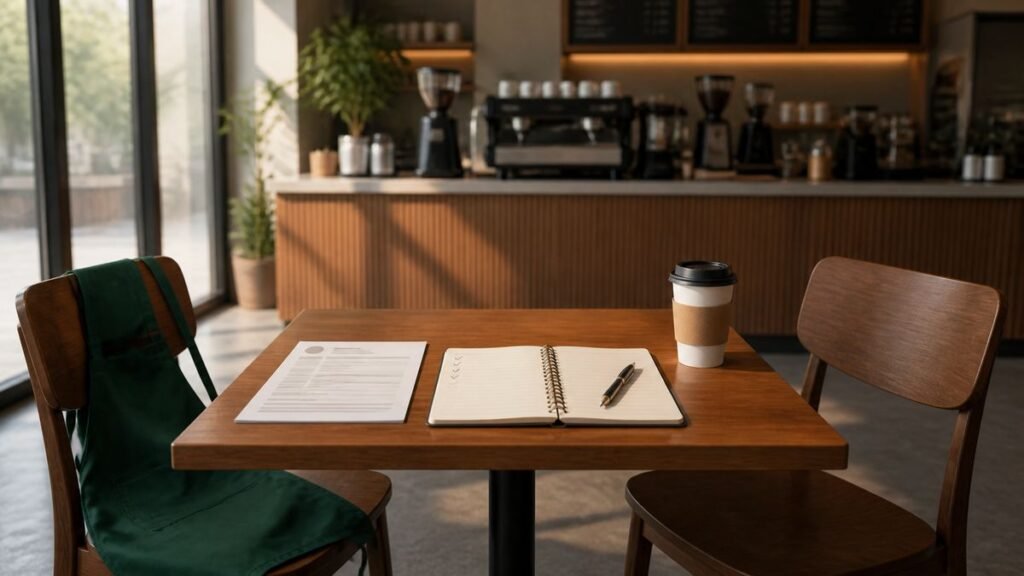
Starbucks interviews are short, conversational, and built around fit. Expect a phone call to schedule, a sit-down with the store manager at the store itself, a complimentary drink that doubles as a menu test, and fifteen to twenty minutes of questions about why you want to be there, how you handle repetition and rushes, and when you can start. Coffee skills are trained after hiring; the interview measures whether you will be good to work beside at 5:30 a.m.
Everything below comes from more than four years of sitting on the hiring side of Starbucks interviews, updated for the way stores hire now: the full question list with sample answers, the parts of the process most applicants never think about, and the role-specific prompts baristas and shift supervisors get.
Prefer a printable version? The Starbucks interview prep sheet (PDF) lists every question below with one-line answer cues; download it, write your own answers next to each, bring it along.
⬇ Download the full Starbucks Interview Guide (PDF, free)
How the Starbucks hiring process works
The path runs online application, a scheduling phone call from the store, an in-store interview with the store manager, and usually a same-week decision. Some markets add a short second conversation for shift supervisor roles. Three moments in that path decide more than applicants realize.
The phone call is not just scheduling. When the manager calls, they are already forming an impression. Sound like you expected the call, accept the slot they offer or give a clear reason for another day, and smile while you talk; it carries through the line. A warm phone call means the manager walks into your interview hoping to hire you.
The walk-in matters. Arrive at least five minutes early, and remember the manager is not waiting at the door. Introduce yourself to whoever is at the register the way a future coworker would: your name, that you are here to interview at three, could they let the manager know when they have a minute. Store managers routinely ask their baristas what they thought of a candidate, and the first impression you make on the floor gets repeated back to the person deciding.
The free drink is a test. Most stores offer you a complimentary drink at the start. Order something you actually like from the real menu, say why, and drink it. Waving it off, or ordering as if you have never been inside a Starbucks, reads as indifference to the product you would be selling all day.
The Starbucks interview questions, with answers
Eighteen questions cover nearly every Starbucks store interview. The first four are the ones almost everyone gets; the rest rotate by store and role. Each comes with what the manager is listening for and answers that have worked.
1. Why would you like to work at Starbucks, and not somewhere else?

Most applicants list the perks: flexible hours, part-time openings, a big brand, steady customers. Not a bad answer, but the strong version flips the perspective and talks about what the store gets from hiring you, tied to something real about the culture. Managers are proud of how their stores run; show them you noticed.
Sample answers: “I like how organized this store is and how relaxed people seem inside it at the same time. I like the coffee, the variety, and the way the partners here treat each other. That friendly working environment is why I would rather work here than somewhere else.”
“I meet the requirements and I think I fit the team working here. Your part-time schedule also lines up with my college timetable, so it is a good match on both sides. I have applied elsewhere too, but Starbucks is my first choice.”
2. Why this position? (Barista, shift supervisor, or another role)
Show that you know what you applied for. Match your strengths to the job description, or say plainly that you like the nature of the work; if nothing else, location, past experience, and hours are honest reasons.
Sample answers: “I led a small team at my last job and people worked well under me, so I applied for shift supervisor to put that to use here.”
“I like being on my feet, working with my hands, and talking to people, so barista is a natural fit. This store is also a short walk from my dorm.”
3. This job is repetitive. What would motivate you to do it well every day?
Barista work is repetitive, and the manager wants to know you will not fade by month two. Either own a preference for routine work done well, or argue that with the right attitude no shift is the same.
Sample answers: “Honestly, I prefer routine jobs. Once I learn how to do something, I do it well and I get satisfaction from that.”
“From where I stand this job is not repetitive. Baristas do the same tasks, but new people walk in all day, you talk to them, small problems come up and you solve them on the spot. No two shifts feel the same to me.”
4. What are your strengths and weaknesses?
Name strengths that matter behind a counter and a weakness that mostly does not, then show what you do about it. Never claim to have none; and a weakness some managers read as a strength, like being overly friendly with customers, is a safe pick.
Sample answers: “I tend to be over-friendly with people, and customers can occasionally read that the wrong way, so I stay mindful of it. My strengths are that I pick up systems fast and I read what different people need, which I think helps at the register.”
“My English is not as strong as I want it to be, so I take evening classes and practice at home. On the other side, people describe me as responsible; I have never missed a deadline or shown up late to a shift.”
5. Tell us a little about your working experience
This tests whether you listen and stay on point. Mention one or two relevant roles, any customer-facing, sales, supervisory, or manual job, and talk about them positively; the manager already saw the full list on your application. No work history yet? Volunteering and summer jobs count, because the point is showing you know what having a job means.
Sample answers: “I worked two years part-time as a bank teller. It taught me how to talk to people and figure out what they actually need, which I think transfers straight to the counter here.”
“I have only had summer jobs: two months of construction labor, fruit picking, and volunteering at a research center. I learned what a routine job and real pressure feel like, and now I want to start something longer-term here.”
6. If a coworker were gossiping about someone, saying something untrue, how would you react?
Managers do not want you refereeing other people’s problems. They want to hear you focus on your job, stay out of gossip, and keep the team feeling like a team.
Sample answers: “I would say I do not think that is true and get back to work. Gossip always exists; I try to keep good relationships with everyone and not feed it.”
“That is their opinion. I stay friendly with everyone and keep out of it, and if two people really cannot get along, that is a conversation for the manager, not for me.”
7. What would your former colleagues or teachers say about you?
Two things are being tested: what you say about them, and whether your self-image matches what a reference call turns up. Every store is a team, and applicants who badmouth former colleagues do not last. Stay humble, offer one or two traits, or admit you cannot speak for them.
Sample answers: “They were good people and did their jobs well; I doubt they spent much time evaluating mine. Maybe they would say I was responsible and never started conflicts. I think they would say we got along.”
8. How long would you like to work at Starbucks?
Hiring and training cost time and money, so managers favor people who will stay or reliably return. Convince them you see this as more than a stopgap, even if your honest horizon is a year or a run of summers.
Sample answers: “If you are happy with my work and my colleagues like working with me, I would gladly stay for years. I cannot see a reason to leave.”
“Honestly, this is a summer job, but I would want it every summer while I am in school. Once we have both invested in training me, it would make no sense to start over somewhere else next year.”
9. What would you do if you were late for a shift?
Start by establishing that you are not late, that you understand a missing person hurts everyone on the floor, then say you would notify the shift supervisor the moment you knew.
Sample answer: “I have never been late for school or work; I plan to arrive fifteen minutes early rather than trust the last bus. If something extraordinary happened, I would call the supervisor as soon as I knew, so someone could cover my station until I arrived, and I would apologize to whoever covered.”
10. What have you learned in the last year?
The specific lesson matters less than the attitude: do you see setbacks as lessons, do you keep working on yourself. Something about people skills lands best in a people job.
Sample answers: “I have matured this year. Working with colleagues and customers improved how I communicate and how I understand the way other people see things.”
“I learned that people you trust can let you down. It was a hard year personally, but I treat it as a lesson and I am still standing.”
11. What was a goal you set for yourself in the last year, and how did you accomplish it?
Responsible people have goals. Pick one connected to the job if you can, better communication, learning to make good coffee, landing a first job, or a personal goal that shows determination.
Sample answers: “Graduating was the goal, and I used my free time to do it with good marks. Now the goal is a first job and being good at it.”
12. Describe a time a customer was not satisfied with your service. What did you do to fix it?
Most Starbucks customers are pleasant; some will complain for no reason. The manager wants to know you expect that, it will not rattle you, and you know the moves: apologize, ask what went wrong, fix it. No experience? Say what you would do.
Sample answers: “This is my first job application, so it has not happened yet. If it did, I would apologize, ask what I got wrong, and make it right. Every one of those situations prepares you for the next.”
“I once mixed up orders and handed someone tea instead of a cappuccino, and they were already annoyed about the wait. I apologized, made them a larger cappuccino, and added a pastry I paid for myself. They were startled enough to apologize for their tone.”
13. How comfortable are you in close quarters with up to five coworkers?
Say it is no problem, and use the moment to compliment what you saw while waiting: the baristas’ system, how they avoid getting in each other’s way. It shows you paid attention.
Sample answer: “Not a problem at all. Watching your team while I waited, everyone knows their station and helps each other without colliding, and the customers stay happy. I would be glad to be part of that in a small space.”
14. What do you like about coffee?
You do not have to be a coffee obsessive, but you need to see it as something positive: energy, a pause in the day, the thing people talk over. Managers want to sense you take some pride in the product. Even non-drinkers can answer this well.
Sample answers: “It brings people together. Thousands of conversations start over a cup of coffee every day, and I like being part of that.”
“I do not drink coffee myself, but I see what it does for people: energy, a break, a reason to sit down with someone. It is a good thing that Starbucks does it well.”
15. Give an example of the best customer service you have provided
Talk about exceeding expectations, then prove it with one specific moment. First job? Show you understand why service matters here and what you would do to deliver it.
Sample answers: “At my last retail job a customer asked a technical question about a computer I could not answer, so I called a friend who knew electronics and got them the answer. They were genuinely grateful. Moments like that make me proud of the work.”
“A customer’s phone had died and he needed to make an urgent call, so I offered him mine. He came back to our store for years after that.”
16. What would you do if you saw someone stealing from the register?
Report it to the shift supervisor. Community matters here and you should not run to management over every small thing, but theft is past every limit, and if nobody reports it the whole shift can end up under suspicion.
Sample answer: “I would report it to the shift supervisor or store manager immediately, whether it was a coworker or a customer. Stealing is not acceptable, and if the culprit is not found, everyone on the shift suffers for it.”
17. When are you able to start?
Show determination: as soon as they need you, and Starbucks is your first choice. If you genuinely have a notice period elsewhere, say so; leaving a current job overnight would not speak well of you either.
Sample answers: “I can start immediately. I have had other interviews, but this is my first choice; if you want, we can sign today.”
“I would love to start soon, but walking out on my current job tomorrow would be irresponsible. I need a few weeks to finish properly and negotiate my notice, and I will push to start here as fast as I can.”
18. Do you have any questions?
Ask something. It signals you care about the job, not just a job. Skip anything already covered in the posting or the conversation; ask about next steps, the team, the training, the culture.
Sample questions: “How long has this team worked together? Everyone was so nice when I walked in.” “What does training look like, and how do you get baristas ready for the morning rush?” “What are the next steps after today?”
Barista and shift supervisor: the role-specific questions
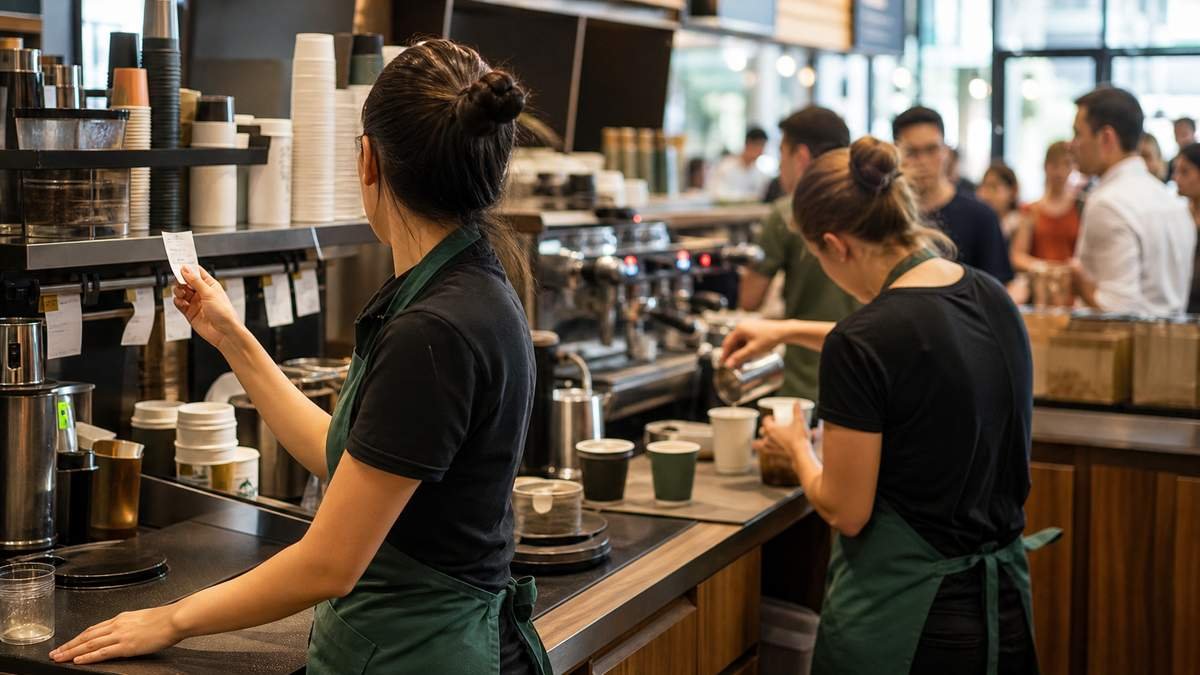
Applying for the barista role specifically? On top of the general questions above, hiring managers add prompts that test how you will hold up behind the bar during a morning rush.
How would you keep your energy up during a long line of mobile orders and drive-thru customers? Name a technique, not an adjective: calling drinks out loud, clearing the smallest ticket first, staying warm with the customer in front of you while your hands work on the next cup.
A customer says their drink was made wrong. What do you do? Remake it immediately, apologize once without excuses, and let them watch the remake if it was an allergy or milk mix-up. Managers listen for ownership with zero argument; the drink costs less than the regular.
Why barista, and not a register or lobby role? Talk about the craft and the pace: learning the bar sequence, the satisfaction of a clean rush, remembering regulars’ drinks. It signals you understood the job before applying, which most candidates cannot show.
Shift supervisor candidates get one more layer: a time you coached a struggling coworker, how you would open a store short-staffed, and how you handle a partner who keeps arriving late. Prepare one true story for each, told in four sentences, and remember that the manager is deciding whether to leave you holding the keys.
What to wear, what to bring, and how the decision comes
Dress the way partners look behind the counter on a good day (the full Starbucks dress code spells out the current rules): clean, neat, closed-toe shoes, nothing you could not wear near a hot bar. Business casual is fine; a suit is too much for a store interview. Bring your availability written down, and a pen; a resume is optional since the application is already on the manager’s screen.
Decisions come fast. Many managers decide during the interview and call within days; a quiet week usually means the store filled its slots or is waiting on a second candidate. Availability that covers early mornings and weekends decides ties, because that is when stores are hardest to staff.
Once you are hired, the package behind the paycheck is worth understanding: the Starbucks employee benefits guide covers what unlocks at 20 hours a week and the perks partners forget to use. Comparing coffee jobs? Our Dunkin’ interview questions guide covers a chain where many stores are run, and staffed, by franchise owners.
Frequently asked questions
Is the Starbucks interview hard?
No; it is a friendly conversation of about fifteen to twenty minutes with the store manager, and applicants rate it easy. The real filters are attitude, availability across mornings and weekends, and whether the manager can picture you on their team.
What questions does Starbucks ask in an interview?
Why Starbucks, why this position, how you handle a repetitive job, strengths and weaknesses, your experience, a difficult customer story, what you like about coffee, and when you can start. Baristas also get bar-specific prompts about rushes and remaking drinks.
What should you wear to a Starbucks interview?
Clean business casual with closed-toe shoes matches how partners look on shift; a collared shirt or neat top and plain pants are plenty. Skip strong fragrance and anything you could not wear near a hot bar.
How long does it take to hear back after a Starbucks interview?
Most applicants hear within a few days to a week, and some managers decide on the spot. If a week passes quietly, a polite call to the store is normal; managers often have another opening or a wait list.