
Target screens most applicants with six recorded questions. Before any human conversation, hourly candidates complete a virtual interview: read a prompt, get a short window to think, and record an answer on camera. The Target interview questions in that recording decide whether you ever meet a manager, so preparation starts with the six prompts, not with handshake advice. Best Buy opens some store roles with a recorded round too; our Best Buy interview questions guide covers how its version works.
The six change slowly and leak fast. Applicants post the current set on r/Target within days of each revision, employees confirm which version is live, and the themes have stayed stable through mid-2026 even as wording shifts. That makes this one of the few retail interviews you can rehearse almost word for word.
Store roles are the focus here: guest advocate, general merchandise, fulfillment, Starbucks kiosk, and style. The recorded-screening format itself is spreading across retail, and the HEB interview guide covers the other big grocer running video-first hiring. For retailers that still start with a live interview, see our Kohl’s and Burlington interview guides.
How Target hiring works: recording first, manager second
The path runs through Workday: an online application, the virtual interview invitation by email, a recruiter or system review of your recording, then an in-person conversation at the store for candidates who clear it. Some applicants report offers straight from the recording during high-volume seasons, and most who interview in person hear back within a day or two.
Target’s own interview guide frames the sit-down as mutual: you are interviewing them as much as they are interviewing you, and arriving with two genuine questions about the team fits that framing exactly.
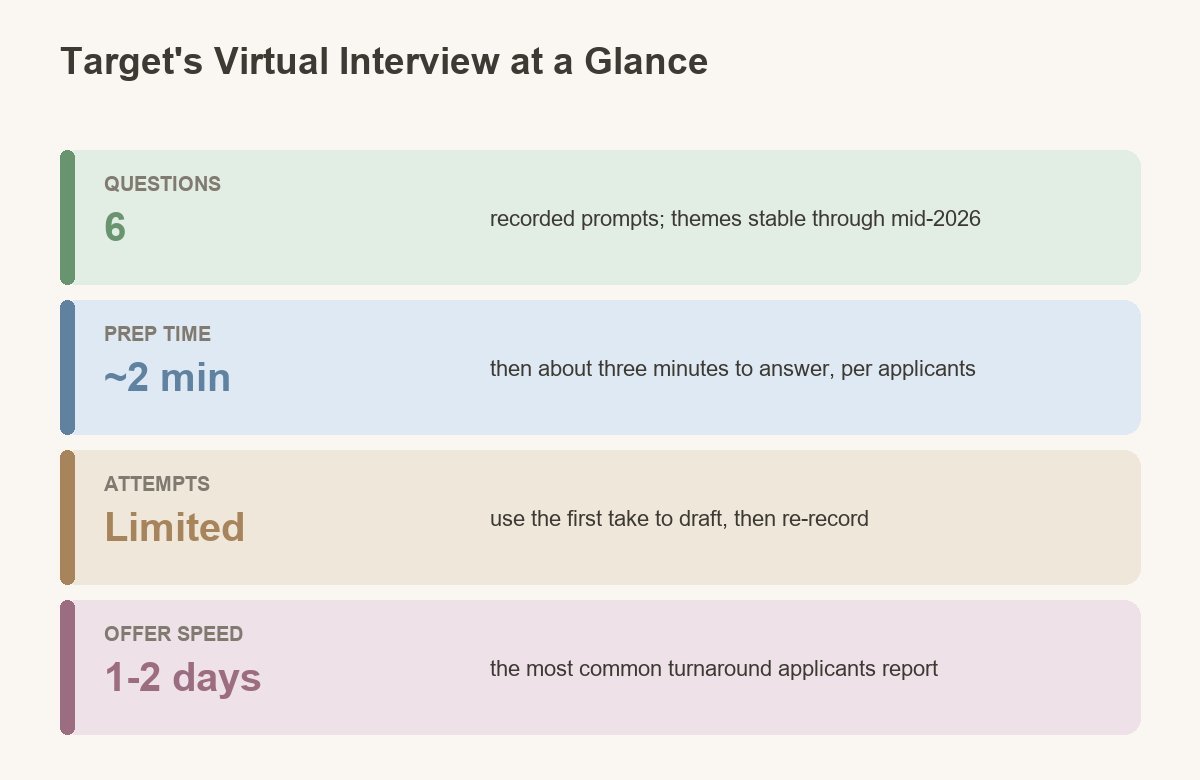
Applicants describe roughly two minutes to consider each prompt and about three to answer, with a limited number of re-record attempts per question. Burn your attempts carelessly and the panic compounds; budget them and the format becomes an open-book test.
The 6 Target virtual interview questions
The mid-2026 store set centers on guest interaction: why you want the role, balancing tasks against helping a guest, handling an item a guest cannot find, adjusting your own work to help the team, prioritizing when time runs short, and a yes-or-no check on the job’s physical and schedule requirements. An applicant posted the live set verbatim:
“1. **Tell us why you are interested in the position and describe your relevant knowledge and experiences.** 2. **Imagine you are on the sales floor working to complete your assigned tasks, and you notice a customer, or guest as we call them at Target, who app…”
– r/Target, May 2026 (68 upvotes)
A second questionnaire circulates for some roles, leaning behavioral: best work achievement, a difficult task you handled, how you apply past experience, working with different perspectives, and achieving a goal with another person. Prepare by theme and both versions are covered. For the different-perspectives prompt, give one story where a disagreement stayed respectful and produced a better outcome, and end with what you took from the other person’s way of working. For the goal-with-another-person prompt, tell one true story and name what the other person contributed, not only what you did.
1. Why are you interested, and what relevant experience do you bring?
Sample answer: “I shop this store, so I already know the layout and how the team greets people, and I want to work somewhere that busy but organized. My last two summers were on a pool snack bar where I ran the register and restocked at the same time, which is the same juggling this role asks for. I am looking for steady hours through the school year, and this is the schedule that fits.”
Need your own version? Our why do you want to work here guide builds the answer in three parts, with samples for retail, grocery and warehouse jobs.
2. You are on the sales floor working on your assigned tasks and a guest appears to need help. How do you balance helping the guest and completing your work?
The full wording in the posted set reads: “Imagine you are on the sales floor working to complete your assigned tasks, and you notice a customer, or guest as we call them at Target, who appears to need assistance. How do you decide what to do in that moment, and how do you balance helping the guest and completing your work?”
The trap is picking one.
The answer Target scores well is both, in order: greet the guest now, because a person outranks a task, then return and finish. Say the sequence out loud and mention flagging a teammate if the guest needs more than a minute.
Sample answer: “I’d stop and greet the guest first, because a shelf can wait a minute and a guest who gives up and leaves can’t. I’d ask what they need. If it’s quick, like finding an aisle, I’d walk them there and go straight back to my task. If it will take longer, I’d bring in a teammate or my lead so the guest is covered and my area still gets done, and I’d tell my lead if that pushes my task back.”
3. A guest tells you they can’t find an item they came in for. Describe how you would respond and the actions you would take.
Sample answer: “First I would walk them to the aisle instead of pointing, because pointing loses people. If the shelf is empty I would check stock on the device, offer the online option or a nearby store, and suggest the closest substitute on the shelf. The guest should leave with something: the item, an order, or a concrete plan.”
4. Describe a time you had to adjust what you were working on to support the needs of a group or a team.
Pick a real moment when you paused your own task because the team needed you somewhere else: a rush at the register, a coworker who called out, a group project that changed direction. Say what you set aside, how you made sure it still got done, and how it turned out.
Sample answer: “At my last job I was restocking when the line at the front backed up and my lead asked for help. I told her where I’d stopped, ran a register for about half an hour until the line cleared, then went back and finished the stock before my shift ended. The point was that the guests came first and my own work still got done.”
5. When you’re given several important tasks at the same time, how do you decide what to work on first? If time becomes tight, how do you ensure tasks are completed correctly?
Current team members call this the hardest prompt on the sheet. Name a rule: guest-facing and safety tasks first, biggest team impact second, and tell your lead early which task will slip instead of rushing everything badly. That last clause, communicating the miss before it happens, is what separates strong answers.
6. Can you meet the job’s physical and schedule requirements? (Yes or no)
The last item isn’t a recorded answer. It lists the essential functions of store jobs: climbing up and down ladders, working a flexible schedule that includes nights, weekends and holidays with regular attendance, and scanning, handling and moving merchandise, including frequently lifting up to 40 pounds. It also asks about any state or local license the job needs.
Answer honestly. The question itself says “with reasonable accommodation, if necessary,” so a yes can still come with an accommodation request later in the process.
Recording tactics, learned from people who bombed it
Treat the recording like an open-book test, because it is one.
The questions above are public, the prep window is generous, and the retry system rewards applicants who plan their attempts instead of improvising on the first take.
“Pro tip for those who may be reading this. Start the first attempt, read and consider the question while it’s going. I personally opened notepad and wrote a little script for myself. Hit retry and read off the script”
– r/Target, June 2026 (10 upvotes)
Keep bullet notes rather than full scripts, though; reading word for word flattens your voice, and warmth is half of what the reviewer is grading. Front-light your face, keep answers between sixty and ninety seconds, and close each one by naming the role.
One bombed answer is not the end. The same thread is full of people who froze, misspoke, or made a crying face at the camera and still got the store interview, because reviewers watch six answers, not one.
The store interview, and what decides close calls
The in-person round revisits the recorded themes with follow-ups, then lands on the practical deciders: your availability across evenings, weekends, and the holiday season, and which departments you would work. Wide availability wins ties here the way it does across retail, and holiday-season flexibility carries extra weight at a company that staffs up every fourth quarter. If you can hold early-morning truck shifts or closing hours, say so unprompted. Managers assemble schedules like puzzles, and the applicant who volunteers the awkward pieces gets remembered when two recordings score the same.
Dress business casual; a red top is a friendly nod, not a requirement. Bring your schedule written down, two questions about the team, and the same energy you recorded with, since the interviewer has usually watched your video minutes before meeting you.
Frequently asked questions
What are Target’s 6 interview questions?
The six recorded prompts cover why you want the role, balancing tasks against helping a guest, a guest who cannot find an item, adjusting your work to support the team, prioritizing under time pressure, and a yes-or-no check on physical and schedule requirements. A second questionnaire used for some roles swaps in behavioral prompts such as working with different perspectives.
How do I pass a Target interview?
Prepare one story per theme before the recording, use the prep window to outline, and answer in sixty to ninety seconds with the guest put first in every scenario. Wide availability plus a warm on-camera delivery clears both rounds for most applicants.
Does Target give everyone a virtual interview?
Nearly all hourly store applicants get the recorded round, usually by email within days of applying. Some corporate and specialty roles interview live instead, and during peak season a strong recording alone can produce an offer.
How long does it take to hear back from Target?
Most applicants report an answer within a day or two of the store interview, and about a week when volume is high. A quiet week after the recording usually means the review queue, not a rejection, so wait before reapplying.