

Most HEB interviews start with a recorded video round. Applicants answer HEB interview questions twice: once on camera for corporate recruiters, then again in person with store leadership if the recording passes. Knowing which stage you are in, and what each one screens for, matters more than memorizing answers.
Plenty of applicants get this wrong in both directions. Some treat the video round as a formality and record a flat sixty seconds; others assume the in-person invitation means the job is theirs. An actual HEB interviewer on r/HEB corrects both mistakes in one post, quoted below.
The advice here covers store roles at the Texas grocer: cashier, stocker, Curbie, and department jobs. If you are applying across several grocery chains, the Aldi interview guide describes a very different format built around group hiring events.
How HEB hiring works: video first, store second
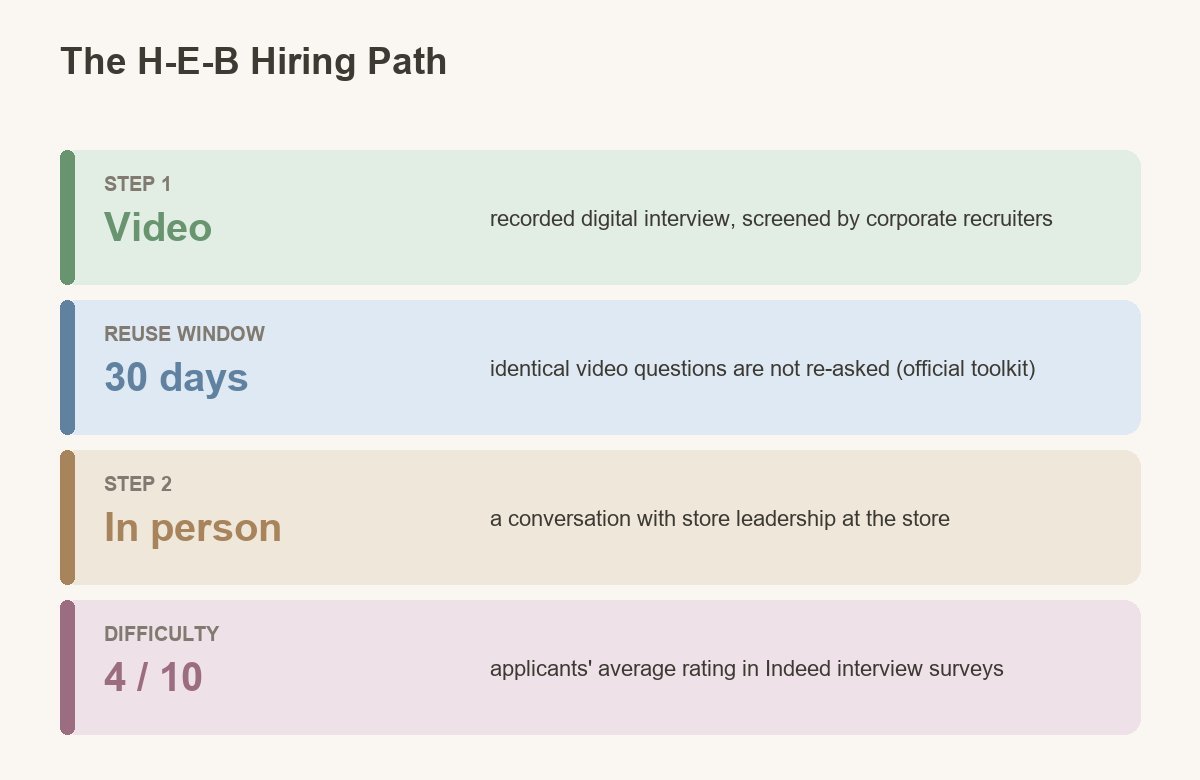
The sequence is an online application, a digital interview you record on your own time, a screening pass by corporate recruiters, and then an in-person conversation at the store. HEB’s own candidate toolkit confirms one useful rule: a digital interview with identical questions completed in the past thirty days does not need to be recorded again.
“As someone who makes hiring decisions and conducts interviews at Heb, please do not bring a paper copy of your resume😂 we can see your resume if you attached one in your application, but it very rarely means anything to us. Being scheduled for an in person interview does not mean you’ve got the job. It only means you’re going to be interviewed. The video application you sent in was only step 1 of the process. Corporate recruiters watch those and decide if you’re moving on to the actual intervie…”
– r/HEB, May 2026 (7 upvotes)
The video is the real gate.
Some roles add steps. Curbie and e-commerce applicants describe a newer protocol where an HEB recruiter runs a separate phone screen and a Zoom conversation before the store visit, so a longer chain does not mean something went wrong with your application. The whole path still moves quickly once the recording clears review, and applicants most often describe hearing back within a day or two of the store conversation. Silence for a week after the video round usually means the clip is still in the queue, not a rejection.
HEB video interview questions, and how to record them
The video round asks a short set of get-to-know-you and service prompts: tell us about yourself, describe a time you gave great customer service, why HEB, and your availability. You record against a timer, usually with a chance to think first, and the recording is judged by recruiters who never met you.
Employees who passed it give consistent advice: relax, speak to the camera like a person, and anchor every answer in the department you applied for.
“its important to be professional, but not stuck on and full of yourself. also, use key buzz words directly related to grocery customer service and the department that you are applying for.”
– r/HEB, June 2026 (4 upvotes)
Three recording rules cover most of it. Light your face from the front and check the frame before the first question. Keep each answer between forty-five and ninety seconds, one concrete story per prompt. And close each answer by naming the department, because a recruiter sorting hundreds of clips remembers the bakery applicant who talked about the bakery.
The HEB interview questions to prepare for
Eight prompts cover the in-person round: tell me about yourself, why HEB, your availability, your definition of good customer service, attendance expectations, a coworker conflict, working under pressure, and your own questions.
1. Tell me about yourself
Three sentences: where you are now, what you do well with people, why this store. The interviewer heard your video version already, so add something new instead of replaying it.
2. Why do you want to work at HEB?
Sample answer: “Partly loyalty, honestly. I have shopped at this store my whole life, and everyone in my family has a strong opinion about which location has the best tortillas. But mostly it is that people I know who work here stay for years, and companies where nobody leaves are usually doing something right by their people. I want a job worth keeping.”
3. What is your availability?
Grocery peaks on evenings, weekends, and holidays, so present your widest honest window and flag the immovable blocks. Overnight stocker applicants should confirm they can hold the schedule long-term, because a reset body clock is half that job.
4. What is your definition of good customer service?
Define it as solving the need behind the question, then prove it with one act: walking a customer to the aisle, opening a register when the line builds, remembering a regular’s usual order.
Sample answer: “Good service is noticing before being asked. At my last job I watched for the customer standing still in an aisle, because standing still means lost. Walking someone to the shelf takes thirty seconds and changes how they remember the whole store. Politeness is the floor; noticing is the job.”
5. How often is it acceptable to miss work?
This one shows up in HEB interviews more than at other grocers, and the safe honest answer is: for emergencies, and rarely. Reliability is the trait a department manager is really measuring, so mention your attendance record at school or a previous job if it is good.
6. What would you do about a coworker conflict?
Talk to the person first, privately and kindly, and escalate only if it touches safety or customers. Give one real story where the direct conversation fixed something operational.
7. How do you handle pressure and rushes?
Sample answer: “I make my task list smaller, not my effort bigger. During a Friday rush at my last job I would call out what I was doing, clear the fastest task first, and ask for help before I was buried instead of after. Pressure spreads when people go quiet, so I stay loud and friendly on purpose.”
8. Do you have questions for us?
Ask what separates a good first month from a great one, and how partners move between departments. Both signal you plan to stay, which is what this employer wants to hear most.
Overnight stocker, cashier, Curbie: how the bar moves
The interview weight shifts by role. Cashier and bagger conversations stay light and personality-driven. Overnight stocker interviews probe stamina and pace, because the job carries case-count expectations and hours of heavy lifting; current stockers on r/HEB push back on the idea that anyone gets waved through. Curbie applicants field customer-service scenarios plus the longer recruiter chain described earlier.
Answer for the role in front of you. A stocker applicant who talks about lifting habits and holding a case pace beats one reciting customer-service lines, and a Curbie applicant should have one story about fixing an order mistake fast.
Frequently asked questions
Are HEB interviews difficult?
Applicants rate HEB interviews around 4 out of 10 for difficulty in Indeed’s interview surveys: harder than a walk-in fast-food chat, easier than a corporate loop. The video round filters more people than the in-person conversation does.
How do you dress for an HEB interview?
Business casual fits every store role: plain pants, a collared or neat top, closed shoes. Record the video round in the same outfit; recruiters judge the clip the way a manager judges the handshake.
What are the 5 main questions asked at an interview?
The classic five are tell me about yourself, why do you want to work here, your strengths, your weakness, and your future plans. HEB covers all five across its video and in-person rounds, phrased around grocery service.
What should you bring to an HEB interview?
A photo ID and your written availability cover it; an HEB interviewer on r/HEB specifically advises against handing over a paper resume, since your application is already on their screen. Bring one anyway only if you need it yourself as a memory aid for dates.