
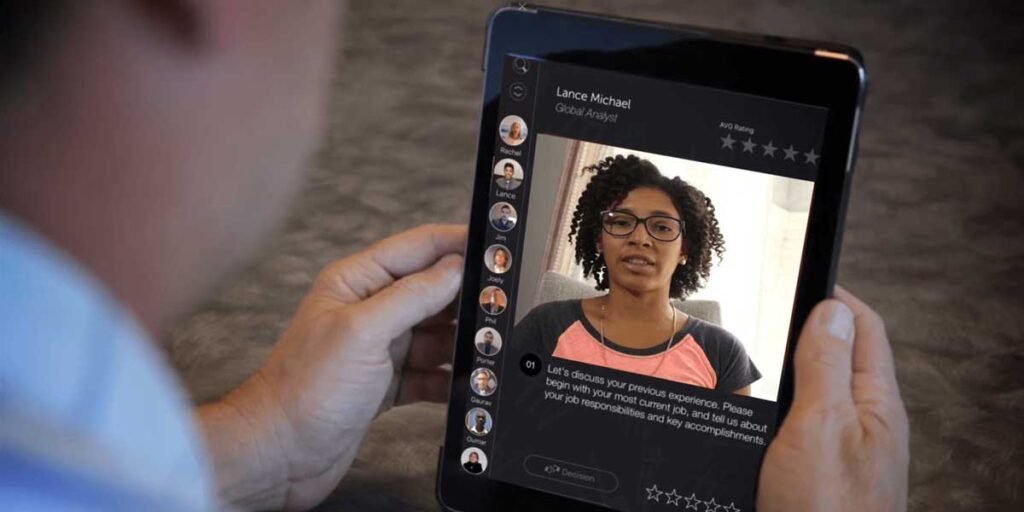
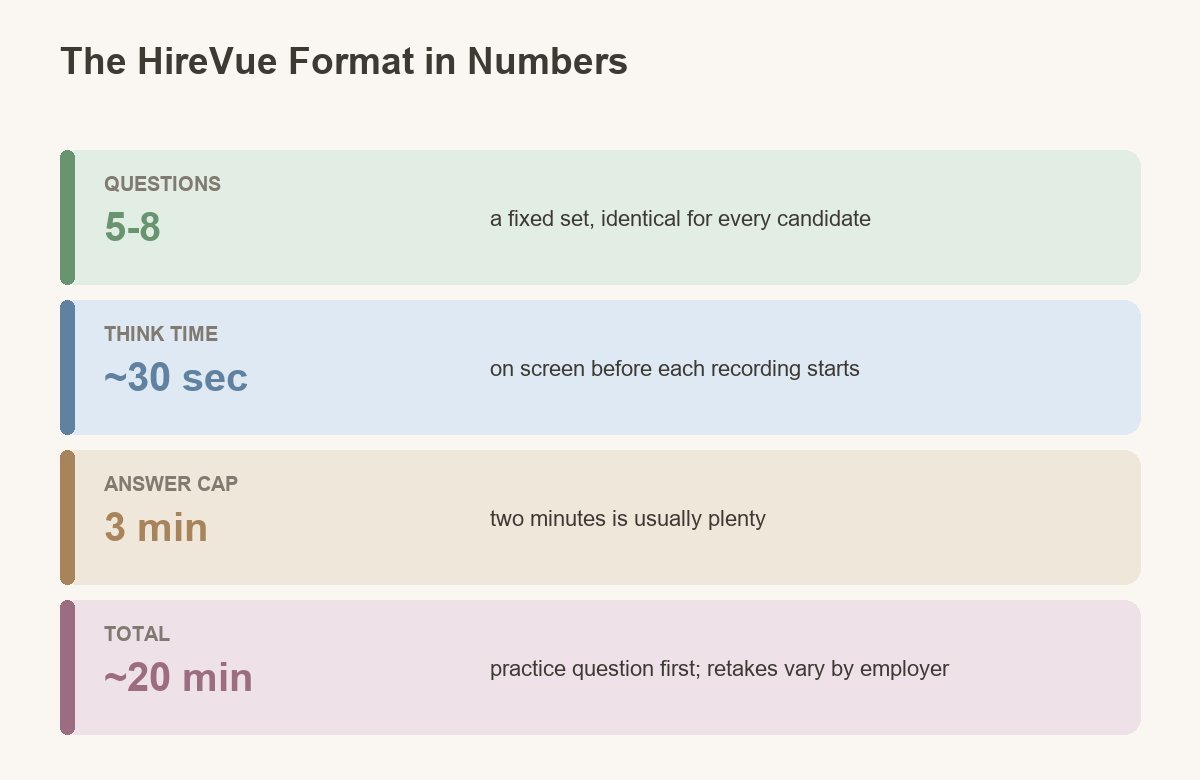
A HireVue interview asks five to eight fixed questions on camera. You get roughly thirty seconds to think after each prompt appears, up to three minutes to answer, and about twenty minutes total, usually with a practice question first. The HireVue interview questions themselves are ordinary behavioral prompts; what rattles people is answering them to a webcam with nobody nodding back.
Employers configure the same tool very differently, which is why one applicant reports three retakes per question and the next gets none. The format below is the common core, the company table maps the big deployments, and the tactics section covers the two things everyone actually wants to know: whether notes are allowed and what happens to cheaters.
One reassurance up front. The thread below started as a bombed-interview post, sub-minute answers and full panic, and ended with an update in capital letters: passed, recruiter call scheduled.
What a HireVue interview actually is
HireVue is a one-way video screening tool: the employer records the questions once, every candidate answers the identical set, and reviewers watch the clips later. HireVue’s own candidate guidance covers the mechanics; at most employers a human recruiter reviews the recordings, sometimes with algorithmic scoring assisting the sort.
Candidates trade folk theories about keyword-scanning AI, and a consulting applicant who survived fifty of these advises hitting terms like problem solver and team player just in case. Treat that as cheap insurance rather than gospel: clear structure and concrete stories are what pass reviews by humans and software alike, and no keyword rescues a rambling answer.
Nothing about the format measures charisma under pressure.
It measures whether you prepared five stories and can tell one warmly in two minutes, which is why it rewards preparation more than any live interview you have done.
The HireVue interview questions to prepare
Eight prompts cover nearly every deployment: tell us about yourself, why this company, a strength and a real weakness, a difficult task you handled, working with different perspectives, a customer or client moment, performing under pressure, and why you over other candidates. Five prepared stories, each usable for two or three prompts, cover the whole list.
1. Tell us about yourself
Sample answer: “I’m two years into customer-facing work, most recently running a register and curbside orders at the same time, and I applied here because this role rewards exactly that kind of juggling. Outside work I captain a rec volleyball team, which taught me more about keeping a group’s energy up than any job has. I’m looking for a place where being organized and being friendly are the same skill.”
2. Why do you want to work here?
Name one specific, observable thing about the employer and attach yourself to it. The camera version of this answer fails when it could be pasted into any company’s interview, so make the middle sentence impossible to reuse. A detail from your local store, the company’s posted values, or a product you genuinely use all work. Reviewers sorting forty clips remember the answer that could only belong to their company.
3. What is your greatest strength, and a real weakness?
One strength with a proof story, one true weakness with the fix you actually made. On camera the fake-weakness answer reads even worse than in person, because there is no interviewer to charm past it.
4. Describe a difficult task or challenge you handled
STAR carries this one: situation, task, action, result, in that order, ninety seconds. Put a number in the result if one exists, because the result sentence is what reviewers remember when comparing clips.
5. How do you work with people who see things differently?
One story where a disagreement produced a better outcome than either starting position.
End on what the other person’s approach taught you.
6. Tell us about a time you helped a difficult customer
Sample answer: “A regular came in furious about a billing mistake that genuinely was our fault. I let her finish without interrupting, apologized once, and fixed the charge while she watched instead of promising a callback. Then I flagged the pattern to my manager and it turned out three other accounts had the same error. She stayed a customer, and the fix helped people who never knew to complain.”
7. How do you handle working under pressure?
Name your actual technique: shorter communication, smallest task first, asking for help before drowning. Then prove it with thirty seconds of a real slammed shift.
8. Why should we hire you over other candidates?
One trait they cannot train, one proof, one line of logistics: what you offer, why it is believable, and when you can start. Nine sentences of self-praise scores worse than three of evidence.
HireVue by company: same tool, different test
The biggest difference between HireVue interviews is not the questions; it is the employer’s configuration. The deployments below are the ones applicants search most, with the full company guides linked.
| Employer | Setup applicants report | What stands out |
|---|---|---|
| Target | 6 recorded questions for store roles | Guest-scenario prompts; the set leaks on Reddit within days of each revision |
| State Farm | Behavioral set for corporate and claims roles | Agent-office jobs often skip HireVue entirely and interview in person |
| HEB | Digital interview screened by corporate recruiters | An identical set completed within 30 days does not need re-recording |
| JPMorgan Chase | Behavioral plus role-specific prompts for banking | The classic finance HireVue: expect why-banking and client-trust questions |
| Airlines (cabin crew) | Service scenarios plus appearance standards | The most competitive HireVue pools; candidates recycle answers across carriers |
If your employer is not listed, prepare the eight universal prompts above plus one company-specific why-here answer, and you have matched what any deployment can ask.
Notes, retakes, and the cheating question
Candidates openly use notes, and some go further than notes:
“Google the questions. Write them down with the answer in the STAR method. Tape the paper on the screen and just read it… I have gotten 3 jobs (JetBlue, Bank of America and Chase) with Hirevue and I did them all the same way..”
– r/cabincrewcareers, May 2026 (41 upvotes)
Bullet notes beside the camera are standard practice and nobody penalizes them. Reading a full script is where the tactic turns on you: replies in that same thread warn that reviewers can tell when you are not being yourself, and a flat recitation loses the warmth the recording exists to measure. Write five bullet points per story, not five sentences.
As for ChatGPT, the research Google surfaces on this question found it impractical for video-based assessments, and HireVue’s published materials describe similarity scoring that compares answers across candidates to flag copied responses. The honest summary: tools that write your answers produce the generic, reusable-anywhere responses that score badly, and unusually similar answers get flagged. Prepare your own stories; use whatever helps you outline them.
Panic, for the record, is survivable.
“sub-minute answers are not automatically bad on HireVue. rambling usually hurts more than being a little short, especially if you actually answered the question instead of circling. also, when you feel panicked in those one-way interviews, your own memory of it is usually harsher than how it looked on screen. people walk out thinking they looked terrible when they mostly just looked nervous. the game stuff is a black box anyway. i would not try to reverse engineer that part after the fact. if a…”
– r/interviews, June 2026 (2 upvotes)
The applicant who started that thread passed. Short answers that actually answer beat long ones that circle, and your memory of the recording is crueler than the recording.
Frequently asked questions
How do you pass a HireVue interview?
Prepare five STAR stories covering the eight universal prompts, keep bullet notes beside the camera, answer in one to two minutes, and front-light your face. Structure plus warmth passes both human and algorithmic review; scripts and keyword-stuffing help neither.
Is a HireVue interview hard?
The questions are easier than a live interview’s, because they are fixed, predictable, and often published by past candidates. The difficulty is the format: talking to a silent camera feels unnatural, and one practice recording on your phone removes most of that edge.
Can you use ChatGPT for a HireVue interview?
Using it live is impractical, and research on video assessments found it performs poorly there anyway. Drafting your own stories with AI help is fine; submitting generic AI-written answers produces exactly the copied-sounding responses similarity checks flag.
How does HireVue detect cheating?
HireVue’s published materials describe similarity scoring that compares written and coded answers across candidates and flags unusually close matches. Off-camera reading is not detected so much as heard: a recited answer loses the natural delivery reviewers are listening for.