

A shift lead is an hourly worker with keys, not a manager. You open or close the building, count the cash, set breaks, delegate tasks, and handle whatever goes wrong until a salaried manager is back on the clock.
The title sits in the awkward gap between crew and management. That gap is exactly why it’s worth understanding before you take it.
Should you take the promotion? The honest frame: the pay bump is modest, the responsibility jump is not, and the job’s true value is the line it puts on your resume. Everything below breaks down what the work looks like day to day, how it shifts between employers, and how to get through the interview that stands in front of it.
What a Shift Lead Actually Is
Strip away the title variations and the role is consistent: a shift lead is the senior hourly person on the floor, trusted with keys, codes, and the cash drawer, who keeps the operation moving when no salaried manager is present.
You still ring registers, make drinks, or stock shelves. You just do it while also owning the shift’s outcome.
So is a shift lead technically a supervisor? At most employers, no. Shift leads direct the work on their shift, but they typically can’t hire, fire, discipline, or change anyone’s schedule on their own authority. They stay hourly and overtime-eligible, unlike salaried management.
Some companies do blur this line. The only reliable answer lives in your employer’s own job description and pay classification.
Workers who hold the job describe that ambiguity better than any HR document. Here’s how one Walgreens shift lead put it in a thread that struck a nerve:
“Go ahead……pull up a Shift Leaders job description. We are liaisons between management(Store MGR,ESM)and the CSAs. We run the shift, not necessarily the people. We can strongly suggest that they follow the daily plan that was laid out by management, but we are really there to make sure the building doesn’t burn down in the absence of the actual MANAGERS. We have no actual authority over anyone. It’s corporate’s fault the way they created this ambiguous position that has no real structure beh…” (excerpt — 1,024 characters in full)
– r/WalgreensStores, December 2025 (159 upvotes)
That’s the job in one paragraph: accountable for the shift, with influence instead of authority over the people working it.
Good stores make that workable by backing their leads. Weak stores leave them stranded in the middle.
Core Shift Lead Responsibilities
The task list varies by industry, but core shift lead responsibilities repeat almost everywhere. Indeed’s employer guide for the role lists supervising shift workers, assigning tasks, mentoring, documenting incidents, and managing cash drawers among the most common duties, and worker accounts match that list closely.
- Opening and closing. Working the door keys and alarm codes, running opening checklists, and verifying the store is actually ready before doors open.
- Cash counts and deposits. Counting drawers at 5:45 a.m. with half the lights on, verifying safe counts, preparing deposits, and documenting any discrepancy the moment it appears.
- Break scheduling. Sequencing breaks so the floor never drops below workable coverage, including the legally required ones in states that mandate them.
- Delegating tasks. Assigning stations, prep work, or zones based on who’s on and what they’re good at, then following up without hovering.
- Customer escalations. Taking over the refund argument, the complaint, or the incident report so crew members don’t have to absorb it.
- Coverage calls. Working the callout: contacting the availability list, rebalancing the floor, and looping in a manager when the shift can’t run safely short.
- Compliance checks. In food service, that means temperature logs, date labels, and food safety standards; in retail, it leans toward safety walks and loss-prevention basics.
What’s absent from that list? Hiring, firing, writing schedules, and setting store strategy. Those stay with salaried management; a shift lead executes the plan a manager wrote and reports how it went.
How the Role Changes by Employer
What happens to the job when you change the logo on the door? The keys-and-cash core carries over, but the texture of the work depends heavily on where you hold it. Three common versions show the spread:
| Employer type | Common title | What dominates the shift |
|---|---|---|
| Retail pharmacy (Walgreens, CVS) | Shift lead / SFL | Register audits, merchandising resets, photo department, vendor check-ins, covering the front end alone for long stretches |
| Coffee (Starbucks) | Shift supervisor | Play-calling the floor: assigning bar, register and drive-thru positions in cycles, managing the cash drawer, keeping drink times on target through rushes |
| Fast food (Taco Bell, Chick-fil-A) | Shift leader / team leader | Rush management: staging prep before peaks, repositioning people mid-rush, food safety checks, closing the line down to standard |
Walgreens leads in particular describe a heavy solo-coverage version of the job, where the shift lead may be the only non-pharmacy employee in the building for hours. Starbucks formalizes its version the furthest; the shift supervisor role has its own interview track, which our Starbucks interview guide covers in its shift supervisor section.
One warning that shows up repeatedly in Walgreens threads: the glamorous parts of the description aren’t the hard parts. As one commenter advised a new hire, in a thread about starting the job:
“Be prepared to unload truck! It’s BRUTAL 😭”
– r/WalgreensStores, May 2026 (5 upvotes)
What a Shift Lead Gets Paid
How big is the bump over crew pay? Most often between one and three dollars an hour at the same store, going by self-reported figures workers post. Indeed’s hiring data puts the average US shift leader at $17.09 an hour, with reported pay running from minimum wage up to about $42 in high-cost markets.
Context matters more than the average, though. One Chick-fil-A franchise ad offered its shift leaders $16 an hour, while big-box retail crew can start near that with zero leadership duties; our Chick-fil-A pay breakdown shows how wide the same company’s rates run by location. Compare against your own store’s crew rate, not a national number.
Is Shift Lead Worth It?
So is the promotion worth taking? That depends entirely on what you want next. If you plan to stay hourly at the same store for years, the math is unflattering: a dollar or two more per hour buys the callout phone calls, the cash accountability, and the blame for every shift that goes sideways.
Plenty of experienced crew decline the keys for exactly that reason. It’s a defensible call.
If you want to move up, the calculation flips. Shift lead is the resume line that turns “worked in food service” into “led teams of five through closing operations and cash reconciliation.” Assistant manager postings almost always ask for lead or supervisory experience, and this is the job that supplies it while someone else still carries the store-level accountability.
Eighteen months with keys can outweigh five years without them on a management application.
The trade, stated plainly: you accept management-shaped stress at hourly pay for a while, in exchange for proof you can run a floor. Take the deal if you intend to cash that proof in. Skip it if you don’t.
Shift Lead Interview Questions (and What Each One Scores)
Shift lead interviews are short and behavioral. What is the interviewer, often your own store manager, actually listening for? Evidence you can direct former peers, follow cash procedure, and stay calm when the plan breaks. One respondent in a shift lead interview thread framed the role the way you should frame your answers:
“You’ll be the acting supervisor for the specific shift you’re on. Which means you will be telling them what is required from them (employees) on that shift. Rather it be prep or stations. Usually created by the manager. Your job is to make sure the team knows and understands. You will make sure that everything is ran well within the shop. You should know the ins and outs of the establishment, in which they will teach you (should teach you) if you get the job. Your contact is the AGM/GM/(Owner b…” (excerpt — 649 characters in full)
– r/careeradvice, January 2026 (4 upvotes)
How would you handle giving direction to someone who was your peer yesterday?
This scores whether you can hold authority without performing it. A strong answer names the awkwardness instead of denying it: acknowledge the relationship changed, keep direction task-focused, and never trade on the friendship or against it. Sample approach: “I’d be upfront that assignments come from the shift plan, not from me picking favorites. I’d give the same standard to everyone and handle pushback one-on-one, off the floor.”
A scheduled closer no-shows an hour before their shift. Walk me through what you do.
This scores your order of operations under time pressure. Interviewers want a sequence, not a sentiment. Sample approach: “First I’d confirm they’re actually a no-show, not just late. Then I’d work the availability list for the same role, rebalance stations if nobody bites, and tell the manager on duty what coverage looks like before it becomes their surprise. Closing short is a last resort, and it comes with a plan for which tasks get cut.”
Your drawer count is $20 off at close. What do you do?
This one is pass-fail on procedure and honesty. The scored answer: recount with a witness where policy allows, check for common causes like a mis-keyed refund, document the variance exactly as found, and report it up the same night. The instant-fail answers are covering the gap from your pocket or rounding the paperwork. Interviewers ask this because cash trust is the entire difference between crew and keyholder.
How would you coach a teammate who works hard but slow?
This scores observation and patience. Weak answers jump to “I’d tell the manager.” Strong answers start with watching: find which step is slow, show the faster method once, and give it time before escalating. Effort-versus-speed is a coaching problem, not a discipline problem, and interviewers listen for whether you know the difference.
A customer demands a refund that policy doesn’t allow. What now?
This scores de-escalation plus judgment about your own limits. Offer what policy does allow, explain the why once without arguing it twice, and know the dollar threshold or situation where you call the manager instead of improvising. Knowing when the decision isn’t yours is a leadership signal, not a weakness.
Why do you want this role?
This scores motive. “I want the raise” is honest but incomplete; managers promote people who see the job as a step. Tie your answer forward: you want to learn floor leadership, cash handling, and coaching because assistant manager is the goal. Ambition with a plan reassures the interviewer the added stress won’t burn you out in a month.
The Crew-to-Shift-Lead Promotion Path
Most shift leads are promoted from within, and the promotion rarely goes to whoever asks loudest. So who gets the keys? Whoever a manager has quietly watched doing lead-shaped work for months, which means the ask works best as the final step of a sequence, not the first.
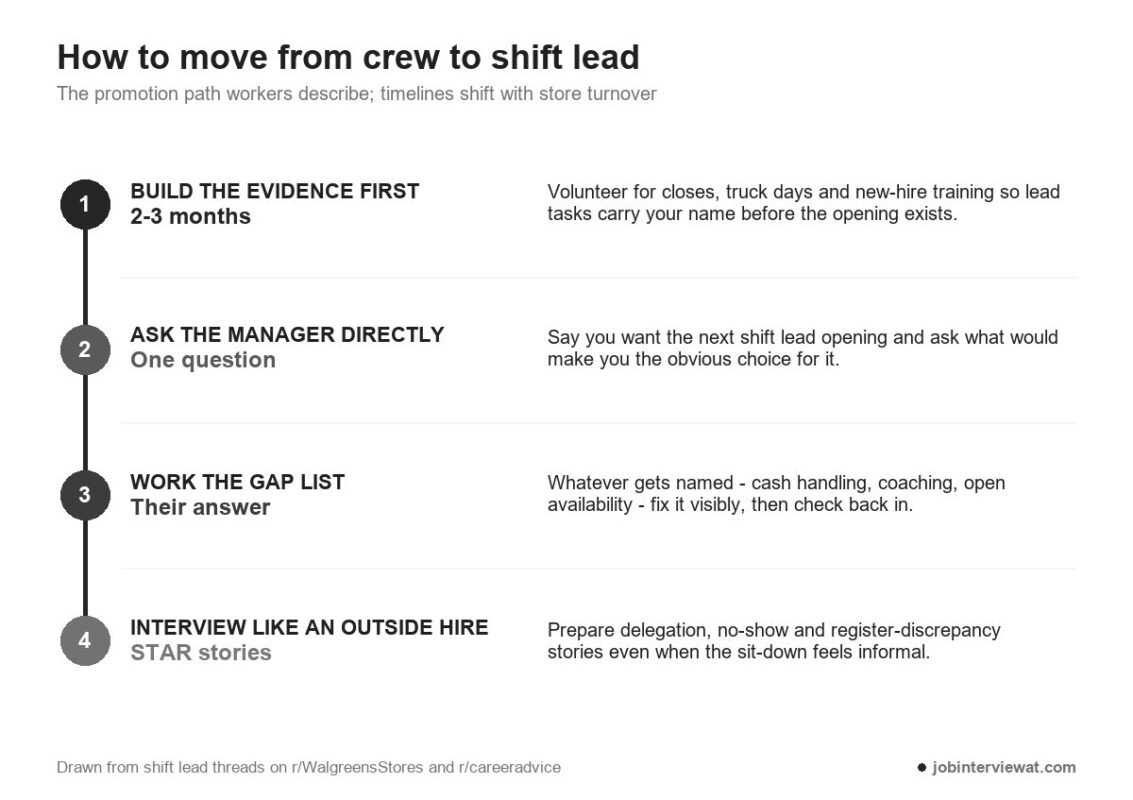
Build the evidence first. Volunteer for closes, truck days, and training new hires, the tasks leads own, so your name attaches to them before an opening exists.
Then ask directly: tell your manager you want the next shift lead spot and ask what would make you the obvious choice. Whatever they name, cash handling, open availability, coaching, fix it where they can see it and check back in.
When the opening comes, prepare like an outside candidate even if the interview is your manager across a break-room table. Have specific stories ready for delegation, a no-show, and a register problem. The behavioral format follows the same rules as any structured interview; our guide to the most common interview questions and answers covers how to build those STAR stories so they land in under two minutes.
FAQ
What are the responsibilities of a shift lead?
Shift lead responsibilities center on running one shift: opening or closing the building, counting cash drawers and preparing deposits, scheduling breaks, delegating tasks, handling customer escalations, calling in coverage for callouts, and enforcing safety or food-safety standards. Hiring, firing, and store strategy stay with salaried management.
Is a shift lead a manager?
No, at most employers a shift lead is an hourly, overtime-eligible employee who directs work during a shift but holds no formal management authority. They typically can’t hire, discipline, or change schedules alone. A few companies classify the role closer to management, so check your employer’s own job description.
How much more does a shift lead make?
Shift leads commonly earn about one to three dollars an hour more than crew at the same store, based on figures workers report. Indeed’s hiring data lists $17.09 an hour as the US average for shift leaders, with wide variation by region and industry.
What should I say in a shift lead interview?
Give behavioral answers with a clear sequence: how you’d direct former peers without ego, handle a no-show by working the availability list before escalating, document a register discrepancy honestly, and coach a slow teammate. Frame your motive as a step toward assistant manager, not just a raise.