

Tell the right person, early, in two sentences. That’s the whole job of a call-out: say who you are, say you can’t work the shift, and give a time when you’ll update them if you can.
Everything past that is optional, and over-explaining is where people get into trouble. A made-up story rarely buys anything either. Point systems like the one Walmart associates describe count the absence itself, and a story that unravels costs you trust on top of the point.
Here’s how to call out of work properly: pick the channel, use words that fit in a few seconds, stick to reasons that hold up, and know how attendance points at hourly jobs and federal law treat the absence.
Should you call, text or use an app?
Use the channel your employer’s attendance policy names. If the handbook says phone call, a text can be treated as no report at all, and if it names a scheduling app or hotline, a message to your manager alone may not get logged. When the policy is silent, contact whoever builds your schedule.
Methods differ more than people expect, so which one does your employer want? A poster in r/Explainlikeimscared (April 2026) said a previous job accepted a text but the current one required a phone call. Neither employer is wrong, but a habit from your last job can read as a no-call at your new one.
Timing follows the same rule. Many handbooks set a cutoff before the shift starts, so find the number and beat it. If you already know at 9 p.m. that you’re too sick to work, send the message then rather than at 5 a.m.
Calling out sick by text has one real advantage: it leaves a timestamp you can point to later. A phone call is harder to ignore, though, so if the shift is about to start or nobody replies to your text, call. When the call goes to voicemail, leave your name, your shift and the time, then follow up in writing if the policy allows it.
Send it to the person your policy lists, usually your direct manager, the shift lead on duty or a store line. Don’t hand the job to a coworker unless the policy says that’s fine.
What should you say when you call out?
Say who you are, that you can’t work today’s shift, a one-line reason and when you’ll update them. That takes two or three sentences, and it gives your manager what they need to start finding coverage.
Type the message into your notes app before you dial. Why bother? The first ten seconds of a call are when people over-explain, and a script keeps you from wandering into a symptom report. These four cover the common cases, and each works as a call or a text. Swap the brackets and use one only if it’s true.
Sick
Hi [manager's name], this is [your name]. I'm sick and can't work my [start time] shift today. I'll update you by [time] about tomorrow's shift. Thanks.
Family emergency
Hi [manager's name], this is [your name]. I have a family emergency and can't make my [start time] shift today. I'll send you an update by [time]. I'm sorry for the short notice.
Car trouble or no ride
Hi [manager's name], this is [your name]. My car won't start and I can't get to my [start time] shift on time. I'm trying to line up another ride and will tell you by [time] whether I can come in late or need to miss the shift.
Personal day
Hi [manager's name], this is [your name]. I need to take a personal day today and won't be in for my [start time] shift. I know it's short notice, and I'm glad to talk about coverage when I'm back.
The personal-day script works best when your employer has a personal-day benefit. Same-day “personal reasons” can still count as an ordinary unplanned absence under an attendance policy, so ask in advance whenever you can.
Say this: “I’m sick and can’t work today’s shift.” Not this: three overlapping problems, a symptom-by-symptom account, or a promise like “I’ll definitely be back tomorrow” that you can’t know yet. Stacking reasons can sound like you’re building a case, and a return date you miss becomes a second problem.
Do you have to give a reason when you call out?
Usually your employer decides how much to ask, so the real requirement sits in your handbook. A plain category such as “sick” or “family emergency” is the usual level of detail, and a doctor’s note may be required after a set number of days.
Give a category, not a case file, and make sure the category is true. That also covers mental-health days. “I’m unwell and can’t work today” is accurate and enough for a single day, and whether your employer counts it as sick time or personal time depends on the leave rules you were given.
Not sure what your employer requires? Look for three things in the handbook: the notice deadline, the name of whoever receives the message, and any line about documentation. Those three settle most call-out questions before they come up.
What counts as a good reason to call out of work?
A good reason is a true one that keeps you from doing the job safely or on time. The common ones are illness, injury, a family or childcare emergency, a death in the family, a car that won’t run and a mental-health day where your employer’s policy allows it.
The reason has to be real. Is it a reason, or an excuse? An invented one is an excuse, and managers learn to spot the pattern more than the story. A manager on r/askmanagers (August 2026) listed what actually raises flags, and the list says little about the reason itself:
“Twice in one year spread out is in no way an issue. My red flags are: * Patterns such as always on Monday, Friday, before/after a holiday * Calling in around a deadline or other commitment more than once * No call, no show is always an issue * Mom/dad/girlfriend/boyfriend should only call in for you if you are completely incapacitated * Crazy or long drawn out excuses every time you call in This is based off a team of office workers in insurance industry, YMMV depending on industry.”
– r/askmanagers, August 2026 (120 upvotes)
That’s one manager in one office, and the manager says so. Still, it matches what shift workers report: the expensive mistake isn’t calling out, it’s not calling. A commenter in r/careerguidance (January 2026) who said they’re a manager described missing a shift by accident and wrote that most places are forgiving of a one-off if you call, apologize and explain.
Many employers treat repeated or multi-day no-call/no-shows as grounds for termination. The exact rule is in your handbook, and it’s worth reading once before you need it.
How do attendance points work at hourly jobs?
Many hourly employers run a points or occurrence system: an absence, a late arrival or an early exit adds a fraction of a point or a whole point, and reaching a set total triggers coaching or termination. The values and cutoffs differ by employer, so only the numbers in your own policy count.
Walmart is the best-documented example. In a February 1, 2019 announcement, Walmart said associates in most locations can earn up to 48 hours of Protected PTO a year, and that absences covered by it don’t affect an associate’s attendance record. That figure is from 2019, so treat it as a starting point and confirm your own balance.
Do the rules still work that way? Current associates describe how it works in practice. An r/walmart commenter (August 2026) put it this way:
“No, its a lie Calling in automatically is documented. PPTO or an approved reason like bereavement, Jury Duty, approved bad weather, LOA etc are the only ways out of the point Its more likely the TL is just removing their points as a favor, in which case they’ll end up caught and possibly fired themselves at some point.”
– r/walmart, August 2026 (35 upvotes)
The same idea shows up in a r/WalmartEmployees thread from October 2026. A commenter wrote that if you use enough PPTO and use it correctly, the occurrence won’t even generate for management to act on, and pointed to the attendance tab in Walmart’s time-and-attendance tool as the place to see where points came from. Another commenter in a June 2026 r/walmart thread said a sickness lasting more than three days goes through a leave of absence handled by a third party, with doctor paperwork. Treat that as a lead to confirm with your store, not a rule.
Point values, the total that ends a job and the reporting steps for your store sit in Walmart’s internal attendance policy, so any number quoted on a blog is unverified. The orientation modules are where attendance and points first come up, and our Walmart orientation guide walks through what that day looks like.
What does the law protect when you call out?
Federal law doesn’t require paid sick leave, and FMLA leave is unpaid and limited to workers who pass three tests. For an ordinary one-day call-out, your employer’s policy and any state or local sick leave law usually matter more than FMLA. If your sick time or PTO builds up per hour worked, our PTO accrual calculator shows how much you’ll have by a given payday.
The Department of Labor’s paid leave page says there is currently no federal law guaranteeing access to paid sick leave, although many states and localities have passed their own. As of December 2024 it counted 18 states and the District of Columbia with laws requiring covered private employers to provide paid sick leave. Eligibility, accrual and notice rules differ by place, so your state labor department’s website is where your rules live.
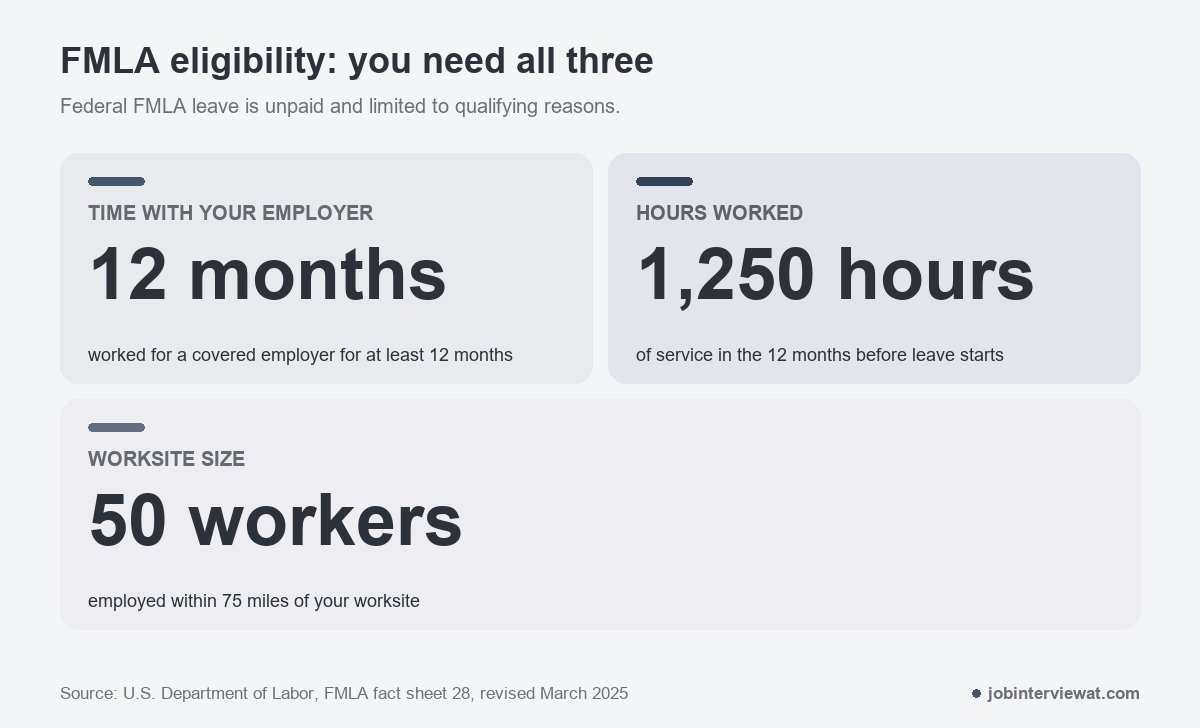
FMLA is the federal exception. According to the Department of Labor’s FMLA fact sheet (revised March 2025), eligible workers can take up to 12 workweeks of leave in a 12-month period for covered reasons. To be eligible you need all three of these:
The same fact sheet says you must give notice “as soon as possible and practical,” and that an employer may ask for information from your health care provider and must allow 15 calendar days to supply it. FMLA is built around serious health conditions and family care, not a single sick day. The Department of Labor’s FMLA mental health page gives the example of a chronic condition, physical or mental, that requires treatment by a health care provider at least twice a year and recurs over an extended period.
Could a longer absence qualify? If you think so, talk to HR before you start missing shifts, because the paperwork matters more than the phone call. This is general information, not legal advice, and a specific situation is a question for HR or your state labor department.
What should you do the day you return?
Thank your manager, ask whether anything needs covering or catching up, and hand over any note your policy requires. Do it in the first few minutes of the shift, while the absence is still fresh to them. What does that sound like?
“Thanks for covering for me. Is there anything that got missed that I should pick up first?” is enough. Skip the recap of symptoms, and don’t apologize three times.
How do call-outs affect raises and promotions?
One clean, properly reported call-out rarely hurts your standing, but a pattern can. What makes it a pattern? The manager quoted earlier named Mondays, Fridays and days around holidays, which are the stretches that read as a habit rather than an illness.
Reliability becomes an argument when you ask for more. In our guide to asking for a raise, a reliability record (attendance, covered call-outs, holiday shifts worked) is one of the three pieces of evidence to bring. And if you’re aiming at a lead role, read what the shift lead job involves: working the call-out and finding coverage is part of it, so you’d be on the receiving end of these messages.
If the call-outs are really a sign you’re ready to leave, giving notice beats letting attendance slide. Our two weeks’ notice guide covers how to do that without burning the reference.
Call-out questions
How do you call out of work?
The way to call out of work is to contact the person your employer’s policy names, as early as you can, using the method it names. Give your name, say you can’t work your shift, add a one-line reason if asked and say when you’ll update them.
Do you have to give a reason when you call out sick?
Often you only need to say you’re sick, but it depends on your employer’s policy. Some ask for a doctor’s note after several days, and FMLA or state sick leave rules can change what you owe, so read your handbook.
Can you get fired for calling out sick?
Employers can fire people over attendance, especially for a no-call/no-show or for going past an attendance limit. A properly reported illness is usually handled through points or sick time instead, though protection depends on your state, your employer’s policy and whether FMLA applies.
Is it better to call or text when calling out?
Use whichever your policy names. If it allows both, a text leaves a record and a call is harder to miss, so call when the shift is close or nobody answers.