

The best questions to ask at the end of an interview are the two or three that fit the job in front of you: what success looks like in the first 90 days, what the hardest part of the role is, and what the next steps and timeline are. Bring five, and expect to use two or three.
I spent ten years as a corporate interviewer, including at Walmart, Bank of America and Wells Fargo. The question slot at the end won’t rescue a weak interview. It can fix a gap you left, and it tells you whether you want the job.
Five questions to ask at the end of an interview, in any job
These five work in almost any interview. Each one earns its place with something specific, so the question has a purpose and isn’t just recited.
- “What would a strong first 90 days look like in this role?” You learn the real priorities, and the interviewer pictures you doing the work.
- “What’s the hardest part of this job for someone new?” You hear the problem you’d be hired to handle. GRB, a UK graduate careers site, says to be wary if the interviewer can’t name any challenge.
- “How do you measure whether someone in this role is doing well?” You find out what your reviews will be built on.
- “What do you like about working here, and what keeps you here?” People like talking about their own jobs, and the answer tells you more than the careers page.
- “What are the next steps, and when do you expect to decide?” You leave with a date. That date is what your follow-up email after the interview should be timed from.
Write them on a card or in phone notes and bring them. Herzing University’s career development office gives the same advice, since interviews can be rigorous and memory gets thin at minute forty.

What your questions can and can’t change
Most of the score is written while you answer their questions, not while you ask yours. In a structured interview, the U.S. Office of Personnel Management says each interviewer records a proficiency score for each competency, rated from 1 (Awareness) to 5 (Expert) on a five-point scale.
The questions at the end are rarely one of those competencies. So can the slot turn a 2 into a 4? Not on its own. What it can do is clear up an answer you rushed, or show you understood the job better than the earlier answers suggested.
“By the time the candidate can ask questions, the interviewer(s) already made their decision. They’ll politely answer the questions though, so that their recruiter could reject you a week later.”
– r/jobsearchhacks, February 2026 (185 upvotes)
I would soften that a little. My view, from helping introduce a new interview score sheet at Walmart, is that most boxes are filled by the time a candidate is asked for questions, but the interviewer can still add a note. A sharp question about the actual work earns one. A canned one does not.
Froze on this part last time? It probably wasn’t the reason the offer went elsewhere.

Pick your questions by the interview you’re in
A list of 50 questions doesn’t help much with five minutes left. The room decides which two or three are worth the time. Here’s how I would pick for six common interview situations.
Retail or hourly job
Store managers are mostly filling shifts, so ask about the shifts. On our McDonald’s interview questions page, availability came up in 4 of the 6 applicant reports we collected. Ask “Which shifts are hardest for you to fill?” and “What does training look like the first week?”
If the hard shifts work for you, say so right there.
That answers the question the manager cares about most. The same goes for big-box stores; our Target interview questions page lists what those managers ask.
Recruiter phone screen
The recruiter runs the process, not the team, so ask about the process. “How many rounds are there, and who will I meet?” and “What’s the pay range for this role?” both fit here. Pay is a normal topic with a recruiter, and it is better learned now than after three rounds.
Panel interview
Aim one question at the team members, not only the manager. One panelist on Reddit found that teammates freeze when asked something heavy in front of their boss:
“Yep. A lot of management does but when you’re on a panel with 2 randos and a manager, the other teammates freeze up because they don’t know what to say in front of a manager. So they kind of freeze. So I adjusted that question for panels to basically just ask “what is your favorite part about working here?””
– r/interviews, April 2026 (13 upvotes)
Keep the teammate question light, like that one. Save the question about how the team handles disagreements for the manager.

Leadership role
Ask about authority and the mess you’d inherit. “What decisions would this role own without needing approval?” and “What’s the one problem on this team you’d want fixed first?” both show you’re thinking like the person in charge. For a store-level example, our Walmart team lead interview questions page walks through what those interviews test.
When you already work for the company
The interviewer may already know you, so generic culture questions sound odd. Ask what they would need to see in the new role that they haven’t seen in the current one, and how the handover from the old team would work. Only an internal candidate can sensibly ask those two.
Final round with the hiring manager
This is the place for a closing check on your fit. Herzing’s career development writer Sharon Rosin suggests: “Given our conversation today, is there anything else I can tell you to help you with your decision?” It invites a concern you can still answer before you leave.
The “perfect candidate” question, and asking about their doubts
One question gets recommended more than any other right now. A February 2026 post on r/jobsearchhacks with 1,018 upvotes said to ask “What would the perfect candidate look like?” and then listen closely, so you can show you match.
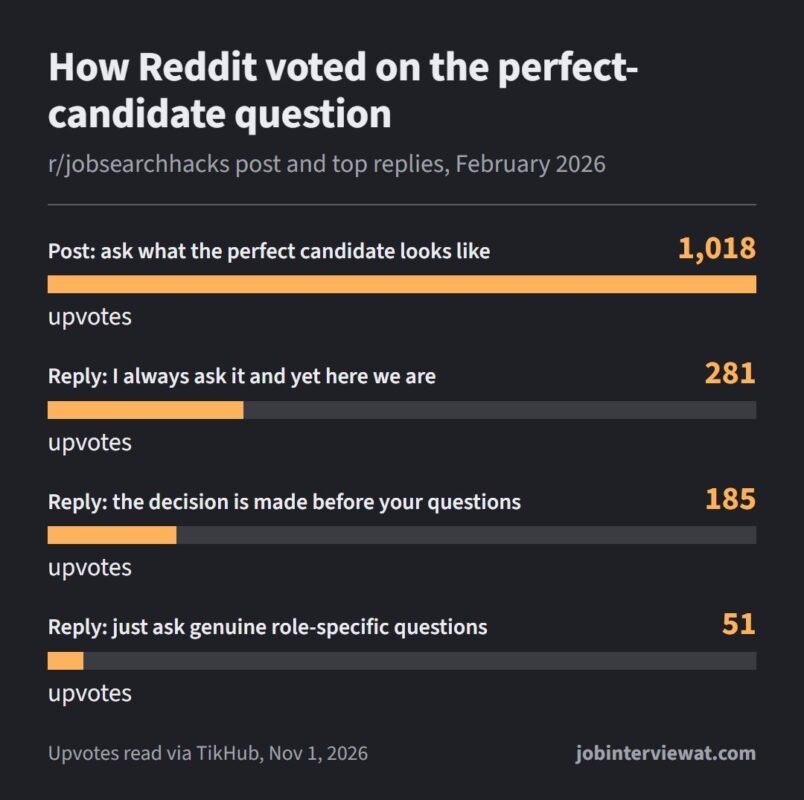
The responses under it were less sure. The most-upvoted, at 281, said they always ask it “& yet here we are.” The 185-vote one said the decision is already made. Another, at 51, told people to drop the act and ask genuine questions about the role.
The doubt-question version split people too. One person suggested asking why you wouldn’t be a good fit, since a misunderstanding can be corrected. Someone else, with 16 upvotes, said it leaves the interviewer’s last thought about you a negative one.
Which version should you use, then? I would put the perfect-candidate question early in a recruiter call, while the rest of the conversation can still be shaped around it. At the end, the softer “anything else I can tell you” wording works better. It opens the door to a concern without asking the interviewer to list flaws, and it keeps the last few minutes on what the candidate can still add instead of on what is missing.
Questions to skip, and what to do when they already answered yours
Skip anything the job posting or the company’s site already answers. Hold detailed questions about time off and benefits until there’s an offer; Herzing calls that standard advice for a first interview. A recruiter screen is the exception for pay, as noted earlier.
What if they covered every question on the card? Don’t force one out. Say “You’ve answered most of what I wanted to know, especially about the training schedule,” then ask about next steps. Naming what they answered proves the listening happened, and it beats a filler question.
Also skip anything that sounds like an exit plan, such as how soon a transfer is allowed. It is a fair thing to want. It is a bad last impression.
End-of-interview question FAQ
What is the 30-60-90 rule in an interview?
It usually refers to a 30-60-90 day plan: what you’d learn in your first 30 days, contribute by 60 and own by 90. You can turn it into a question by asking what the interviewer would expect at each of those points.
What is the biggest red flag to hear when being interviewed?
A vague answer to “what’s the hardest part of this job?” is one of the clearest. If no one can name a single challenge, either they don’t know the role well or they don’t want to say. GRB gives the same warning.
How many questions should you ask at the end of an interview?
Two or three is enough in most interviews, with one about next steps. Bring five so you still have some left if the conversation already covered a few.