

Send a short thank-you email to each person who interviewed you within 1 day, then wait for the date they gave you. If that date passes with no word, send one polite check-in two business days later. If they gave no date at all, wait about a week before you check in.
Your first follow up email after interview day is the thank-you, and it’s the easy one. The second message is harder because it asks a question, and the right moment depends on what the interviewer said at the end of the conversation. Get that timing right and both emails can stay under 100 words.
Two different emails get called a follow-up
A thank-you email and a check-in email do different jobs. The thank-you says you appreciated their time and still want the role, and it goes out within a day. The check-in asks where the decision stands, and it waits until the employer’s own timeline has run out.
Mixing the two is where people go wrong. A thank-you that asks “any update yet?” the morning after reads as impatient. A check-in with no thanks in it can read like a demand.
What can either email change? Less than most candidates hope. I interviewed job seekers at Walmart and later helped introduce a new interview score sheet there, and my view is that your score is written down before your email arrives. The email can’t add points to an answer you already gave. It can close a gap, though: the reference you promised, a certification you forgot to mention, or a correction to the availability you stated. If you have one of those, put it in the thank-you and keep the rest short.
When to send a follow up email after interview rounds
The clock for a check-in starts from what the interviewer told you, not from the interview date. If they named a day, wait two business days past it. If they named nothing, wait about a week. If they said they’re still interviewing, give them the time they asked for before you write.
Hiring takes longer than most candidates expect. A recruiter who posted on r/ResumeCoverLetterTips in August 2026 put the usual wait at 24 to 72 hours after a phone screen, 1 to 2 weeks to schedule another round, and 2 to 6 weeks for a decision after a final interview, longer at big companies. In the same post, the recruiter wrote that a slow answer doesn’t automatically mean a rejection.
Company size shifts the line too. Tessa Ganassi, a former recruiter quoted by The Muse, suggests following up about a week after the interview at a company under 200 employees that said it wants to move quickly. At a company of roughly 10,000 that’s still finishing first-round interviews, she suggests waiting about a month.
Why two business days after a promised date, and not the same afternoon? Hiring teams miss their own deadlines all the time, often by a day or two. A note sent the following Tuesday after a Friday promise lands as patient, while one sent Friday at 5 p.m. lands as a nudge.
| What they told you at the end | When to send | What to send |
|---|---|---|
| “We’ll decide by Friday” | Thank-you within a day; check-in the next Tuesday | Thank-you, then the check-in template |
| Nothing about timing | Thank-you within a day; check-in about a week after the interview | Thank-you, then the check-in template |
| “We’re still interviewing other candidates” | Thank-you within a day; nothing more until the window they gave has passed | Thank-you only |
| You have another offer with a deadline | As soon as you know the deadline | The offer-deadline template |
| Your first check-in got no answer | About a week after that check-in | The second check-in, then stop |
| Hourly store job, only a phone number | After the day the manager gave you, at a slow hour | A short call or visit asking for the manager who interviewed you |
The offer row is the one exception to waiting. Ganassi’s advice in The Muse is to reach out as soon as you know you’re entering final rounds elsewhere, so the company has time to decide or speed things up.
Thank-you email template (send within a day)
A thank-you email should take about 30 seconds to read: one line of thanks, one specific detail from the conversation, one line tying you to the job, and your name. Send a separate version to each interviewer and change the detail in each, since people on the same panel often compare notes.
Subject: Thank you, [job title] interview on [day]
Hi [Name],
Thank you for meeting with me today about the [job title] role. I enjoyed hearing about [one thing they told you, such as the new store opening or the weekend coverage problem], and it made me more sure the job is a good fit. [One sentence linking something you’ve done to that detail.]
You asked about [item], so I’ve attached it here. I look forward to hearing about next steps.
Thank you,
[Full name]
[Phone number]
The detail line is the part that works. Say “You mentioned closing shifts are the hardest to cover, and I’m free every weeknight.” Not “I’m a hard worker and a team player.” The first gives the manager a reason to pull your file back out; the second is what everyone writes.

After a phone screen, the same email works with one change: thank them for the call and mention the next step they described. After a panel, send each person their own version. Don’t have every address? Ask the recruiter to pass your thanks to the team, and name the people you met.
Check-in email when you haven’t heard back
A check-in email names the job, the date you interviewed and who you met, then asks one question: is there an update on the timeline? Keep it to four lines or fewer. Send it to your main contact, often the recruiter, and not to every interviewer on the panel.
Subject: Following up on the [job title] interview
Hi [Name],
I hope your week is going well. I interviewed for the [job title] position on [date] with [names], and I’m still very interested in the role. Is there an update on the timeline for a decision? I’m happy to send anything else you need.
Thank you,
[Full name]
If that gets no answer, wait about a week and send a shorter second note. It gives them an easy way to close the loop.
Subject: [Job title] interview, [date]
Hi [Name],
I’m checking back on the [job title] role I interviewed for on [date]. If the position has been filled, I’d appreciate knowing so I can plan my search. Either way, thank you for your time.
[Full name]
When another employer has made you an offer, use this one instead, and only if this job is still the one you want:
Subject: [Job title] interview, timing question
Hi [Name],
I interviewed for the [job title] role on [date], and it’s still my first choice. I’ve received another offer and need to answer by [date]. Is there any chance of a decision before then?
Thank you,
[Full name]
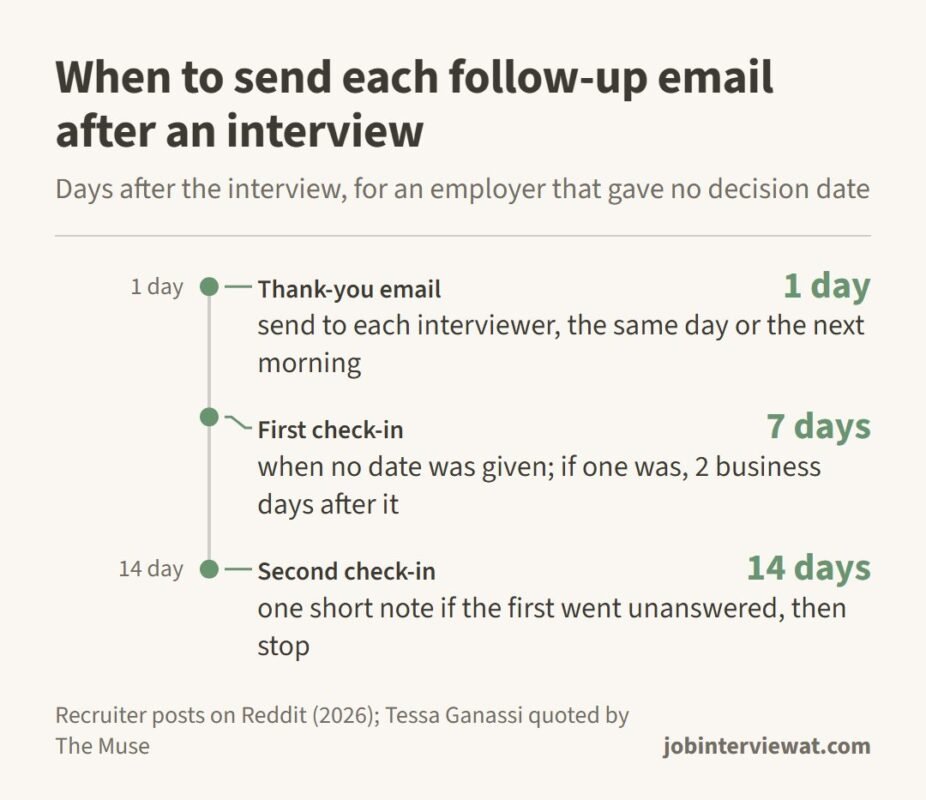
On the no-date path, that puts the first check-in around 7 days after the interview and the second around 14 days. Two unanswered notes is where you stop. Ganassi told The Muse she doesn’t recommend going further without a response, because by then silence typically means the company isn’t interested.
Silence before that point is often workload. In an April 2026 r/AskHR thread, one commenter said the recruiters they work with carry 30 to 40 open requisitions and talk to 50 to 100 candidates a week. Another explained that a promise to get back to you by Friday often applies only to candidates who are moving forward. That’s blunt, but it’s useful: if the date passes and two notes go unanswered, put your energy into the next application.

Does a follow-up email change the decision?
A follow-up email rarely decides who gets hired, and hiring managers disagree about whether it helps at all. Its value is small but real enough: it reminds a busy recruiter who you are and fills a gap you left in the interview. It won’t rescue an interview that went badly.
The accounts split in both directions. In a December 2025 r/recruitinghell discussion, one former hiring manager estimated that about 25% of candidates sent a thank-you email and said it didn’t affect their decisions. A long-time recruiter in the same discussion said very few candidates send one at all. The original poster described managers at several companies passing follow-up emails around to make fun of the sender, while a commenter who’d run hundreds of interviews as a manager pushed back hard on that picture.
“Yeah I just don’t think there’s ever really a case where you were going to get a job but they decided not to because you didn’t email them to ask for a status update”
– r/interviews, August 2026 (36 upvotes)
Other candidates credit the follow-up with the offer. In an October 2026 r/interviews thread arguing that following up isn’t desperate, one commenter described the sequence plainly:
“i sent a thank you the same day, and followed up 2 weeks later. i got the job!”
– r/interviews, October 2026 (20 upvotes)
Both can be true at once. Nobody can show that the second email caused that offer, and nobody loses a job for skipping a status request. Where’s the downside, then? It sits almost entirely in the check-in: three notes in a week, or an opener The Muse flags as a mistake, “just wondering if you remember me.” A short thank-you has no cost worth worrying about.
Hourly jobs: following up with a store manager
For a crew, cashier or stocker job, the follow-up often isn’t an email. Many hourly interviews end with a manager’s name and the store’s phone number and no email address, so the follow-up is a short call, or a visit at a quiet hour, asking for the manager who interviewed you.
That matches how big chains hire. McDonald’s says on its applicant FAQ that hiring “is handled at the store level,” and it points applicants to the store where they applied, not a corporate inbox. Our McDonald’s interview questions page explains how that store-level interview runs. If the manager gave you a cell number, as one r/jobs poster’s interviewer did in August 2026, a two-line text works the same way: your name, the job, the day you interviewed and a question about next steps.
Call between the lunch and dinner rushes and say: “Hi, this is [name]. I interviewed with [manager] on [day] for the [crew or cashier] job and wanted to see if a decision has been made. I’m still available [your days and hours].” Repeating your availability does more than the thanks, because the manager is filling shifts. Calling about an application before you’ve had an interview is a different conversation; how to follow up on a job application has scripts for that stage.
Follow up email after interview: quick answers
Should you follow up twice after an interview?
Yes, a second check-in is fine if the first got no answer. Wait about a week after it, keep it shorter, and stop there. A third unanswered note rarely changes anything, and Ganassi’s advice in The Muse caps follow-ups with no response at two.
Is it too soon to send a thank-you email the same day?
No, the same day is fine as long as you write it after you’ve left and it mentions something specific from the conversation. Champlain College Online’s career blog warns against sending a canned note while you’re still walking out the door.
Should you send a follow-up after a phone interview?
Yes, a short thank-you email after a phone screen is normal and takes two minutes. Thank them for the call, mention the next step they described, and stop there. Screens often move fast; one recruiter put the usual wait after a screen at 24 to 72 hours.
How long after an interview should you hear back?
Often within a few days after a phone screen and anywhere from one to six weeks after later rounds, by one recruiter’s 2026 estimate. Big employers sit at the slow end. If you’re also asking how long the whole search takes, our page on how long it takes to find a job has the federal numbers.
What do you say if you’re rejected after following up?
A one-line thank-you is enough, and for an entry-level or part-time job you can skip it. In an August 2026 r/interviews thread, the top answer said a short, polite request for feedback is worth sending only when you really want that company or industry.