

How long does it take to find a job? For people still unemployed in September 2026, the median search had lasted 11.5 weeks so far, or about two and a half months, according to the Bureau of Labor Statistics. Hourly store, restaurant and warehouse jobs often move much faster, sometimes one to two weeks from application to first shift.
That gap is the real answer. The national number blends quick hourly hires with office searches that run for months. Below you’ll find what the government data shows, how long each step of an hourly hire usually takes, and how to tell when your own search needs a different approach.
How long it takes to find a job, by the numbers
In September 2026, 29.2% of unemployed people had been looking for less than five weeks and 27.1% for 27 weeks or more, according to the BLS duration of unemployment table. The rest fell in between, so if you’re two or three months in, you’re in the middle of the pack.
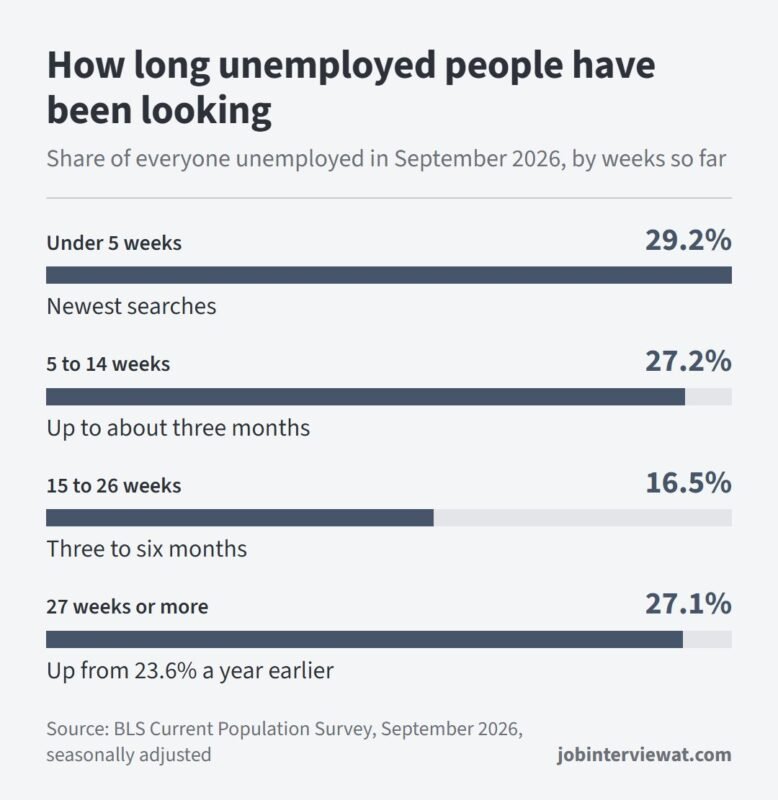
Read these numbers carefully before you compare yourself. The survey counts people who are still unemployed and asks how long they’ve been looking so far. It doesn’t track how long finished searches took. Someone hired in week three never shows up in the 27-week group, so the data leans toward people who are still searching.
Two trends stand out. The median rose from 10.1 weeks in September 2025 to 11.5 weeks a year later. The share looking 27 weeks or more rose from 23.6% to 27.1%. If your search feels slower than a friend’s from last year, the data backs you up: searches aren’t getting shorter.
The average is higher still, at 24.8 weeks. A small group of very long searches pulls it up, which is why the median is the better yardstick for your own search.

How long an hourly job takes to land
Add up the published steps and an hourly hire at a big employer often takes one to three weeks from application to first shift. Each step has its own clock, and a few employers publish theirs.
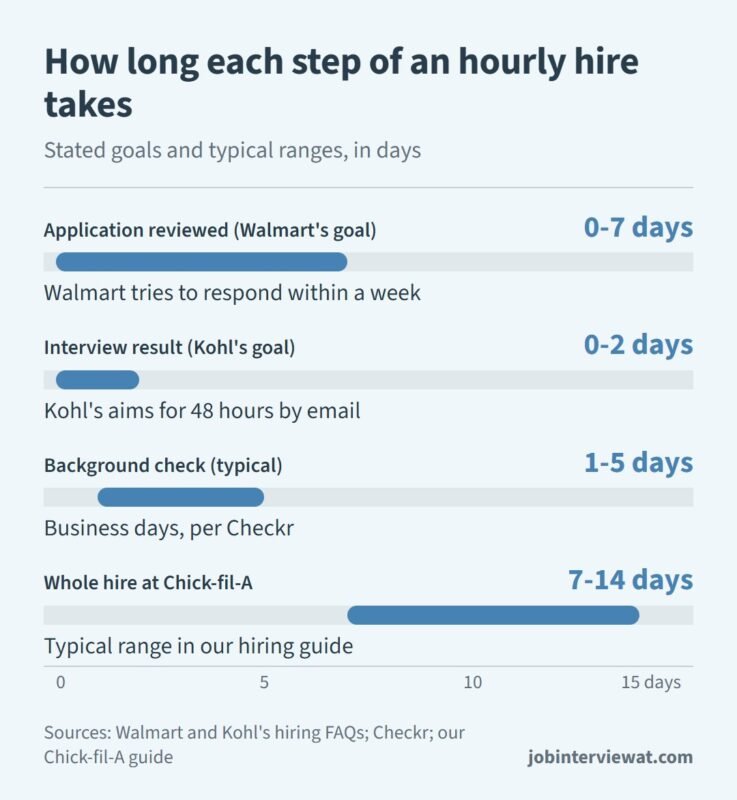
- Application review: Walmart’s hiring FAQ says it tries to respond within a week, though some roles and locations take longer.
- Interview result: Kohl’s says it tries to email the outcome of an in-person store interview within 48 hours.
- Background check: most take one to five business days, according to the screening company Checkr. Kohl’s tells new hires up to a week or longer.
- Whole process: our Chick-fil-A hiring process guide puts a typical hire at one to two weeks.
Self-reported numbers on Glassdoor tell a similar story. As quoted in our guides, the average time to get hired was 6 days at Burlington, 7 at Dunkin’, 8 at Wendy’s and 9 at Panera. Those are averages of whatever people chose to report, not company figures.
Why do hourly jobs move faster? They hire more often. Restaurants and hotels hired 5.2% of their workforce in August 2026 and retail hired 4.3%, against 3.3% across all industries, BLS data show. More openings turn over each month, so your application has more chances to land on an open slot. Our guide on how to get a job fast turns that into a one-week plan.
Even hourly hires can stall at the end, though. In an October 2026 r/AskRetail thread, a new hire at a clothing store was still waiting for a start date a week after finishing onboarding. One reply pointed to seasonal hiring:
“During holiday seasonal hiring it can take a while to get employees started anywhere. Reach out!”
– r/AskRetail, October 2026 (5 upvotes)
Another reply suspected a pending background check, one common hold-up after an offer that our guide to how long a background check takes explains. Our Walmart background check guide explains what that stage involves at one large employer.
Why some job searches take much longer
If you’re after an office or professional role, you’re on a different clock. In an October 2026 r/Layoffs thread asking how long people took to land again after a layoff, the top reply said “Took about 3 months to find something.” Another commenter needed ten months after switching fields into marketing.
An October 2026 r/jobsearch post with 792 upvotes described six to eight months for a business operations role: 13 interviews at separate companies, sometimes three rounds each, and two offers. Every new employer meant starting its process from the beginning.
Three things stretch a search most often:
- Narrow availability. For hourly work, the schedule you can cover often decides it. In a September 2026 r/twentyagers thread, one commenter lost a perfumery job because public transport couldn’t get them there on weekends.
- A narrow target. If you apply only for one title in one field, you cut the number of openings you can compete for.
- Several rounds per employer. The r/jobsearch poster above sometimes went three rounds with a single company before hearing a decision.
The year itself matters too. With the long-term share rising, a search that took you two months in 2025 may take longer now, and that isn’t always about you.
When to change your approach
Review your search every two weeks and change something specific if it isn’t producing results. The data doesn’t give a deadline, but your own log will tell you where the search is stuck.
- No callbacks after two weeks: widen your availability or the roles you’ll take, and recheck your resume against the postings.
- Callbacks but no interviews: follow up once on each application and finish any assessments still pending.
- Interviews but no offers: practice your answers out loud, starting with “why do you want to work here?”
- Money running short: take a bridge job and keep searching.
Bridge jobs are common. In an August 2026 r/jobhunting thread, a person with a microbiology degree took a retail job while they kept looking, and the top reply was blunt:
“It’s called a bridge job. Everyone does it. At that rate even the employers get it.”
– r/jobhunting, August 2026 (25 upvotes)
Seasonal roles are the quickest bridge in the fall. Our seasonal jobs roundup tracks which employers are posting now and who keeps people on afterward.

How long does it take to find a job? Quick answers
How long does it take to get a job?
For people still unemployed in September 2026, the median search had lasted 11.5 weeks so far, BLS data show. Hourly jobs at stores and restaurants often take one to two weeks from application to first shift.
How long does the hiring process take?
For an hourly role, adding up the published steps gives roughly one to three weeks: about a week for the application review, a day or two for an interview result, and one to five business days for a background check. Multi-round office hiring usually takes longer.
How long does it take to get hired at Walmart?
Walmart says it tries to respond to applications within a week. After a conditional offer, most background checks there clear in 2 to 5 business days, based on applicant reports.
Is it normal to be unemployed for six months?
It’s common. In September 2026, 27.1% of unemployed people had been looking for 27 weeks or more, up from 23.6% a year earlier. A long search isn’t proof that you’re doing something wrong, but it’s a reason to review your approach.
What is the average time to find a job?
The mean in September 2026 was 24.8 weeks, but a small group of very long searches pulls it up. The median of 11.5 weeks is a better picture of a typical search.