

Walmart starting pay is $14 to $19 an hour at most stores. The exact number depends on your state, your store, and whether the role needs a skill like slicing meat or mixing paint, and Walmart prints it on every job posting before you apply.
One thing trips people up. Those postings often show a band like “$15 to $28,” and new hires read the 28. You will be offered the bottom of that band. The way to earn more from day one is picking a better-paying role or shift, not negotiating, because for entry-level store jobs there is no negotiation.
The Official Numbers, Straight From Bentonville
Walmart’s own corporate site, as of September 2026, lists the average U.S. hourly field associate at $18.25 an hour. That average includes people with years of tenure, department leads, and high-wage states, so treat it as a midpoint of the workforce, not an opening offer.
The same corporate pages publish the full bands: Team Associate $14 to $37 an hour, Team Lead $19 to $37, Sam’s Club $16 to $37, and distribution and fulfillment centers $17.85 to $40.40, per Walmart’s Ask Walmart page as of September 2026. Two useful floors hide in that list. Sam’s Club starts $2 higher than the stores. And warehouse work starts nearly $4 higher than store work, which matters if you live near a distribution center and can handle the physical pace.
The $14 store floor dates to January 2023, when Walmart raised its minimum from $12 in a move covered by the Wall Street Journal and trade press. It has not moved company-wide since, which is why state minimum-wage laws now do more to set your offer than Bentonville does.
Walmart Pay by Role
Entry-level pay at Walmart is flat by design. A cashier, a sales-floor associate, and a daytime stocker at the same store usually sit within a dollar of each other. The gaps open up with skills, shifts, and supervision.
| Role | Typical hourly range | What moves the number |
|---|---|---|
| Cashier / front end | $14–$19 | Location; most common entry role |
| Sales floor / stocker (Cap 1, Cap 2) | $14–$19 | Tenure and market more than department |
| OGP / personal shopper | $14–$18 | Metrics-tracked picking role |
| Cart and lot | $14–$17 | Usually the lowest band in the store |
| Deli / bakery | ~$16–$19 | Counts as a skills role in most stores |
| Overnight stocker | $15–$20 | Base band plus the overnight differential |
| Auto care / pharmacy tech | $14–$24 | Certifications raise the ceiling |
| Team lead | $19–$37 | First supervisory tier |
Ranges combine Walmart’s posted bands (September 2026) with role averages from Gridwise’s 2026 Walmart pay guide, which puts the typical cashier at about $15 to $16 an hour nationally. Deli figures lean on associate reports of the skills premium described below, so verify the posting for your store.
Cap 1, Cap 2, and What the Shift Codes Mean
Walmart splits stocking into shifts it calls caps. Cap 1 works the morning, Cap 2 works the afternoon into evening, and the true overnight crew stocks while the store sleeps. Base pay for Cap 1 and Cap 2 sits in the same band as the sales floor. Only the overnight shift adds a differential on top, so a “stocker” posting can mean three different take-home numbers depending on which shift the store is filling.
Raises Come Yearly, Promotions Come Faster
Hourly associates get one performance-based raise per year, per Walmart’s Ask Walmart page as of September 2026, and Gridwise’s 2026 guide notes the merit increases typically land in early spring with no fixed percentage. Associates are blunter about the size:
“Not outside of the raises we get. Unless your states min wage is more than what you make. Cries in ten cent raise a year.”
– r/WalmartEmployees, October 2025 (6 upvotes)
The meaningful money is in moving up, not waiting. Walmart’s corporate site says the average U.S. associate lands a first promotion within nine months, and that about 75% of salaried store, club, and supply-chain managers started hourly, with those salaried roles averaging over $117,000 in fiscal 2025. Skeptical veterans on Reddit note the flip side: minimum-wage bumps keep pulling new-hire rates toward what longtime associates earn, so tenure alone compounds slowly.
What Actually Sets Your Walmart Starting Pay
Four layers stack into a Walmart starting pay offer: the $14 company floor, your state’s minimum wage, a skills premium for certain departments, and a shift differential for overnights. The posting for your specific store already has this math baked in.
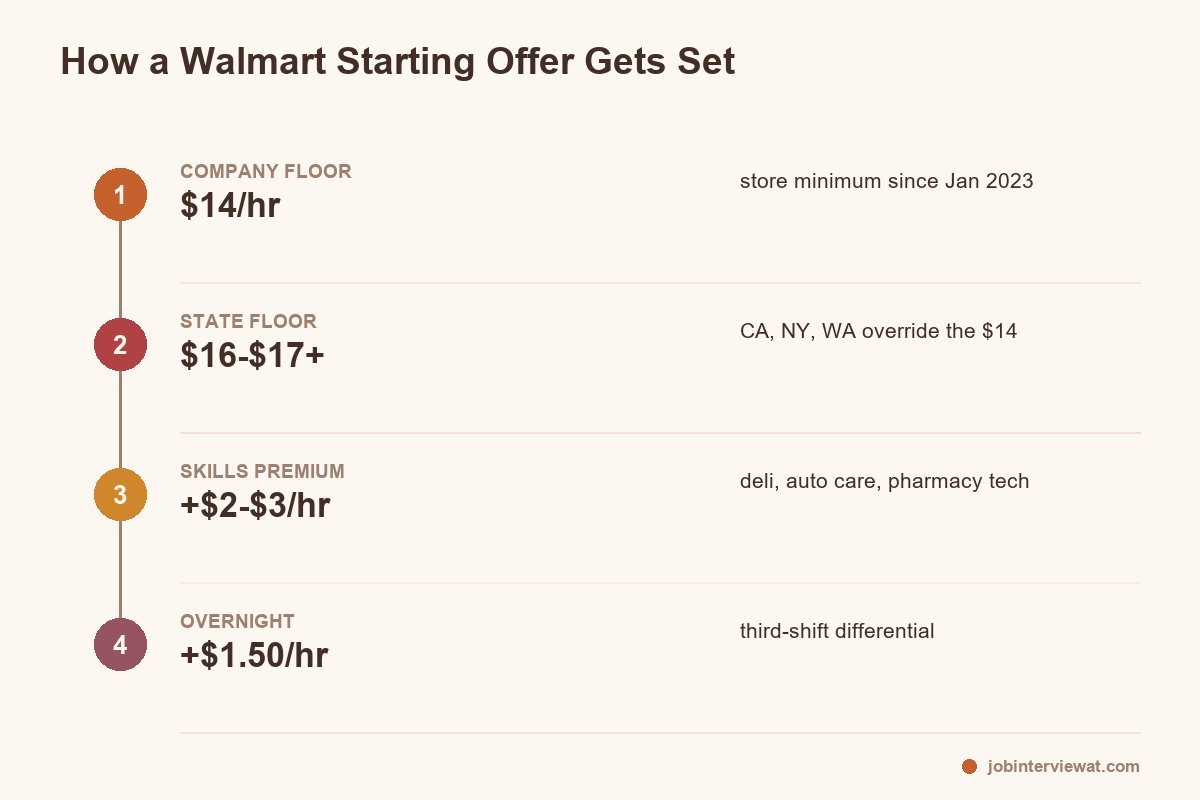
State floors do the heaviest lifting. Gridwise’s 2026 guide pegs California entry roles at $17 to $20 an hour and Seattle-area stores at $18 to $22, since both states set minimum wages over $16. In states with no minimum wage law of their own, like Oklahoma, Mississippi, and Alabama, the $14 company floor is the effective starting point and most entry postings sit at $14 to $16.
The premium layers come straight from people doing the jobs. One frequently upvoted r/WalmartEmployees breakdown from June 2026 reports skills-based positions starting $2 to $3 over the store minimum, supervisory roles starting $5 over the team they lead, and a $1.50 hourly bump for overnight hours. Walmart does not publish these increments, so treat them as associate-reported and confirm at your store.
Paychecks Are Biweekly, With One Exception
Walmart pays every two weeks. Associates in New York report weekly checks because state labor law requires it for manual workers. If two weeks is too long to wait, hourly associates can pull part of already-earned wages early through the One@Work app (formerly Even) and the Walmart MoneyCard, both listed in Gridwise’s 2026 benefits rundown. Your first check covers only the days you actually worked in that cycle, so plan the first month tight.
Part-Time Benefits Worth Counting
Part-timers get more here than at most retailers, with waiting periods on the good stuff. From Walmart’s corporate benefits page as of September 2026: a 401(k) with up to a 6% match once you’re match-eligible (Walmart’s 2026 Associate Benefits Book sets that at 1,000 hours credited in your first year, for all associates), a stock purchase plan matching 15% of the first $1,800 you put in each year, PTO accrual from day one, and Live Better U covering 100% of tuition and books for degrees and certificates. Our Walmart 401(k) guide walks through the match, vesting and what happens to the money when you leave.
The waiting periods, per Gridwise’s 2026 guide: the 10% store discount arrives after 90 days, dental and vision after six months, and full medical plans require full-time status of 34-plus hours a week. Walmart’s 2025 plan-year medical coverage starts at $36.10 per pay period for eligible associates, per the corporate site. A part-time cashier counting on health insurance should read that eligibility line twice before accepting the schedule.
Where Pay Shows Up in the Hiring Process
Pay appears exactly once in Walmart’s hiring flow: printed on the posting. It does not come back as a discussion point later, and interviewers have no authority to move it for entry roles. Asking “is the rate flexible?” in the interview wastes one of your few minutes on a question with a fixed no.
“$15 is the minimum for the position you saw $28 is the max. You will not get offered more than $15 and they do not negotiate except a very select few positions, stocker is not one of them. Yes pay is every two weeks.”
– r/WalmartEmployees, June 2026 (13 upvotes)
So the pay decision happens before you apply, when you choose which posting to click. After that, what you can influence is getting hired at all: the online screener knocks out more applicants than the interview does, and our Walmart assessment test guide walks through the scenarios it throws at you. For the conversation itself, the Walmart interview guide covers the questions store managers lean on. Walmart also hires at 16 for many store roles, and the posting minimum applies at any age; if you are job hunting as a teen, the wider list of jobs that hire at 16 gives you comparison points.
How Walmart Stacks Up for a First Job
Judged purely on the opening hourly number, Walmart sits mid-pack. Gridwise’s 2026 comparison puts Target at $15 to $24 for entry hourly roles, Amazon warehouses at $18 to $22, Home Depot at $15 to $21, and Costco at $19 to $26, against Walmart’s $14 to $19 for store associates.
We break down the strongest of those in our Costco starting pay guide, and fast food now competes too: see what In-N-Out pays to start and how much Chick-fil-A pays before assuming retail wins.
What the hourly comparison misses is ceiling and density. Costco pays more but operates a fraction of Walmart’s locations, and Walmart’s promotion pipeline into six-figure salaried management is unusually well documented for retail. If you need a job within biking distance this month, a store on nearly every side of town is itself a form of pay.
Walmart Starting Pay FAQ
How much does Walmart pay per hour?
Most Walmart store associates start between $14 and $19 an hour, and the company reports its average hourly field associate makes $18.25 as of September 2026. Warehouse roles start at $17.85, and Sam’s Club at $16.
Does Walmart pay weekly?
No, Walmart pays biweekly in nearly every state; New York associates report weekly checks under state law. The One@Work app lets hourly associates access part of their earned wages before payday.
How often does Walmart give raises?
Walmart gives hourly associates one performance-based raise per year, typically processed in early spring, per its corporate site as of September 2026. Bigger jumps come from role changes, since skills and supervisory positions start $2 to $5 over base rates by associate reports.
What does Walmart pay 16 year olds?
Walmart pays 16-year-olds the same posting minimum as adult hires in the same role, typically $14 to $16 an hour depending on the state. There is no separate teen wage tier, though minors are limited to certain departments and hours.
The full Walmart hiring path, step by step
- Assessment test: The online questionnaire inside the application
- Interview questions: What they ask and how to answer
- Background check: Timeline, scope and red flags
- Drug test: Which roles get screened, and when
- Orientation: Length, pay, dress code and day one
- Starting pay (you are here)
- Pay stub: How to get it, even after you quit
- Employee discount: What the 10% card really covers