
Most Walmart store applicants never take a drug test. So does Walmart drug test at all? Yes, but the screening is concentrated in a short list of roles: pharmacy, auto care, asset protection, firearms counters, salaried management, and CDL drivers. If you applied for cashier, cart pusher, or general stocker, the cup almost certainly never appears.
Walmart publishes no public drug-testing policy page, which is why applicants end up asking Reddit the night before orientation. The closest thing to an official statement is a line in Walmart’s Global Ethics FAQ, and everything below separates what that document actually says from what thousands of new hires report happening in real stores.
Does Walmart Drug Test Every New Hire?
No. Walmart drug tests applicants for safety-sensitive and regulated positions, not the general store workforce. Walmart’s own Global Ethics FAQ says applicants “may be drug screened as part of the post-offer hiring process or prior to accepting certain positions.” The operative words are “may” and “certain positions.”
Which positions? Walmart never lists them publicly, so the working map comes from employees. Ask a store full of associates and you get a consistent answer:
“If you don’t work an AP role you won’t be tested”
– r/walmart, July 2026 (21 upvotes)
That answer is slightly too narrow. Pooling recent applicant reports from r/walmart, r/WalmartEmployees, and r/walmart_RX, the tested list covers roles where impairment touches safety, controlled substances, or federal law:
| Role | Pre-employment test | Why |
|---|---|---|
| Pharmacy (tech and pharmacist) | Yes, applicant-reported for every new hire | Handles controlled substances |
| Auto Care Center / TLE | Commonly reported, varies by store | Lifts, machinery, customer vehicles |
| Asset protection | Yes, widely reported | Physical security work |
| Sporting goods (firearms stores) | Reported where guns and ammo are sold | Firearms handling |
| Vision center | Reported by employees | Clinical setting |
| Salaried management | Reported by employees | Company policy |
| CDL truck drivers | Yes, federally required | DOT regulation, not Walmart’s choice |
| Cashier, stocker, deli, cap teams, seasonal | Typically no | Not classed as safety-sensitive |
Every row except the driver row is applicant-reported practice, not published policy, and individual stores drift from it. One June 2026 thread has a sporting-goods hire who was told a test was coming and it simply never happened; another store reportedly tested automotive hires while the store one town over did not. Treat the table as the strong pattern, not a guarantee.
Where the Test Falls in the Hiring Timeline
The screening, when it exists for your role, comes after the job offer and before your first day. Nothing happens at the interview. You apply, take the online assessment, interview, get a conditional offer stating your starting pay, and only then does a tested role generate screening paperwork, usually a clinic order with a deadline of about 24 hours to show up, according to applicant reports.
One point of confusion swallows more nervous applicants than any other. The Walmart assessment test is a personality and situational-judgment questionnaire that every applicant completes online, while the drug test is a separate post-offer lab screening that only specific roles ever see. Passing one has nothing to do with the other.
Orientation is the other anxiety point, and the applicant consensus is boring: orientation is paperwork, videos, and a store tour. For tested roles the sample was already collected at the clinic days earlier. Walking into orientation means your screening, if you had one, came back fine. What actually happens in the interview room is a separate topic, covered in the Walmart interview guide.
Tests That Happen After You Are Hired
Skipping the pre-employment test does not mean the subject is closed forever. The same Global Ethics FAQ reserves two triggers for current associates: testing “following certain on-the-job injuries,” where law permits, and testing when there is “reasonable basis to suspect you’re under the influence of drugs” at work.
The injury trigger is the one hourly workers actually meet. Get hurt on a baler, a pallet jack, or a ladder, and the incident report can come with a clinic order attached. Reasonable-suspicion testing needs a manager willing to document observed impairment, which is a higher bar in practice than on paper.
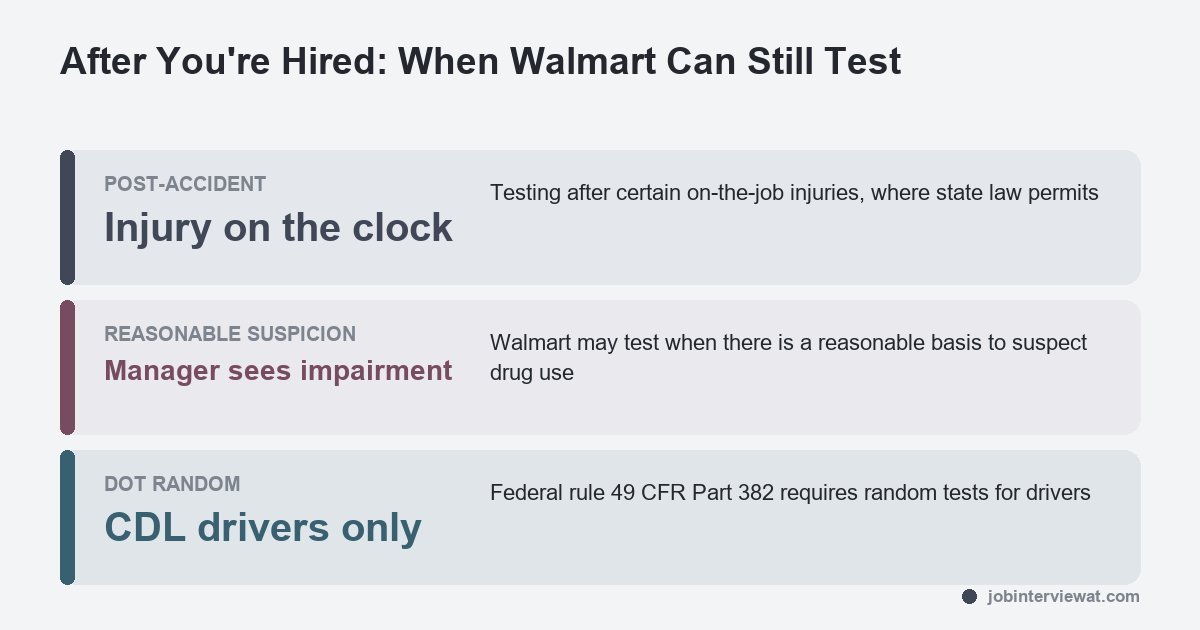
True random testing is a different animal. For store associates it is essentially unheard of in employee reports. For Walmart’s private-fleet drivers it is mandatory: federal rule 49 CFR Part 382 requires every CDL carrier, Walmart included, to run pre-employment, random, post-accident, and reasonable-suspicion testing. Drivers are the one group where none of this is store discretion.
What Kind of Test to Expect
Applicants consistently describe a urine test collected at a third-party clinic, with eScreen the name that comes up most in onboarding paperwork. Reports describe a standard panel screening for THC, cocaine, opiates, amphetamines, and PCP, with results back in a few business days. None of this is published by Walmart, so specifics can differ by state and vendor.
Pharmacy applicants describe the strictest version: a test for every new hire plus periodic randoms afterward, which tracks with a workplace built around controlled substances.
Weed, THC, and Legal-State Complications
State legalization has not removed THC from the panel. A pharmacy hire put it flatly:
“And yes, weed is part of the test, even if it’s legal in your state”
– r/walmart_RX, June 2026 (9 upvotes)
The legal picture underneath is genuinely messy. A handful of states now limit how employers can act on legal off-duty cannabis use, but those protections routinely carve out safety-sensitive roles, and federal rules override state law entirely for DOT drivers. THC also lingers in urine for days to weeks after use, far past any impairment, which is why legal-state applicants for tested roles still fail. If your situation involves medical cannabis or a state protection question, that is a conversation for an employment lawyer in your state, not a general article.
If You Fail or Refuse
Walmart’s ethics FAQ states the consequence in one line: an applicant or associate who tests positive for illegal drug use “may be ineligible for employment.” In applicant reports that translates to a withdrawn offer before hire, and to termination for employees who fail a post-incident or suspicion test. Refusing a required test is treated the same as failing it, and for DOT drivers that equivalence is written into the federal rule.
A failed screening is not a criminal record, and it does not follow you to other employers the way a conviction does. Career-site reporting suggests rejected candidates can reapply after a waiting period, commonly described as six months to a year, though no official Walmart figure exists. Applicants sorting out how screenings interact with an actual record should look at which major employers hire people with felony records, where Walmart’s background-check practice gets covered on its own. To see how Walmart compares with Target, Costco, Home Depot and other chains, our list of jobs that don’t drug test puts them side by side.
Having sat on the corporate side of hiring, my honest read of this policy is that Walmart spends its screening budget where regulators and insurers force it to, and nowhere else. Put your preparation into the assessment and the interview. If your offer letter is for pharmacy, TLE, asset protection, firearms, management, or a driving job, keep 24 hours clear for the clinic visit between offer and orientation, and assume THC counts no matter what your state legalized.
Walmart Drug Test FAQ
Does Walmart drug test at orientation?
No, applicant reports consistently describe Walmart orientation as paperwork and training with no drug test. Roles that require screening complete it at a third-party clinic after the offer and before orientation, so being scheduled for orientation generally means any required test already cleared.
Does Walmart drug test for weed?
Yes, THC is part of the urine panel applicants describe, including in states where cannabis is legal. Most hourly store roles are never tested at all, but tested roles like pharmacy, auto care, and driving screen for weed, and DOT rules require it for drivers regardless of state law.
What kind of drug test does Walmart use?
Walmart uses a urine test collected at a third-party clinic, with eScreen the vendor applicants name most often. Reports describe a standard panel covering THC, cocaine, opiates, amphetamines, and PCP, usually completed within about 24 hours of the request, with results in a few business days.
Does Walmart drug test overnight stockers?
No, overnight stockers report no pre-employment drug testing, the same as cashiers and other general store associates. A stocker can still be tested after an on-the-job injury or on documented suspicion of impairment, and equipment-heavy distribution center roles follow stricter rules than stores.
The full Walmart hiring path, step by step
- Assessment test: The online questionnaire inside the application
- Interview questions: What they ask and how to answer
- Background check: Timeline, scope and red flags
- Drug test (you are here)
- Orientation: Length, pay, dress code and day one
- Starting pay: What new hires really make
- Pay stub: How to get it, even after you quit
- Employee discount: What the 10% card really covers