

Warehouses, trades, and restaurants hire the most felons. The bigger point, though, is that the company list is the easy half of the search. Most rejections don’t happen when you apply; they happen after a conditional offer, when the background check comes back and someone in HR reverses course.
That stage is workable. Which large employers have verifiable second-chance programs, what a felony legally can and cannot show on a check, two federal incentives you can name out loud in an interview, and a word-for-word structure for the record conversation: each of those is preparation you can do this week, and the rest of our Job Search guides cover the steps that come after.
Companies that hire felons, sorted by strength of evidence
Company lists for people with records tend to mix three very different things: employers with documented programs, employers that signed a pledge years ago, and employers people on forums say gave them a shot. Those are not equal, and treating them as equal wastes applications. Here is the same information sorted honestly.
| Evidence level | Employers | What it means for you |
|---|---|---|
| Documented program, verifiable today | Walmart, Home Depot, Lowe’s, Kroger, McDonald’s, Koch Industries, JPMorgan Chase, Bank of America, Verizon, Walgreens, Best Buy, GM, Microsoft, American Airlines (all current Second Chance Business Coalition members); Dave’s Killer Bread, which has hired people with criminal backgrounds for close to 20 years | Apply with confidence. These companies publicly commit to hiring and advancing people with records. |
| Publicized commitments, current policy unclear | Starbucks, Target, Chipotle (fair-chance pledges from the mid-2010s) | Apply, but expect the outcome to depend on the store, the role, and your state. |
| Community-reported only | Amazon warehouses, UPS, FedEx Ground, most staffing agencies | Applicants with records report offers regularly, but there is no published policy to hold anyone to. Treat as apply-and-see. |
One caveat applies even to the strongest tier: coalition membership covers the company, not every job in it. JPMorgan Chase can champion second-chance hiring and still be barred from putting certain convictions in FDIC-regulated roles, because federal banking law requires a waiver for crimes involving dishonesty. The same split shows up in healthcare systems and airlines. Apply to the company, but pick the role with the check in mind.
How does a felony show up on a background check?
A felony conviction can appear on an employment background check indefinitely under federal law. The seven-year limit in the Fair Credit Reporting Act covers arrests and other non-conviction records, while several states, California and New York among them, cap conviction reporting at about seven years.
That distinction surprises people constantly, so it bears spelling out. Section 1681c of the FCRA excludes arrest records older than seven years from consumer reports, but convictions are exempt from that limit at the federal level. Whether your 2009 conviction shows up in 2026 depends on your state’s rules, not on a federal clock running out.
What employers are supposed to do with what they see is a separate rule. The EEOC’s 2012 enforcement guidance tells employers to weigh three factors before rejecting someone over a record: the nature of the offense, how much time has passed, and whether it relates to the job. A blanket “no felonies” policy invites a discrimination claim. In practice, plenty of employers still run one, quietly, at the offer stage. That is the pattern behind posts like this one:
“Yes I have tried factories/ warehouses, second chance employers and a recruitment center that manage hiring for multiple businesses. Every time I get offered a job, a few days later I get a call saying they saw my background check and denied the position. One of the interviews I had the manager himself told me he did 8 years, so I thought I was golden with only 6 months nope. And they wonder why people become homeless… Guess I’ll die than.”
– r/jobhunting, August 2026 (135 upvotes)
If that call comes, you have rights in that exact moment. Before an employer finalizes a rejection based on a background report, the FCRA requires a pre-adverse action notice with a copy of the report, and you get a window to dispute errors or add context. Reports do contain mistakes: wrong person, dismissed charges listed as open, sealed records that should never have appeared. Read yours line by line.
And if your conviction qualifies for expungement or sealing in your state, that is the highest-return legal move available. A sealed record generally cannot be reported to an employer at all. Most states run the process through the original sentencing court, and legal aid offices handle these petitions for free. Sealing and reporting rules differ by state, so treat everything here as general information and a legal aid office as the authority on your specific case.
What Ban the Box changes, and what it leaves alone
Ban-the-box laws remove the conviction checkbox from the initial application and delay record inquiries until later in hiring, often until a conditional offer. Per the National Employment Law Project’s count, 37 states and over 150 cities and counties have adopted one, and 15 states extend the rule to private employers.
What the box’s removal buys you is an interview, and that matters, because face time beats a checkbox for a candidate with a good story since conviction. What it does not buy you is secrecy. The check still runs, usually right when you can taste the offer. Plan the record conversation for that stage instead of hoping the topic never surfaces.
Two federal incentives you can name in the interview
Hiring you can put money on an employer’s table, and most small-business owners have never heard of either program. Mentioning them, briefly and at the right moment, reframes you from risk to line item.
The first is the Work Opportunity Tax Credit. The IRS lists “qualified ex-felon” as a targeted group: anyone hired within one year of a felony conviction or of release from prison for that felony. The credit runs 40% of the first $6,000 in first-year wages, up to $2,400 per hire, for employees who work at least 400 hours. The paperwork is one pre-screening form, Form 8850, and it must be completed on or before the day of the job offer, so raising it early is doing the employer a favor.
The second is the Federal Bonding Program, which the Department of Labor has run since 1966. It gives the employer a free fidelity bond covering your first six months on the job, with a zero-dollar deductible, no cost to either side, and no paperwork burden beyond a call to the state bonding coordinator. It exists specifically to neutralize the “what if” fear that kills offers at the last step.
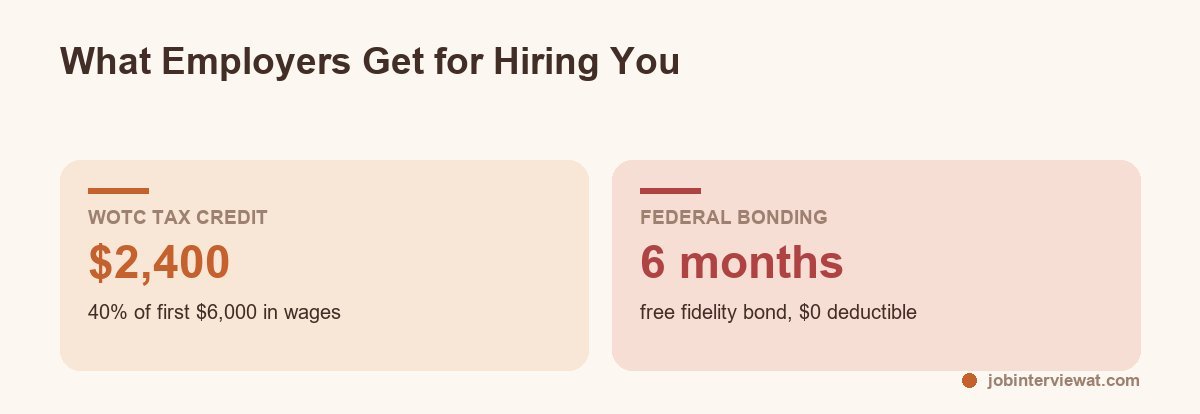
Delivery matters more than the facts here. One sentence at the close of an interview is enough: “One thing that might be useful, hiring me qualifies you for the federal WOTC credit, up to $2,400, and free fidelity bonding for six months. I can bring the forms.” Said plainly, it signals preparation. Said desperately, it sounds like a discount coupon. Practice it until it lands as information.
The four-move answer when an interviewer raises your record
The record conversation follows a four-move structure: own it in one sentence, decline to relitigate it, pivot to what changed, and close with dated evidence. Everything that goes wrong in these conversations comes from skipping a move or reversing the order.
Move one: own it in one sentence. Name the conviction and the year, without euphemism. “I have a felony conviction from 2019 for drug possession” beats “I made some mistakes when I was younger” every time, because vagueness reads as concealment and forces the interviewer to imagine worse.
Move two: no details tour. Do not explain the circumstances, the co-defendant, the unfair sentence, or the lawyer who botched it. Every added detail extends the part of the interview you least want extended, and blame-shifting is the number one signal interviewers hold against candidates with records.
Move three: pivot to what changed. One or two specifics with dates. A completed program, a credential, sobriety time, parole finished early. The pivot only works if the specifics are checkable.
Move four: evidence since. End on what you’ve done, not on what you promise. Work history since release, a reference from a supervisor, certifications. Then stop talking and let the interviewer move on.
Sample answer for a warehouse or trades role
“Before we go further, you’ll see a felony on my background check, a 2019 conviction for drug possession. I served my time and finished parole in 2022. While inside I completed a forklift certification and a 12-step program, and since release I’ve worked 14 months at a distribution center with no attendance issues; my shift lead there is one of my references. I’m happy to answer whatever you want to know, and the rest of my record is an empty page.”
Sample answer for a customer-facing role
“I want to be upfront: I have a felony theft conviction from 2018. I’m not going to make excuses for it. What I did afterward was pay full restitution, finish an accounting course, and spend two years cashiering at a grocery store where I handled a till every shift, and my manager there will tell you the drawer never came up short. I understand if you need to verify all of that, and I’d welcome it.”
Both answers run under 30 seconds spoken. Rehearse yours the way you’d rehearse answers to the standard interview questions, out loud, until the conviction sentence comes out flat and factual instead of flinched. Interviewers mirror your comfort level: if you treat the record as radioactive, so will they.
Jobs that hire felons most often: five routes
Warehousing and logistics comes first for a structural reason: the work is measured in units per hour, turnover is high, and the roles carry no cash handling or licensure, which removes the legal barriers that block other paths. Distribution centers, fulfillment, loading docks, and third-shift production are the fastest interviews-to-offers in this market.
Skilled trades come second and pay better over time. Construction crews, electricians, welders, and HVAC shops hire on capability, apprenticeships rarely screen the way corporate HR does, and a journeyman card outlasts every background check. If you’re starting from zero, our guide to transitioning into a trade career lays out the entry points.
CDL driving is route three, with an asterisk. A felony by itself does not disqualify you from a commercial driver’s license. Federal rule 49 CFR 383.51 disqualifies drivers for specific acts, such as using a commercial vehicle in the commission of a felony, with a lifetime ban when the felony involved drug trafficking in a commercial vehicle. If your conviction had no vehicle involved, trucking schools and carriers will talk to you, though individual carriers still set their own insurance-driven rules.
Staffing agencies are route four and the most underrated. The agency runs the check once, and once you’re on their roster, each placement skips a fresh HR gauntlet. Temp-to-hire is the classic back door into companies whose front door would have screened you out, because after 90 days you’re a known worker, not a report.
Restaurants and hospitality round it out, and kitchens have functioned as second-chance employers since long before the term existed:
“Have you tried hospitality? Dishwashers and bussers are often felons. They’re not processing payments or having access to cash tills so it works well.”
– r/jobhunting, August 2026 (11 upvotes)
That logic generalizes. Roles without cash, licenses, or vulnerable populations clear checks that identical-paying roles with them never will. When two openings pay the same, apply to the one the lawyers haven’t touched.
FAQ
What companies will hire convicted felons?
Companies that hire convicted felons with documented programs include Walmart, Home Depot, Lowe’s, Kroger, McDonald’s, Koch Industries, Verizon, and JPMorgan Chase, all Second Chance Business Coalition members, along with Dave’s Killer Bread. Amazon, UPS, and FedEx Ground are widely reported by applicants to hire people with records, but publish no policy, so results vary by role, conviction type, and state.
What is the most common job for a felon?
Warehouse and logistics work is the most common employment for people with felony records, followed by construction labor, manufacturing, and restaurant kitchens. These jobs share the traits that matter: no occupational license, no cash handling, no vulnerable populations, and managers who hire on output. They are also the roles where jobs that hire felons overlap with jobs that promote quickly, since shift-lead positions turn over as fast as entry ones.
Does Amazon hire felons?
Amazon has no published blanket ban on felony convictions, and warehouse hires by people with records are reported often enough to be credible. Each offer still turns on the individual background check, the role, and the conviction. Delivery positions are stricter than fulfillment-center ones because driving roles add motor-vehicle and insurance screening. Apply to fulfillment first, and expect the check at the offer stage, not the application.
What jobs can felons not do?
Felons are barred by law from specific licensed and regulated roles: banking positions at FDIC-insured institutions without a federal waiver after dishonesty crimes, most childcare and K-12 school jobs, many healthcare licenses, TSA-badged airport work, and CDL driving after vehicle-involved felonies. Nearly everything else is an employer’s judgment call, not a legal bar, which is why the interview answer and the incentive programs earn their space in your preparation. Where a license is the obstacle, check your state’s fair-chance licensing rules; several states now require boards to show a conviction relates to the occupation before denying you.