

How to get a job fast comes down to where you apply and how. Restaurants, retail stores and staffing agencies hire a bigger share of their workers each month than most industries, so aim there first. Pick five to ten places near you, lead with your availability, follow up once and be ready to interview the same week.
Why hourly work? It’s where a fast start is most realistic, and it’s what this plan is built for: cashier, stocker, crew member, warehouse associate. If you’re after an office role, the follow-up and interview sections still apply, but expect a longer timeline.
I interviewed job seekers at Walmart and later helped rework how it recruited. The hiring figures below come from the Bureau of Labor Statistics, and the advice from people on both sides of the counter comes from Reddit threads posted in 2026.
Where hiring moves fastest right now
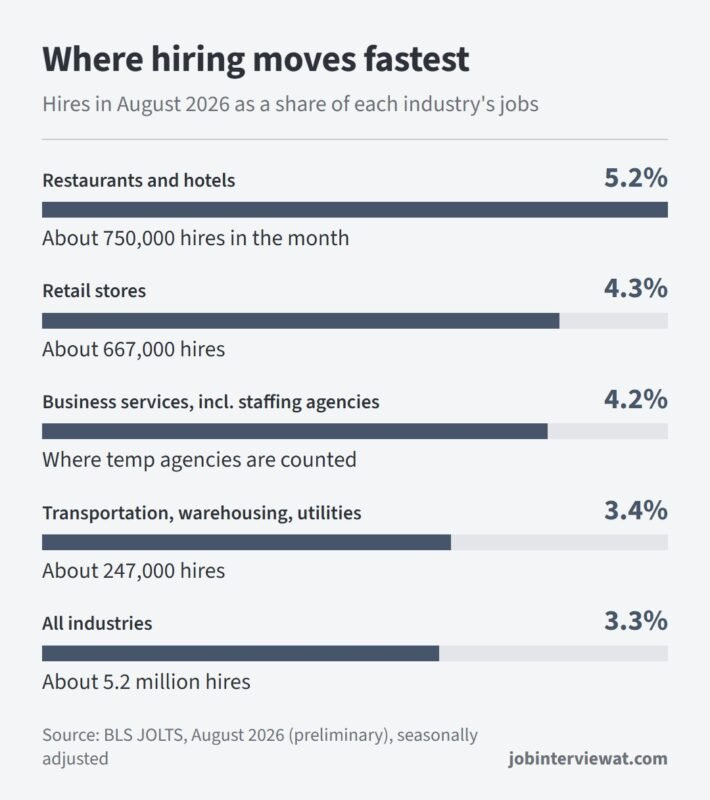
Restaurants and hotels hired 5.2% of their workforce in August 2026, retail hired 4.3%, and all industries together hired 3.3%, according to the Bureau of Labor Statistics’ Job Openings and Labor Turnover Survey. That gap is your shortcut. A restaurant fills open slots about 1.6 times as often as the average employer.
The wider market is open but not easy. Unemployment was 4.2% in September 2026, and employers listed about 7.1 million openings in August. The median spell of unemployment was 11.5 weeks. Those are national numbers, though, and they don’t promise any single application a reply.
Timing helps too. Retailers, parcel carriers and warehouses post holiday roles in the fall, and our seasonal jobs roundup tracks who’s hiring and who keeps people on afterward. A seasonal start is often the quickest way into a store that would otherwise make you wait for an opening.
Build a short target list
A fast search is a narrow one. Sending the same application to fifty places feels productive, but who will you follow up with? Nobody, usually. Write down five to ten employers within your commute that have open postings right now.
Split them into three groups:
- Priority: places hiring for work you can start now, on shifts you can actually cover.
- Stretch: roles that list one requirement you don’t have yet, such as a register or forklift background.
- Bridge: seasonal, temp or overnight roles that pay now and can turn into something steadier.
What moves a name up the list? Availability, more than anything. In an October 2026 thread asking how anyone gets a retail job these days, a store manager answered plainly:
“As a store manager, most of what we’re looking for is prior experience in customer service, and open availability.”
– r/AskRetail, October 2026 (5 upvotes)
That manager was talking about small-box stores like Family Dollar and Aldi. Still, the logic holds for most hourly work: a schedule has holes, and you get hired for filling them. If you can work nights or weekends, that’s the first thing an application should show.

Apply the way each employer hires
Should you walk in and ask for the manager? It depends on who runs the hiring. Big chains route almost everything through an online portal, and a 2026 thread on whether walking in still works was blunt about it:
“A lot of places have at the bottom of their postings that they do not welcome walk-ins or phone calls.”
– r/recruitinghell, October 2026 (15 upvotes)
The same thread agreed that small, owner-run places are different. There, dropping off a resume and asking for the manager can still work. Here’s how the main routes compare:
- Big retail and grocery chains: apply online first. If you want to stop by afterward, go at a quiet hour and say you’ve already applied.
- Franchise restaurants: each owner hires on their own schedule. At Chick-fil-A, for example, every restaurant is run by an independent Operator, which is why, in the Chick-fil-A hiring process, one applicant hears back the same day and another waits two weeks.
- Local shops and diners: walking in with a printed resume is still normal.
- Warehouses: apply direct, and register with one or two staffing agencies at the same time.
Agencies are the closest thing to an instant start. In a September 2026 thread on getting warehouse work quickly, one commenter wrote, “I went to a temp agency and found work the next morning. I go permanent in 2 weeks.” That’s one person’s result, not a promise, but agencies exist to fill shifts fast.
Don’t skip a warehouse posting just because it mentions forklifts. Federal rules make the employer train and evaluate every operator before they drive one, according to OSHA’s powered industrial truck standard. If the listing says experience is preferred rather than required, apply and ask whether they train.

A resume that fits an hourly application
Many hourly applications don’t ask for a resume at all. When one does, keep it to one page that a manager can scan in under a minute and that a hiring system can read. Plain section headings, one column, no text boxes, no photos.
Put these near the top:
- Your availability, written as days and hours.
- Any customer-facing work, paid or not: concessions, church events, family business, babysitting.
- Anything that shows you turn up: school, sports, volunteering, a certificate.
Then cut whatever works against you. A first-time applicant in an August 2026 r/jobs thread listed “80% or above attendance” as an achievement. The top comment, with 841 upvotes, said to “just take that off completely.” Ask yourself whether each line makes a manager more or less sure you’ll cover the shift.
Should you copy words from the posting? Only where they’re true. If the listing says “stock shelves,” “operate a register” or “pick and pack,” and you’ve done it, use those words. If you haven’t, don’t claim it.
If you don’t have a resume yet, a free builder such as 7resume.com gives you a clean layout to start from, so you’re not fighting a word processor. Treat anything a template or tool suggests as a draft. Every line still has to describe something you’ve actually done. For a no-experience version, our guide on how to make a resume for your first job walks through it section by section.
Use AI to tidy your application, not to invent it
An AI tool can tighten your wording or compare your resume against a posting. It can’t know what you’ve done, so it shouldn’t be writing your history for you.
A safe way to use one:
- Write your own notes first: jobs, dates, duties, hours you can work.
- Ask the tool to tidy those notes, not to add to them.
- Check every date, number and skill against what really happened.
- Rewrite anything that doesn’t sound like you.
Keep private details out of public chatbots, including your Social Security number and anything about a former employer’s customers. And don’t let a tool mass-apply for you. Managers notice; one wrote in a 2026 r/jobs thread that so many people now use AI “to spam applications everywhere” that a real follow-up stands out.
Follow up once, about three business days later
Does following up help? A former recruiter in a September 2026 thread said it can:
“If I hadn’t looked at the applicants yet, I would make a special note that you followed up on your application.”
– r/jobsearchhacks, September 2026 (27 upvotes)
The same person added that it doesn’t guarantee anything, and another commenter said follow-ups had never gotten them a reply. So do it once, keep it short, then move on to the next name on your list.
For a store or restaurant, call about three business days after you apply, at a quiet hour: mid-morning or mid-afternoon on a weekday, never at lunch rush. Ask for the hiring manager, and if they’re busy, ask when to call back. Then say something like:
“Hi, my name is Jordan. I applied online for the overnight stocker opening on Monday. I wanted to confirm you got it and let you know I can work any night of the week. Is there anything else you need from me?”
That’s it. You’re confirming interest and repeating your availability, not asking them to skip their process. If the posting says no calls, respect it and follow up by email or in the portal instead. Our guide on how to follow up on a job application adds an email template and the status pages to check first.

Be ready to interview the same week
Hourly interviews can happen fast and run short. A night stocker in an April 2026 r/WalmartEmployees thread was moved forward after one question on a walk around the store. Another commenter described the same pace:
“Literally their only interview question was why do you want to work here? And then I had orientation the next day”
– r/WalmartEmployees, April 2026 (11 upvotes)
So have that answer ready before anyone calls. Our guide to answering “why do you want to work here?” gives a three-part answer for store, restaurant and warehouse jobs.
Beyond that one question, prepare two or three short stories you can tell in under a minute each:
- A time you showed up when it was hard to.
- A time you helped someone who was upset or confused.
- A time you made a mistake and fixed it.
Use a simple order for each: what happened, what you did, how it turned out. Then bring your schedule, written down, so you can answer “When can you work?” without guessing.
After the offer, the wait is usually paperwork. At Walmart, for instance, the background check starts after a conditional offer and most clear in 2 to 5 business days. Other employers run on different clocks, compared in our guide to how long a background check takes.
Review after two weeks, then adjust
Keep a short log: where you applied, the date, whether you followed up and what happened. After two weeks, read it back. The pattern tells you what to fix.
- No callbacks at all: widen your availability if you can, add places from the bridge group or an agency, and recheck your resume against the postings.
- Interviews but no offers: practice your stories out loud and tighten your answer to “why here?”
- Offers on the wrong shifts: take a bridge job if you need the money, and keep applying for the schedule you want.
Don’t read a slow search as a verdict on you. In September 2026, 27.1% of unemployed people had been looking for 27 weeks or more, BLS data show. Long searches are common, and a bridge job keeps money coming in while you look.
A 7-day plan to get hired fast
The fastest week runs in this order: pick your places, fix your availability and resume, apply, practice, then follow up once. Count Day 1 as the day you start.
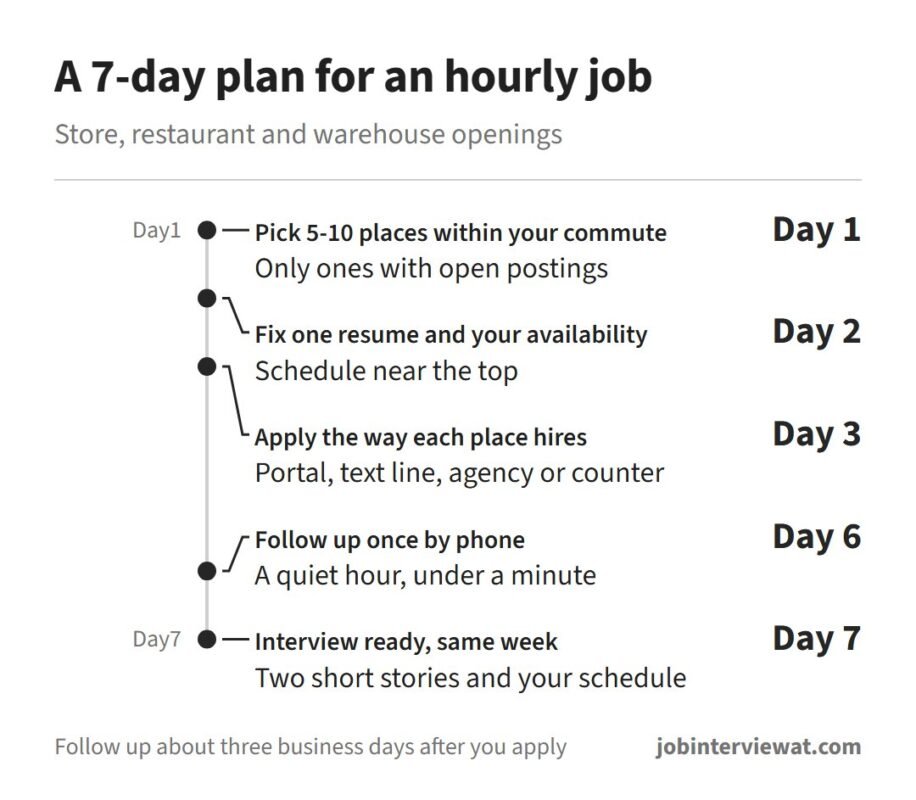
- Day 1: list five to ten employers within your commute that are posting now, sorted into priority, stretch and bridge.
- Day 2: write your availability as days and hours, and fix your resume so that it sits near the top.
- Day 3: apply to every priority employer the way each one hires, and register with one staffing agency.
- Day 4: apply to the stretch and bridge employers.
- Day 5: practice your answer to “why do you want to work here?” and your two or three stories out loud.
- Day 6: make one follow-up call to each Day 3 employer that allows calls.
- Day 7: log what happened and line up next week’s names.
Repeat the week until someone says yes. The list gets better each time, because you’ll know which places answer.
How to get a job fast: common questions
How long does it take to find a job?
For people still unemployed in September 2026, the median search had lasted 11.5 weeks so far, according to BLS data. Our breakdown of how long it takes to find a job explains what that number measures. Hourly jobs can move much faster: a Chick-fil-A hire typically takes one to two weeks, and staffing agencies sometimes place people within days.
What jobs hire immediately?
The quickest starts tend to come from staffing agencies, seasonal retail and delivery roles, overnight stocking and restaurant crew jobs. Restaurants and hotels had the highest hiring rate of any major industry in August 2026, at 5.2% of their workforce in one month.
How do you follow up on a job application?
Wait about three business days, then call once at a quiet hour or send a short email. Give your name, the role and the date you applied, confirm your interest and repeat your availability. If the posting says not to call, use email or the application portal.
How many jobs should you apply to a week?
There’s no fixed number. Five to ten well-matched hourly applications that you actually follow up on usually beat fifty identical ones that you never check on. Add more once your first list is used up.
Can you get a job fast with no experience?
Yes, in hourly work. Lead with your availability and anything that shows reliability, and apply to employers that train new hires. If you’re under 18, check each chain’s minimum age in our list of jobs that hire at 16.
Is walking in to ask about a job still worth it?
At small local businesses, often yes. At big chains, apply online first; many send walk-ins back to the website, and some postings ask you not to call or visit at all.