

A first resume works without any work history at all. Hiring managers at grocery stores, fast food counters, and retail chains read applications from teenagers every week, and none of them expect to see a former employer on the page. What they expect is evidence that you will show up, follow instructions, and cover the shifts they need filled.
That changes how to make a resume for your first job. You are not competing on experience. You are competing on clarity, availability, and proof of reliability pulled from school, sports, volunteering, and home life. I spent years screening candidates for a Fortune 500 company, and the entry-level resumes that got calls were rarely the fanciest ones; they were the ones a manager could say yes to in under a minute.
What employers check on a first resume
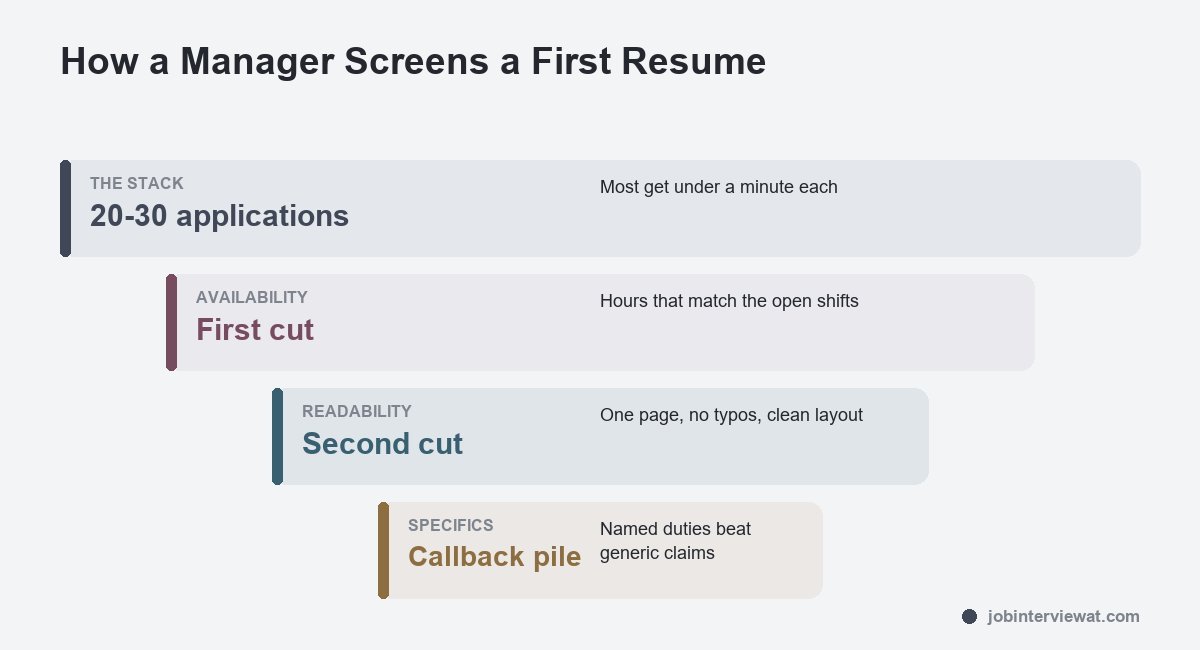
A manager screening first-job applications checks three things in order: whether your available hours match the open shifts, whether the page is clean and readable, and whether any line proves you handle responsibility. Experience is not on that list, because at this level nobody has it.
Picture where this reading happens. A shift supervisor at a grocery store goes through a stack of applications by the register between rushes, giving most of them under a minute. Roughly twenty to thirty come in for one posted opening at a busy location, and the majority disqualify themselves with missing phone numbers, unreadable formatting, or availability that does not cover a weekend.
One typo will not sink you. Five will, because the manager reads sloppiness on paper as sloppiness on a register. Here is how a reviewer on r/jobs put it to a teenager asking for feedback on a first resume:
“Don’t put “(part time)” anywhere on your resume. It’s an irrelevant distinction that could only hurt you. Your professional summary needs to be completely rewritten. Don’t list your education as “highschool student” – just list the name of your high school, then put 2022-Present. **And for the love of God, proofread your resume.** There are typos everywhere, not to mention bad grammar and clunky writing.”
– r/jobs, September 2025 (246 upvotes)
Blunt, but it matches what managers say privately. Read your finished page out loud once and hand it to one adult before you send it anywhere.
How to make a resume for your first job, section by section
A first-job resume needs five sections: contact information, a one-line objective, education, experience or activities, and skills, with your availability stated near the top. Each one has a rule that first-time writers commonly miss.
Contact information
Name in bold at the top, then phone number, email, and your city and state. No street address, no photo, no birth date. Your email should be a plain version of your name; if your current one is a joke handle from middle school, create a new one before you apply. The phone number matters more than teens assume, since call-backs for hourly jobs usually come as a call or text within a few days.
The one-line objective
Skip the two-paragraph summary. For a first job, one line that names the role and your strongest trait does the work: “Reliable high school junior seeking a part-time cashier position, available weekends and weekday evenings.” Notice that the line carries your availability. Putting it here means the manager sees it in the first five seconds instead of hunting for it.
Education, with GPA and coursework rules
List your high school by name with your expected graduation year, exactly as the Reddit reviewer said. Two judgment calls come with this section. Include your GPA when it clears about 3.5 and leave it off when it does not; nobody penalizes a missing GPA, but a 2.4 on the page invites a doubt you did not need to raise. Coursework belongs only when it connects to the job: a foods class for a kitchen role, a business or accounting class for a cashier role, Spanish for any customer-facing job in a bilingual area.
Skills that fit hourly work
Six to eight entries, mixing practical and personal. For retail and food service, the list managers respond to looks like this: cash handling (if you have ever handled money for a club or fundraiser), customer service, punctuality, working on your feet for long stretches, following food-safety or checklist procedures, and any second language. Skip “Microsoft Word” unless the posting asks for it, and skip traits you cannot back with an example, because interviewers probe the skills section first.
The availability line
State the exact days and hours you can work, including weekends: “Available Monday through Friday after 3:30 p.m., all day Saturday and Sunday.” Retail schedules are built backwards from coverage holes, and most of those holes sit on evenings and weekends. A manager choosing between two similar first resumes takes the one whose hours plug the hole without negotiation. If your state requires a work permit for your age, note that you have one or have started the paperwork; the rules by age are covered in our guide to jobs that hire at 16.
What counts as experience when you have none
Experience on a first resume means any recurring responsibility you carried for other people: babysitting, volunteering, a sports team, a club role, a school project, or regular duties at home. Each earns a place if you describe what you did and how often, and none of it needs an employer attached.
The honesty boundary sits in the framing. “Provided regular childcare for two younger siblings, weekday afternoons” is a true statement a manager respects. Inventing a grocery job that never existed is a fabrication that collapses in the first two minutes of an interview, the moment someone asks which register system you used. Frame what you did honestly and specifically; never upgrade it into a job title you did not hold.
| What you did | How to label it | Sample resume line |
|---|---|---|
| Babysitting for neighbors | Childcare provider | Cared for two children ages 4 and 7 on weekend evenings, handling meals, bedtime, and emergencies |
| Church or food-bank volunteering | Volunteer | Sorted and distributed donated food to around 40 families per shift at a community food drive |
| School sports team | Team member | Committed to daily two-hour varsity soccer practices while maintaining a 3.6 GPA |
| Club, band, or student council | Member or officer | Managed a $300 fundraiser budget as treasurer of the Spanish Club |
| Group project or science fair | Project lead / member | Coordinated a four-person team to build and present a semester-long research project |
| Regular chores or family duties | Household responsibility | Prepared weekday dinners for a family of five while parents worked evening shifts |
Write each entry the way jobs are written: a title, the organization or context, the time period, and two or three bullet lines that start with a verb. Numbers make bullets believable, so count what you can honestly count: how many kids, how many families served, how many hours a week.
Worked example: a 16-year-old applying to retail
Here is a complete first resume for a fictional 16-year-old high school junior applying to a grocery store and a fast food restaurant in the same week. Every line follows the rules from the sections you just read.
Maya Torres
Dayton, OH · (937) 555-0143 · maya.torres@email.com
Objective: Dependable high school junior seeking a part-time cashier or crew position. Available weekday evenings after 4 p.m. and all day on weekends.
Education
Ridgeview High School, Dayton, OH · Grade 11, graduating next spring
GPA 3.6 · Relevant coursework: Intro to Business, Spanish III
Experience
Childcare Provider · Torres and Nguyen families · two years, ongoing
- Care for three children ages 5 to 9 on weekend evenings, managing meals, homework, and bedtime
- Trusted with house keys, emergency contacts, and payment handling by two families
Volunteer · Miami Valley Food Pantry · two summers
- Sorted, shelved, and distributed food for roughly 40 families per Saturday shift
- Kept intake lines moving by greeting visitors and directing them to open stations
Team Member · Ridgeview Varsity Soccer · since sophomore year
- Attend daily two-hour practices and weekend games while keeping grades up
- Chosen by coaches to lead warm-up drills for junior varsity players
Skills
Customer service · Cash handling (club fundraisers) · Conversational Spanish · Punctuality · Comfortable standing full shifts · Team communication
Notice what is missing: no photo, no street address, no references line, no “part time” labels, no skills she could not defend in an interview. The whole page reads in under a minute, which is exactly how long it gets.
Formatting rules that get it read
One page, one column, one plain font at 11 or 12 point, saved as a PDF with your name in the filename. Those four choices solve most formatting problems a first resume can have. Margins can stretch to 1.25 inches if the page looks empty; white space reads better than filler.
Skip the designed templates with sidebars, skill bars, and icons. Large chains run applications through applicant tracking software (ATS) before a human sees them, and ATS parsers read plain top-to-bottom layouts far more reliably than two-column designs. A simple document that parses cleanly beats a beautiful one that arrives scrambled.
And in the United States, never attach a photo. It is not customary, it adds legal risk employers do not want, and reviewers flag it immediately:
“Your picture can lead to profiling. Remove it.”
– r/jobs, April 2026 (70 upvotes)
The same goes for your Social Security number, your age, and your full birth date. An application form may ask for some of these later through secure channels; the resume itself never carries them.
What happens after you hand it in
After you submit a first resume, the usual sequence is a call or text within one to two weeks, a short application form if you applied in person, and a 15-to-30 minute interview with a shift manager. Silence past two weeks means move on and apply elsewhere; entry-level hiring moves fast when it moves at all.
Apply to several places in the same week instead of waiting on one answer. When the call comes, the interview for an hourly job stays basic: why you want the job, when you can work, and how you would handle a rude customer. Prepare with our walkthrough of the most common interview questions and answers, and practice speaking each resume bullet out loud as a short story; the method in how to turn your resume into interview answers works even when the bullet describes babysitting instead of a job.
Bring a printed copy to the interview even if you applied online. Managers lose applications, and the candidate who hands over a clean page on request starts the conversation ahead.
FAQ: first-resume questions answered
How do I write a good resume for my first job?
A good first-job resume fits on one page and carries five sections: contact information, a one-line objective stating the role and your availability, education, activities framed as experience, and six to eight defensible skills. Lead with availability, describe babysitting, volunteering, sports, and club roles with verb-first bullets and honest numbers, and have one adult proofread the page before you send it.
How does a 14 year old write a resume with no experience?
A 14-year-old writes a resume from school and home life: grade level and school name, honest activities like pet sitting, yard work, chores, or youth group roles, plus a skills list and clear availability. At 14, federal law limits working hours and most states require a work permit, so add a line noting the permit is in hand or in progress. Employers reading applications at this age expect zero job history.
How do I write my first resume with no experience?
Write your first resume by treating recurring responsibilities as experience: childcare, volunteering, team sports, club officer roles, and regular family duties all qualify when described honestly. Give each one a title, a context, a time period, and two or three bullets that start with verbs and include countable details. What you must not do is invent a job; managers verify quickly and a fabrication ends the process.
How do I create a resume as a beginner?
Create a beginner resume in a plain word processor rather than a designed template: one column, 11-or-12-point font, one page, exported as a PDF named after you. Fill the five standard sections, put your availability in the objective line, and skip photos, birth dates, and street addresses. Simple layouts pass applicant tracking software and read faster for the manager screening a stack between shifts.