

A thank you email after interview day should go out within 24 hours, to each person who interviewed you, and stay under about 150 words. It needs four things: thanks for their time, one specific detail from your conversation, one line tying you to the job, and your name with a phone number.
The detail does the work, while the rest is courtesy, and courtesy alone is easy to forget by the time the hiring manager compares notes.
The thank-you email that works: four parts
Write it in this order, and keep each part to a sentence or two. A short email gets finished; a long one gets skimmed on a phone between meetings.
- Thanks, with the role named. “Thank you for meeting with me today about the shift supervisor position.”
- One detail only they would recognize. Something they told you, a problem they mentioned, or a question you asked and liked the answer to.
- One line connecting you to that detail. What you’ve done that fits the problem they described.
- A plain close. “Thank you again,” then your full name and phone number.
Part two is where most emails go wrong. Here’s the difference in practice:
Say this: “I enjoyed hearing how the store is staffing up for the holiday rush, and it made me more sure I’d be a good fit for the weekend closing shifts.”
Not this: “I enjoyed learning more about the company and the position.”
The second line could go to any employer on earth, so it tells the reader nothing. A recruiter answering a September 2026 r/jobs question put it more bluntly:
“don’t just say “thank you for your time, blah blah.” That’s worse than not sending one.”
– r/jobs, September 2026
Where do you find the detail? Look at your notes from the end of the interview. If you asked good questions at the end of the interview, the answers you got are the easiest material you’ll have.

Timing is simple. Harvard Law School’s career advising office tells students to send the note within 24 hours. If the interview ended late on a Friday, one r/recruitinghell commenter’s rule works fine: send it first thing the next business day, around 9 a.m.
Thank-you email templates for six interview situations
Each template below marks the one line that carries the email. Replace everything in brackets, and don’t send the same text to two people who sat in the same room.

After an in-person interview with the hiring manager
Subject: Thank you, [job title] interview on [day]
Hi [first name],
Thank you for meeting with me today about the [job title] role. I enjoyed hearing about [one thing they told you], and it made me more sure the job fits what I want to do next. At [past job], I [one result that matches that detail].
Thank you again,
[Full name]
[Phone number]
The working line is the third sentence, and if you can’t name a result, name the task you did that matches theirs.
After a panel interview
Send a separate email to each person, and change the detail in each one. Panel members often compare what they received, and two identical notes look like a form letter. One September 2026 r/jobsearchhacks commenter who got the job simply used every email address listed on the panel invite.
Hi [first name],
Thank you for your time on today’s panel for the [job title] role. Your question about [the question this person asked] stayed with me, and I’d add one thing to my answer: [one sentence].
Best,
[Full name]
After a phone screen with a recruiter
Keep it to three sentences. Recruiters handle dozens of candidates, so the useful line confirms the next step they described.
Hi [first name],
Thanks for the call today about the [job title] opening. I’m still very interested, and I’m available for the next interview [days and times]. Please let me know if you need anything else from me.
[Full name]
After an hourly or store job interview
For a retail, restaurant or warehouse job, the store manager may never open email during a shift. A short note still helps, and the line that matters is your availability, because that’s what the schedule depends on.
Hi [manager’s name],
Thank you for meeting with me today about the [crew member / cashier / associate] job. I can work [days and hours], including [weekends / closing shifts], and I can start [date].
[Full name]
[Phone number]
What if you only have the store’s phone number? Call between the lunch and dinner rushes and say the same two sentences.

After an answer that went badly
This is the email worth the most effort. You can’t erase the answer, but you can show what you did with it. The recruiter quoted above suggested exactly this: say you looked into the topic afterward and understood the point better.
Hi [first name],
Thank you for the interview today. I’ve been thinking about your question on [topic], and I don’t think my answer did it justice. [Two sentences: the better answer, or a short example.] I’d be glad to talk it through if it’s useful.
Best,
[Full name]
Keep the fix to two sentences, because a paragraph-long correction reads as anxiety instead of a better answer.
When you only have the recruiter’s email
Can you still send one? Yes, and it’s common. Write to the recruiter, thank them for setting it up, and ask them to pass a short note to the hiring manager.
Hi [recruiter’s first name],
Thank you for arranging today’s interview with [hiring manager’s name]. Could you please pass along my thanks? I especially appreciated hearing about [detail], and I’m very interested in the role.
Thank you,
[Full name]
If you promised something in the interview, such as work samples or a reference list, attach it here. One commenter in the same r/jobsearchhacks discussion asked at the end of the interview whether to send slides, then attached the deck to the thank-you and later got the offer.
Subject lines for a thank-you email
The subject line only has to tell the reader what the message is and which interview it belongs to. Put the job title in it, since a hiring manager may be filling three roles at once.
- Thank you, [job title] interview on [day]
- Thanks for today’s conversation about the [job title] role
- [Your name]: thank you for the [job title] interview
- Following up on our [job title] interview (for a note sent the next morning)
Skip “Checking in” and “Quick question.” Those belong to the second email, the one you send if the decision date passes without a word. That one has different timing, and the follow-up email after interview page lays out when to send it.
How much a thank-you email counts with hiring managers
Most hiring managers welcome a thank-you, and some weigh it heavily, but none of the evidence says it turns a weak interview into an offer.
The clearest numbers are old. In a June 2012 Accountemps survey of more than 500 HR managers at companies with 20 or more employees, 59% called a thank-you from a promising candidate very helpful, 32% somewhat helpful and 10% not at all helpful.
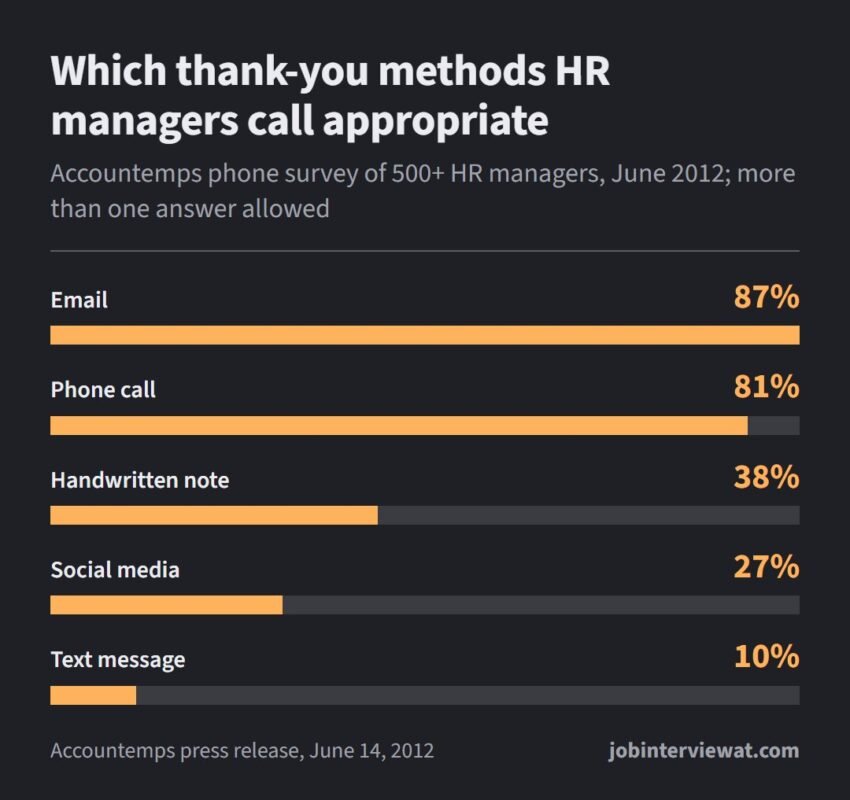
The same survey asked which methods were appropriate. Email led at 87%, a phone call reached 81%, a handwritten note 38%, and a text message only 10%. The survey was done by phone, it asked HR managers rather than every hiring manager, and it measured attitudes, not who got hired. Treat it as a sign of what employers expect, not as proof of an effect.
Recent accounts from recruiters still split. In an October 2026 r/recruitinghell discussion, one recruiter said some older hiring managers will pass on a strong candidate who sends nothing, and described a case where the email reversed that call within an hour:
“I’ve literally had a HM tell me to pass on a candidate in a really difficult search since they didn’t send one. I called the candidate and asked them to send one. An hour later that same HM emailed me back saying they changed their mind and wanted to move forward w offer approval.”
– r/recruitinghell, October 2026
The same recruiter added that when they hire, they personally don’t care. Another commenter warned that a typo can cost you more than a missing email. Both points are fair, so proofread the name and the job title twice.
My view comes from ten years as a corporate interviewer, including nearly three at Walmart, where I helped introduce a new interview score sheet. Most of my scoring was done before any email arrived. What a thank-you could still change was a close call between two candidates, and the one with a specific note was easier to remember.
Thank you email after interview FAQ
Can I send a thank-you text instead of an email?
Only if the interviewer has been texting you already. In the 2012 Accountemps survey, just 10% of HR managers called a text an appropriate way to say thanks, against 87% for email.
Is a handwritten thank-you note better than an email?
A handwritten note can follow the email, but it shouldn’t replace it, since mail arrives days later. If you want to send one, email first and mail the card the same day.
Is it too soon to send it the same day?
No, sending it a few hours after the interview is fine. Wait until you’ve left the building and written down the details, so the note mentions something real. If you need a few minutes to remember who said what, take them.
Should I use AI to write my thank-you email?
You can use it to fix grammar, but write the detail line yourself. “Don’t use AI” was the first advice in that October 2026 recruiter discussion, and a generic AI paragraph is exactly the “thank you for your time” email recruiters say they ignore.
If you have nothing specific to add, a two-sentence thanks with the job title still beats silence, and the check-in comes later as a different email.