

Ask for a raise in a scheduled meeting, with a number ready. That single habit separates asks that get approved from asks that get a shrug: you book fifteen minutes, you say the rate you want, and you back it with evidence your manager can repeat to whoever signs off.
Most advice on this subject assumes a salaried office job with an annual review cycle. If you run a register, stock shelves, or close a kitchen, the mechanics are different.
Your raise is measured in dollars per hour, your manager may not control the budget, and the review that was supposed to trigger a bump may never arrive. Everything below on how to ask for a raise is built for that job, not for a corner office.
When to Ask (and When to Wait)
The best time to ask for a raise is right after visible proof of value: a strong review, added duties, or a documented market gap. The worst time is when your manager is cornered, swamped, or already saying no to the schedule. Four moments give an ask genuine weight:
- Right after a strong review or a visible win. Your value is already on record; you’re converting praise into pay.
- When you’ve taken on lead-type duties without the title. Opening or closing alone, training new hires, holding keys, running the floor when the manager is off. If that sounds like your week, compare your workload against typical shift lead responsibilities. Doing that job at base pay is the strongest raise case an hourly worker can hold.
- When nearby postings list more than you make. Chains publish their rates, and job boards show what the location across the road pays for your exact role. Pay drifts up for new hires while loyal staff sit still.
- At your work anniversary. A clean, natural opening, and one managers expect.
Which weeks should you sit out? Don’t ask right after a write-up, during a hiring freeze your manager has already named, or in the middle of an inventory count. And never spring it at close while your manager is counting a drawer. An ambushed manager gives whatever answer ends the conversation fastest, and that answer is no.
How Much Should You Ask For?
A workable raise ask at most hourly jobs is $1 to $2 an hour, which on a $15 to $18 wage works out to roughly 6 to 12 percent. Salaried workers frame the same request in percent, usually mid single digits unless the job has genuinely changed.
Dollars beat percentages for hourly asks for a practical reason: your manager approves rates, not ratios. “Seventeen fifty” is a number they can take to a district call. And what does a dollar an hour actually buy? On full-time hours, about $2,000 a year before taxes.
For scale, Mercer’s 2026 compensation planning survey found employers delivered a mean merit increase of 3.2 percent early in the year, and Mercer puts retail and wholesale among the lowest budgets at about 3 percent.
That’s the number you get for standing still. A 3 percent bump keeps your pay level with the budget everyone gets; it does not reward anything you did. Asking above it is not greedy, it’s the whole point of asking.
Is 20 percent a lot? Inside the same job at the same company, yes. Jumps that size almost always ride on a promotion, a title change, or a competing offer in hand. Ask for 20 percent with none of those and you hand your manager an easy no.
| Your situation | A workable ask |
|---|---|
| Solid year, same duties | 3 to 5 percent (about 50 to 75 cents on a $16 wage) |
| Lead-type duties added, no title change | $1 to $2 an hour |
| Paid under nearby postings for the same role | The posted rate, with the posting in hand |
| New title or promotion | Negotiate it as a new job, often 10 percent or more |
Build the Case Before You Say a Word
Your case rests on three kinds of evidence, and none of them is effort. Joyce Russell, an organizational psychologist at the University of Maryland’s Smith School of Business, is blunt about why: “Nobody cares about your needs,” she says; what moves a pay decision is the market for your position and what you bring to it. Rent going up is not a case. These are:
- Duties added since your rate was set. Name them with dates. Training new hires, closing solo, handling vendor deliveries, covering the lead’s days off.
- A reliability record. Attendance, covered call-outs, holiday shifts worked. Managers pay to keep people who show up, because half the schedule’s pain comes from people who don’t.
- Market rates from published sources. Big employers post starting pay, so check what Walmart’s starting pay or Costco’s starting pay looks like in your state, or what Chick-fil-A pays by role, and screenshot two or three local postings for your exact job.
The difference shows in one sentence. Not this: “I’ve been here two years and I work really hard.” Say this: “Since March I’ve opened twice a week, trained three new hires, and covered every call-out I was asked to. Postings for my role nearby list a dollar above my rate.” The first sentence describes everyone on the schedule. The second describes a person who is expensive to replace.
Write the three items on a card and bring it.
How to Ask for a Raise Face to Face
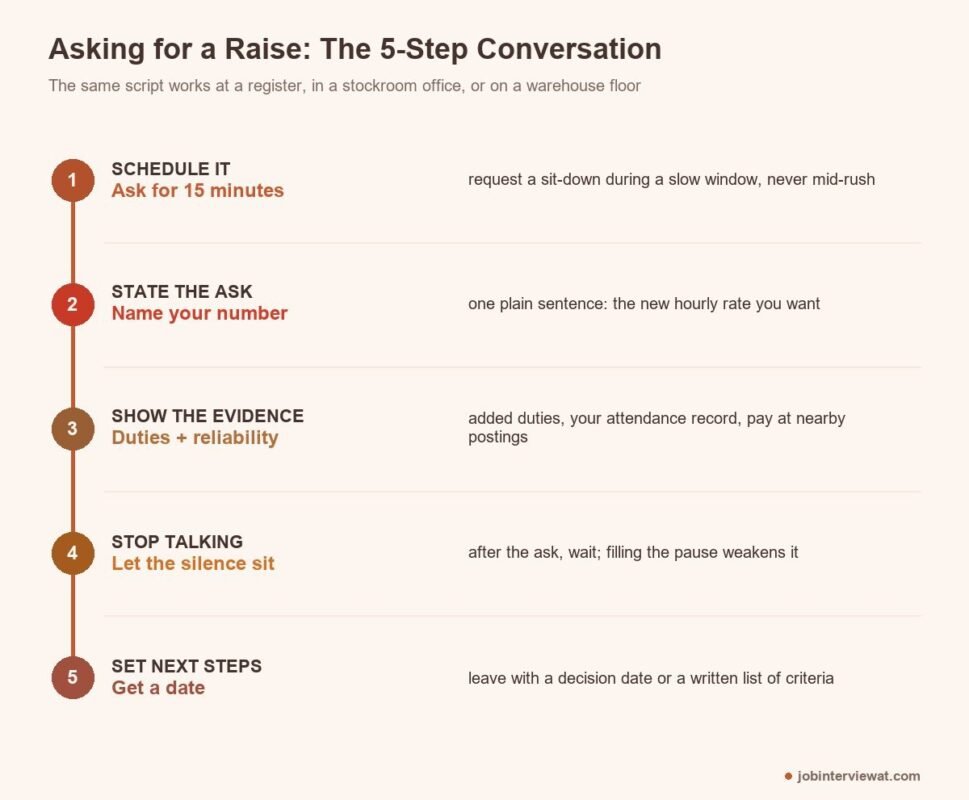
Asking for a raise face to face takes about ten minutes done well: schedule the meeting, state your number in one sentence, give three pieces of evidence, hold the silence, and leave with a date or written criteria. Each of the five steps has one job.
Step 1: Schedule it
“Do you have fifteen minutes this week? I’d like to talk about my pay.” Why name the subject up front? Because it lets your manager check the budget before you sit down, which makes a yes possible in the room.
Step 2: State the ask in one sentence
“I’m asking to move from $16 to $17.50 an hour.” No wind-up, no apology. One commenter on r/careerguidance put the same move in plainer clothes:
“Hey I’ve been here for xyz amount of time I’ve noticed the avg salary/ pay rate is higher than my current rate and I was really hoping to maybe close that gap a bit? Is there a way we can sit down and discuss this? Thanks -you”
– r/careerguidance, January 2026 (3 upvotes)
Step 3: Give the evidence
Three items, thirty seconds each: the duties you’ve added, your reliability record, the market rates you printed. Stop at three. A longer list dilutes the two facts your manager will actually repeat upward.
Step 4: Let the silence work
After the number, stop talking. The urge to soften it with “but I totally understand if it’s not possible” is strong, and it gives the raise away before your manager has said a word. Silence here isn’t rude; it’s the question mark doing its job.
Step 5: Set next steps
A yes gets an effective date: which paycheck. A maybe gets a date to reconvene. A no gets a written list of what would change the answer. You leave with one of those three things or the conversation never ends.
Asking for a Raise in an Email
When does an email beat asking in person? When your manager splits time across locations, when you rarely overlap on shifts, or when you want the request on record. Keep it under 120 words; the email books the meeting and frames it, and the meeting does the deciding.
Subject: Request to discuss my pay
Hi [Manager’s name],
I’d like to set up 15 minutes to talk about my hourly rate. Since [month], I’ve taken on [specific duties], and I haven’t missed a scheduled shift in [period]. Postings for [role] nearby are listing [$X] an hour. I’m asking to move from [$current] to [$target], and I’d rather walk you through it in person than over email.
Could we find a time this week or next?
Thanks,
[Your name]
The letter version is the same text printed, dated, and signed, handed over in person where email isn’t the culture of the place. It reads more formal than a raise ask usually needs, so treat it as a fallback. Whichever format you use, keep a copy; it becomes your receipt when follow-up time comes.
What Your Manager Can Actually Approve
At most chains, hourly rates live inside pay bands set above store level. Managers answering these threads on r/askmanagers describe two kinds of employers: ones that fund raises when your scope grows, and ones that only move when pushed. In both, a manager can often move you within the posted band on their own authority, while anything past the band cap, or off the review calendar, reportedly needs district or HR sign-off.
So a hesitant answer may mean “not mine to give,” not “no.” Ask directly: “Is this a decision you can make, or does it go above you?” It tells you who you’re actually negotiating with.
If the Answer Is No
Turn the no into a spec. Russell’s suggested probe is a nonconfrontational “Can you help me understand why this is a problem?”, and from there you want two things in writing: the specific bar to clear, and the date you’ll revisit. “Take the Tuesday close and hold it for a quarter” is a plan. “We’ll see at review time” is a brush-off wearing a plan’s clothes.
A no can still pay you in other currency: more hours, better shifts, a schedule that fits your second job, cross-training that raises your rate later. If money is frozen above your manager’s head, hours usually aren’t, and moving from 24 to 32 hours a week does more for your paycheck than the raise you asked for would have.
Name the alternative you want out loud rather than waiting for it to be offered, because a manager relieved to escape the money question will often say yes to the substitute. Any of those beats leaving empty-handed.
Then watch what happens next, because the pattern matters more than the answer. One r/careerguidance commenter drew the line that most people draw too late:
“You were supposed to have been informed in any adjustments in your salary during or shortly after an annual review. If you’ve had multiple reviews without an adjustment, expect there will never be an adjustment and start looking for other opportunities.”
– r/careerguidance, January 2026 (5 upvotes)
And if the criteria never arrive, or the revisit date slips twice? Your raise lives at a different employer. Start preparing quietly: refresh your answers to the most common interview questions, and let the market run the negotiation your manager declined to have.
Common Questions
How do you politely ask for a raise?
Request a scheduled meeting, name your number in one sentence, and support it with duties added, your reliability record, and local market rates. Politeness comes from the process: no ambush, no ultimatum, and a genuine willingness to hear the criteria if the answer is no.
Is a 20% raise too much to ask for?
Within the same role at the same employer, a 20 percent ask usually is too much: merit budgets ran about 3 percent in retail in Mercer’s 2026 survey. That size of jump normally requires a promotion, a title change, or a competing offer to carry it.
How do I ask for a raise in an email?
Send a brief note asking for a 15-minute meeting about your hourly rate, with one line each on added duties, reliability, and nearby posted rates, and the number you want. Use the email to book and frame the conversation, then make the case in person.
What should you not say when asking for a raise?
Leave out personal expenses, comparisons to named coworkers, and threats to quit that you won’t back up. Rent and car payments are invisible to a pay band, coworker comparisons drag a third party into your case, and a bluffed ultimatum invites your manager to call it.