

A salary negotiation email thanks them for the offer, names one number, gives one reason for it, and asks one question they can answer by reply. Send it before you accept, as a reply on the same thread, and keep it to four short paragraphs.
Clever phrasing isn’t needed. The recruiter reading your note often has to carry it to someone else for approval, so the easier it is to forward, the better. Below are the five lines every version needs, a table that matches your situation to a template, and six emails to paste and edit.
The five lines every salary negotiation email needs
Word it in five lines: thank them, give one number, give one reason, ask one question, and set a next step. Keep the tone warm and the request plain, and put the number in the second paragraph where it can’t be missed.
Nerves are normal. A Salary.com survey of nearly 2,000 people, published in 2012, found that 37 percent always negotiate salary after a job offer and 44 percent do it occasionally. Just over 18 percent never do, and 48 percent said they always feel apprehensive about it. Writing the ask down buys time to choose each word.
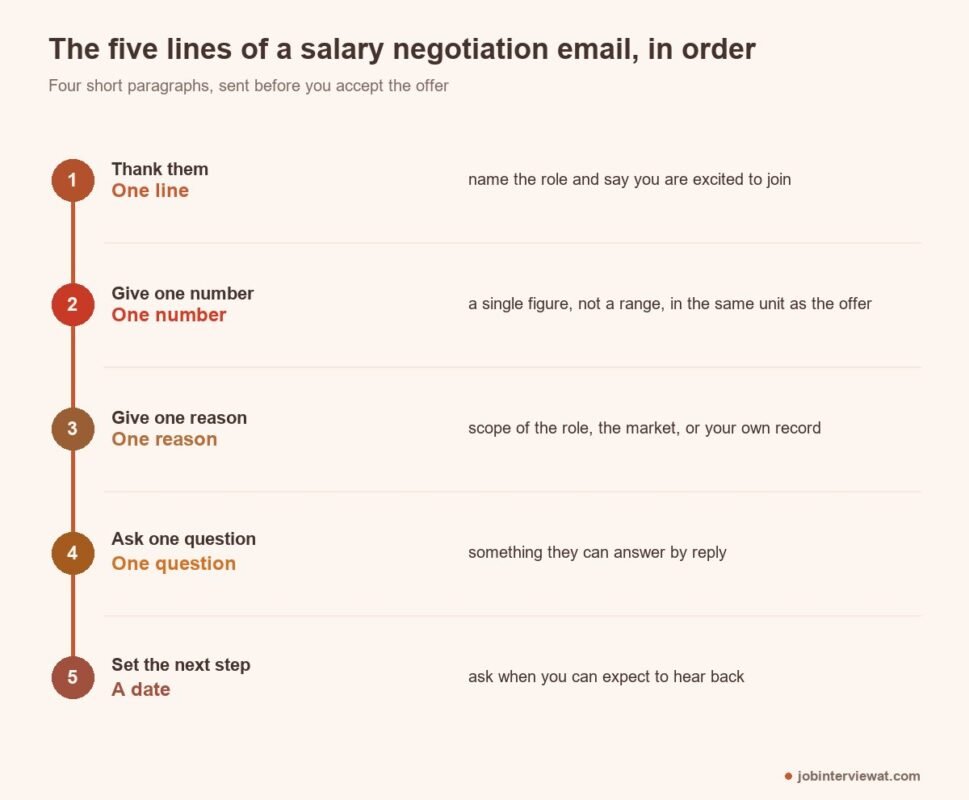
Start with one line of thanks that names the role and says you want the job. Skip the speech. If a thank-you email after the interview already went out, this isn’t a repeat. It’s a reply to the offer.
Give one number in the second paragraph, in the same unit the offer used. I wouldn’t send a range, because a range hands them the bottom of it and the low figure quietly becomes your ask. If the offer was hourly, run both sides through the hourly to salary calculator first so your figure and theirs sit side by side.
Then give one reason. Pick the one that’s easiest to verify: the scope of the role, a market rate with a named source, or something already on your record that matches the posting. Rent and bills may be true, but they give the recruiter nothing to carry to an approver.
Close with one question and a date. “Is there room to move the base to [number]?” gets a yes or a no. “Let me know your thoughts” gets a delay. A date for your decision, or for their reply, keeps the whole exchange from drifting.
Which template fits your situation
Pick the row that matches where you are right now, then use that template. Each row shows what to ask for and the one thing to leave out, so the salary negotiation email carries a single clear request.
| Your situation | Template | What you ask for | Leave out |
|---|---|---|---|
| The offer is fair but a bit low | Counter after the first offer | One base figure above the offer | Your monthly bills |
| The offer lands under the range you gave them | Offer below the range you gave | A figure inside your own range | A brand new, higher range |
| You hold a second offer | You hold a competing offer | Your number, plus a reply date | Any hint of an ultimatum |
| They say the base is fixed | Pay is fixed, so ask for something else | One or two named items | A long wish list |
| You said yes out loud and the letter is coming | You said yes out loud | The base, asked once | Any second or third request |
| They already said no | They said no and you want one more ask | Something written into the offer | A promise to “review later” with no number |
None of these fit a raise at a current job. For hourly pay, the steps are in how to ask for a raise when you’re paid by the hour.
Six templates you can copy
Square brackets mark your details. Replace every one, and delete any line that doesn’t apply.
Counter after the first offer
Use this when the offer is reasonable and there are grounds for a higher base. Start here if none of the other five rows fits.
Subject: Re: [Job title] offer
Hi [Name],
Thank you for the offer for the [job title] role. I’m excited about joining [Company] and working with [team or manager].
Before I accept, I’d like to talk about the base salary. Based on [the scope of the role, market data for this role in your city, or your experience with a named skill], I was hoping for [number]. Is there room to move the offer to that figure?
If that works, I can confirm my acceptance by [date].
Thanks again for your time on this.
[Your name]
Offer below the range you gave
When a recruiter asked for a range early and the offer lands under it, pointing back to that range isn’t moving the goalposts. A reply in an r/careerguidance thread made the same point to a poster who had given a range at the start and received an offer below it. Start from the earlier number.
Subject: Re: [Job title] offer
Hi [Name],
Thank you for sending the offer for [job title]. I’m still very interested in the role.
When we first spoke, I shared a target of [your range]. The offer of [their number] sits below that, and I’d like to close the gap. A base of [a number inside your range] would let me accept with confidence.
Is that possible?
[Your name]
You hold a competing offer
Use this only if the other offer is real. A recruiter may ask who it’s from, and a bluff can cost the job you actually want. State the facts and leave the pressure out of it.
Subject: Re: [Job title] offer
Hi [Name],
Thank you again for the offer. [Company] is my first choice, and I’d like to make this work.
I’ve received another offer with a base of [number]. I’d prefer to join you, and [your number] on the base would let me decline it. Is that something you can approve?
I plan to decide by [date], so a reply before then would help.
[Your name]
Pay is fixed, so ask for something else
When the recruiter says the base is set for the level, move to one or two named items. A sign-on payment, extra paid days off, a later start date or a dated pay step are all fair asks. Pick only the ones worth taking, because a long list gives them more to refuse.
Subject: Re: [Job title] offer
Hi [Name],
Thanks for explaining how the base is set. I understand it’s fixed for this level, and I’m still keen to join.
Could we look at [one specific item, such as a sign-on payment, extra paid days off, or a later start date]? That would help me accept.
If it’s possible, please tell me what you need from me to move it forward.
[Your name]
You said yes out loud and the letter is on its way
The window narrows once a call has ended in agreement. One HR-side reply in an r/jobs thread described the two moments when negotiating normally happens, and said email is the better way to ask afterward.
“speaking from the HR side of things— normally the negotiating stage is in one of two forms; during the interview stage (mostly near the end) or when they verbally provide you the offer. sounds like you said yes on the phone and they were drafting the letter. now, i always advocate for more pay and in this scenario i think it’s okay to either call or email (prefer this) looking to get a higher pay that is something you’re looking for. but be careful if you go too far high the hiring manager migh…” [excerpt — 784 characters in full]
– r/jobs, September 2026 (6 upvotes)
I’d ask once, about the base only, and be ready to hear no. Anything beyond one request risks the goodwill already built.
Subject: Re: [Job title] offer letter
Hi [Name],
Thank you for the offer letter. I’m looking forward to starting as [job title].
Before I sign, I wanted to ask about one item, the base. After looking at [your reason], I had hoped for [number] instead of [their number]. Is there any flexibility?
If not, I understand, and I’m happy to sign as written by [date].
[Your name]
They said no and you want one more ask
A second request works only if it changes shape. Repeating the same number gets the same answer, so ask for something that can be held in writing today. A promised review later isn’t the same thing, as this reply put it.
“I’d exclude the 6 month review part personally. That gives them an easy out to stand firm and never follow through. A promise of an earlier review isn’t a monetary concession.”
– r/careerguidance, July 2026 (2 upvotes)
Subject: Re: [Job title] offer
Hi [Name],
Thanks for checking, and I appreciate you taking this to [the hiring manager or finance]. I understand the base can’t move.
Would [a sign-on payment or a pay step on a set date] be possible instead? I’d like it written into the offer.
If neither works, I’m ready to accept the offer as it stands.
[Your name]
Send it the right way
Reply on the same thread as the offer, so your salary negotiation email lands right beside the offer letter. The subject line doesn’t need the word “salary”, and the résumé shouldn’t be attached again.

Send it before you accept, and send it once. One email with one ask is easier to approve than three messages that each add a request. I’d also read it aloud before sending, because a clumsy line shows up quickly when spoken.
Keep the thanks inside this email, and skip questions about start date logistics or onboarding. Those can wait for the reply.
If the recruiter calls instead
Sometimes the recruiter picks up the phone before anything is written. Here’s a short exchange to keep nearby. The last line moves the revised terms back to email, where they can be read slowly.
Recruiter: “We’d like to offer you [number]. Does that work for you?”
You: “Thank you, I’m excited about the role. I was hoping for [your number]. Is there any room?”
Recruiter: “Let me see what I can do.”
You: “I’d appreciate that. Could you send the details by email so I can review them?”
After you say your number, stop talking and let them answer.
After you send it
Three replies come back to a salary negotiation email: yes, a smaller yes, or no. A yes needs a one-line confirmation and nothing else. A smaller yes means deciding, calmly, whether the new figure clears your own floor before answering. A no points to the last template above.
If two business days pass with no word, send one short nudge. The wording in a follow-up email after an interview works here once the offer details are swapped in, and there is no need to apologize for asking.
Salary negotiation email FAQ
How do I ask for salary politely in a message?
Thank them, state one number, and finish with a question such as “Is there room to move the base to [number]?” Say the figure once, plainly, in the second paragraph.
Hedges like “I was wondering if maybe” blur the number you’re asking for.
Is it fine to negotiate by email only?
Yes. Email gives the recruiter a clear figure to take to an approver and gives you time to choose your words. If they’d rather talk, use the call exchange above, then ask for the revised offer in writing.