
A resume for a warehouse job should fit on one page and prove three things: you can lift and move product safely, you can work the shifts on offer, and you show up. Equipment, scanners and pick rates come after those three.
That order comes straight from the postings. On November 14, 2026, I read 63 live hourly postings on the FedEx and Amazon careers sites. Not one asked for a resume. Forty-five stated a lifting limit, and 46 asked whether you can work nights, weekends or evenings. A resume for warehouse job openings that answers those questions in the posting’s own words gets read faster than a polished one that doesn’t.
What 63 warehouse postings actually ask for
Shift availability and a lifting limit are the two requirements that appear most often in hourly warehouse postings. In the 63 I read, shift availability came up in 46 and a stated lifting limit in 45, while a resume came up in none.
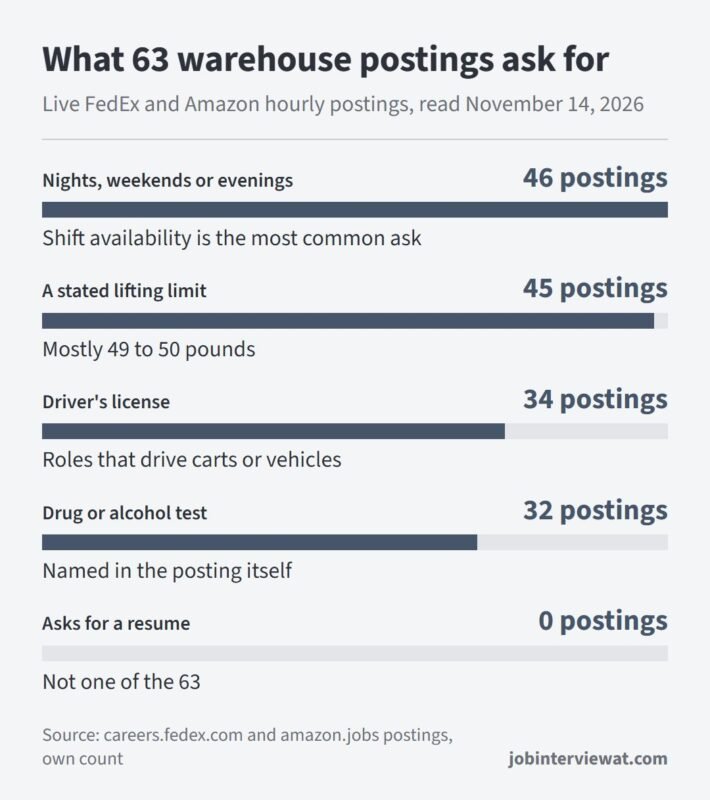
Here’s how the count was made. I pulled 25 FedEx package handler and material handler postings from careers.fedex.com, plus 38 Amazon postings from amazon.jobs: 28 Prime Air Ground Handler roles and 10 Lead Associate roles at Amazon Now sites. Each posting was coded for the words it uses. The sample comes from two employers and two searches, so treat the split as a pattern for big logistics hiring, not a national survey.
The lifting numbers cluster tightly. Amazon’s ground handler postings say “carry/lift up to 50 pounds,” its Lead Associate postings say 49, and four FedEx Material Handler postings say 50 without assistance. Three FedEx Canada seasonal postings go up to 70 pounds, with packages up to 150 moved by equipment.
Look at what the FedEx Material Handler posting lists under qualifications. It reads “Minimum Education None” and “Minimum Experience None.” What it does ask for is a drug screen, a valid driver’s license for the motorized equipment, and “the ability to communicate both timely and effectively, in a noisy operations environment.” That last line is a resume line waiting to be written. Have you worked anywhere loud? Say so.
Pay sits in the postings too. FedEx listed starting wages from $17.70 to $21.75 for package handlers and $20.26 to $27.21 for material handlers. If you want to see what a rate means over a year, the hourly to salary calculator does that math, and the current seasonal hiring list covers who is adding holiday staff.
Do you even need a resume for a warehouse job?
For most hourly warehouse jobs, a resume is optional because the online application asks the screening questions directly. A resume still helps when an employer lets you attach one, when you apply through a staffing agency, or when you walk in.
“I’d scrap the resume for entry level positions. Instead, consider submitting a cover letter along with the application explaining why you’d be a good fit.”
– r/retail, September 2026 (50 upvotes)
Another hiring manager in the same r/retail thread said they only open the resume when an applicant skipped the online form. That matches what I saw screening hourly candidates during my years as a corporate interviewer. The form gets read first. The resume decides close calls, and it’s what you hand over in person. A worker in r/uline described bringing a resume and a completed paper application to a warehouse interview, then taking two four-minute tests. Bring both, and prepare for the questions that follow with the FedEx interview questions guide if FedEx is on your list.
Page order for a resume for warehouse job openings
A warehouse resume reads best in this order: contact details, a two-line summary, skills, work history, training and certifications, then education. One page is enough, even with several years of floor work.
- Contact. Name, phone, email and city. Why the city? A screener calling about an early shift wants to know you live close enough to get there.
- Summary. Two lines that name your shifts, your lifting range and your strongest equipment. Example: “Warehouse associate with two years of overnight picking and loading. Comfortable lifting 50 pounds all shift and running an RF scanner and electric pallet jack.”
- Skills. Six to eight items, each one a thing a posting asks for.
- Work history. Most recent first, three or four bullets per job.
- Training and certifications. Forklift, OSHA courses, first aid, with dates.
- Education. High school diploma or GED is plenty. Amazon’s ground handler and Lead Associate postings list “High school or equivalent.”
Skip the photo, the objective statement and the list of hobbies. If you’re applying to Amazon specifically, the Amazon dress code guide covers what to wear to orientation, which is the next step after the form clears.
Writing the experience bullets
Every bullet should start with a verb and end with a number or a condition the posting cares about. Weight, volume, shift and safety are the four that come up most.
Turning posting language into resume lines
Take a phrase from the posting and answer it with proof. A general description of the job loses to a line that repeats the posting’s own words with proof attached.
- Posting: “lift up to 50 pounds.” Say this: “Loaded and unloaded trailers with cases up to 50 lbs for full 10-hour shifts.” Not this: “Hard worker who can handle physical tasks.”
- Posting: “scan, process, and count product.” Say this: “Scanned and cycle-counted about 300 locations a week with an RF gun, flagging mismatches to the lead.” Not this: “Responsible for inventory.”
- Posting: “nights, weekends, and holidays.” Say this: “Worked the overnight shift four nights a week, including peak season weekends.” Not this: “Flexible schedule.”
- Posting: “communicate in a noisy operations environment.” Say this: “Called out load counts to the dock lead over conveyor noise.” Not this: “Strong communication skills.”
Only write numbers you can back up. A screener who asks “about 300 locations, how did you track that?” expects a real answer. If you don’t know the figure, describe the scope instead: which area, which shift, what equipment.
Starting without warehouse experience
Never worked in a warehouse? Pull bullets from any job where you stood, lifted, sorted or hit a time target. Retail stocking, restaurant prep, moving furniture and landscaping all count, because the physical demands match. O*NET’s task list for freight, stock and material movers is a good vocabulary source: moving freight to and from storage and loading docks, sorting cargo, and recording the units handled.
The first-job approach in how to make a resume for your first job works here too. Lead with reliability: school attendance, a team sport, a volunteer shift you never missed.
Forklift and equipment lines that hold up
List forklift training by truck type, the employer that trained you and the month you were evaluated. Under OSHA’s powered industrial truck rule, forklift certification is the employer’s own record of training, so a card from a former job doesn’t transfer as-is.
The rule is 29 CFR 1910.178(l). Paragraph (l)(6) says the employer certifies each operator, and the record holds the operator’s name, the date of training, the date of evaluation and who did it. Paragraph (l)(4) requires an evaluation at least once every three years. Paragraph (l)(5) works in your favor. A new employer doesn’t have to repeat training you’ve had, as long as you’re evaluated and found competent on their truck.
So what does “Forklift certified” tell a screener? Very little. Write it like this instead:
- “Sit-down counterbalance and stand-up reach truck, trained and evaluated at a previous site, March 2026.”
- “Electric pallet jack and order picker, daily use for 18 months.”
That wording tells the hiring site you’ll need an evaluation, not a full course, which saves them a training slot. Add the warehouse system you’ve used if you know its name, since a screener recognizes SAP, Manhattan or an in-house scanner system faster than a vague “WMS experience.”
Skills to put on a warehouse resume
Five skills cover most warehouse postings: safe lifting to 50 pounds, RF scanner use, pallet jack or forklift operation, accurate counting, and reliable attendance on nights or weekends. Add the soft skill the posting names, often clear communication on a loud floor.
- Physical: lifting and carrying to a stated weight, standing and walking for 10 to 12 hour shifts, working in cold or hot docks.
- Equipment: RF scanner, electric pallet jack, forklift by class, stretch-wrap machine, box cutter safety.
- Accuracy: picking to a list, cycle counts, damage checks, labeling.
- Safety: lockout awareness, PPE, reporting hazards, any OSHA course with its date.
- Working style: on-time attendance, following a lead’s call-outs, training new hires.
If a drug screen appears in the posting, you don’t put anything about it on the resume. It’s a later step, and the FedEx drug test guide and FedEx orientation walkthrough explain when it happens there.
FAQ
How do I describe Amazon warehouse work on a resume?
Describe Amazon warehouse work by role and process: pick, pack, stow or ship dock, plus your rate if you tracked it and the shift you worked. Name the scanner and equipment you used. Skip internal acronyms a screener at another company won’t know.
What are warehouse duties for a resume?
Common warehouse duties for a resume are loading and unloading trucks, picking and packing orders, scanning and counting inventory, labeling, and keeping aisles clear. Pick the four you did most and add a weight, volume or shift to each.
Is one page enough for a resume for warehouse job openings?
Yes, a resume for a warehouse job should be one page. Hourly screeners read the application form first and the resume second, so a second page rarely earns a look.
Before you send it, put the posting next to your resume and match each requirement to a line. If the posting says 50 pounds and nights, those two words belong near the top. Then print a copy for the interview, because some sites still hand you a paper form at the door.