

An employee engagement survey can reveal that people are unhappy with communication from senior leadership. A performance management system can show that managers have completed their scheduled reviews. Both provide useful information, but neither proves that employees feel heard, supported, or motivated in their work.
This is an important distinction for organizations investing in HR technology. Software can collect opinions, document goals, organize feedback, and help managers identify concerns. Whether those capabilities improve the employee experience depends on how the organization uses them.
Employee engagement and performance management also involve different responsibilities. Engagement programs seek to understand how people experience their work, including their relationships with managers, confidence in leadership, and opportunities to contribute. Performance management focuses on expectations, feedback, development, and the assessment of individual contributions. These activities can inform each other, but combining them without a clear purpose may create confusion about how employee information will be used.
For HR leaders researching software, the challenge is to identify systems that support the organization's approach rather than allow a vendor's feature list to define it.
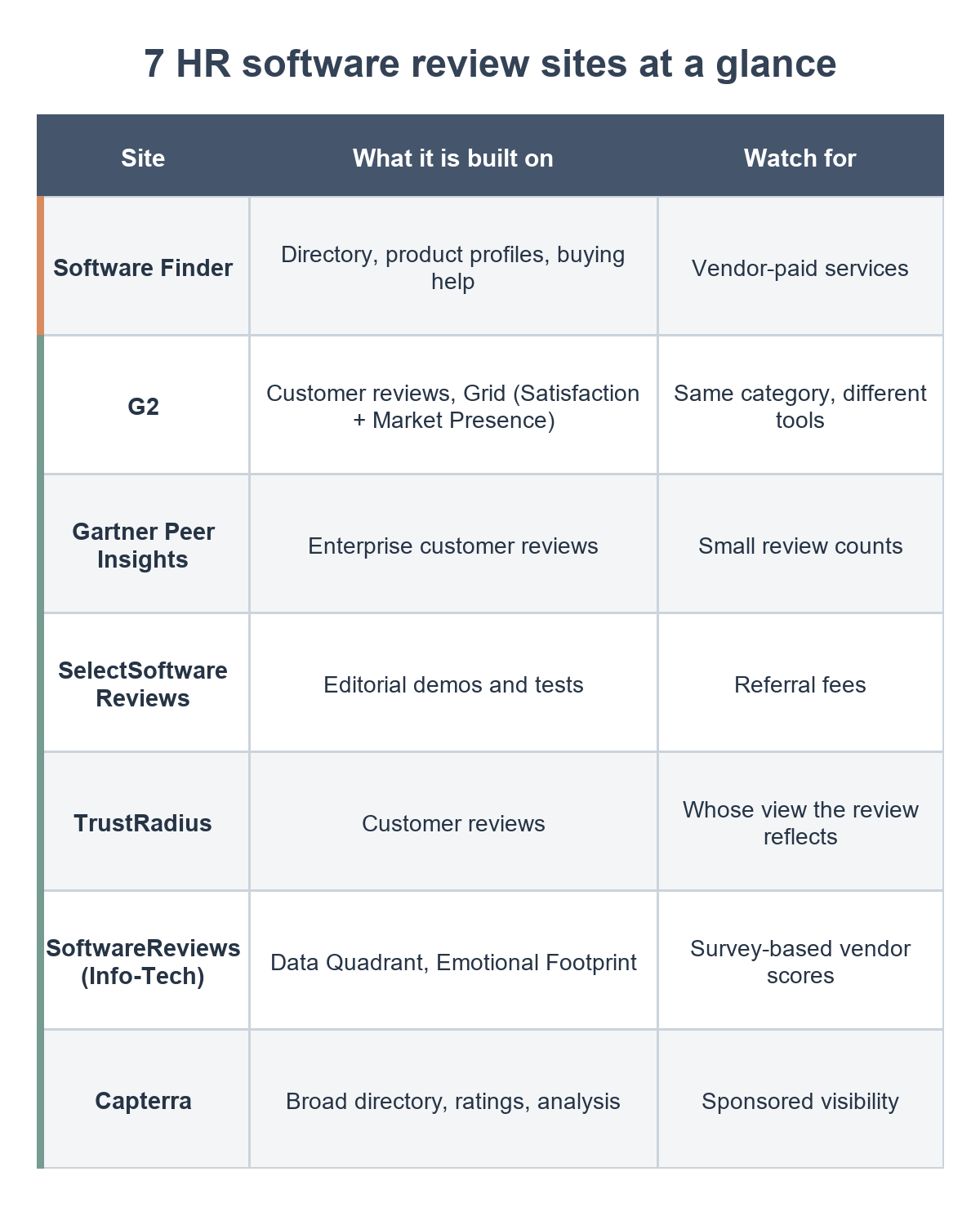
The seven software review platforms below provide different perspectives on employee engagement, performance management, and human capital management (HCM) technology. Some offer broad product directories and customer ratings. Others provide specialist HR evaluations, enterprise research, or detailed information about vendor relationships.
Understanding those differences helps organizations make better use of software reviews while keeping the needs of employees and managers at the center of the decision.
How We Selected These Review Platforms
We considered seven software research platforms based on their coverage of employee engagement, performance management, and related HCM applications.
The selection draws on publicly available product directories, customer review resources, published evaluation methodologies, and information about how the platforms organize HR software categories. It does not represent independent testing of every product listed on these websites.
Four considerations guided the selection:
- Relevant HR software coverage: Each platform provides research on employee engagement, performance management, or closely related workforce applications.
- Depth of information: We looked for useful product descriptions, customer experiences, specialist assessments, or comparisons that help explain differences between software options.
- Transparency: Published information about review methods, rankings, editorial processes, and commercial relationships was considered.
- Usefulness for purchasing decisions: The resources should help HR teams investigate practical concerns such as usability, reporting, implementation, employee feedback, and vendor support.
The platforms are presented as different research resources rather than ranked according to a single numerical score. Software Finder appears first, followed by other platforms with distinct approaches to HR software research.
1. Software Finder
Software Finder provides software directories, product profiles, customer reviews, comparisons, and purchasing assistance across business technology categories, including human resources.
Its HR coverage includes dedicated directories for employee engagement software and performance management software.
The engagement directory covers applications associated with employee surveys, feedback, recognition, and workplace communication. Its performance management coverage addresses software used for reviews, goal tracking, and employee development.
These directories offer a practical way to investigate different approaches to improving the employee experience without assuming that every organization needs a comprehensive HCM suite.
For example, an employer may already have a reliable system for maintaining employee records but lack an effective process for collecting feedback. Purchasing a separate engagement application could address that requirement without replacing its existing HR software.
Another company may have an established survey program but struggle to conduct consistent performance reviews. In that case, a performance management application may deserve closer attention than additional survey tools.
Software Finder provides individual product information that can help distinguish these requirements. Its listings include products such as Lattice, 15Five, WeThrive, and Engagedly, which offer different combinations of performance management, employee feedback, and engagement capabilities.
The product profiles provide information about functions, customer experiences, and pricing arrangements where available. Software Finder also offers purchasing assistance for organizations seeking help identifying suitable applications.
A useful way to approach the directory is to compare products against the work the organization expects people to perform. An employee listening program may require confidential surveys and departmental reporting. A performance management process may depend on configurable review cycles, development goals, and accessible records of manager conversations.
Those requirements should guide the research before product ratings or promotional descriptions influence the shortlist.
Software Finder operates commercial services for software vendors, so buyers should distinguish sponsored visibility from customer feedback and verify important product details directly with suppliers.
Its main value is providing an accessible starting point for researching different HR software categories and identifying products that warrant closer examination.
2. G2
G2 is useful when HR teams want to examine the overlap between employee engagement and performance management applications.
The platform maintains separate Employee Engagement and Performance Management categories. It also identifies related product themes, including performance management applications with engagement capabilities.
This structure reflects an important feature of the market: software categories are increasingly interconnected, even though the management processes they support remain distinct.
Lattice, Leapsome, Culture Amp, 15Five, and PerformYard are among the products appearing in relevant G2 categories or themes. Their capabilities vary, and buyers should not assume that appearing in the same category means they offer equivalent functionality.
An organization looking for performance review software may want configurable evaluations, goal tracking, and regular manager feedback. Another employer may need employee surveys, recognition, or tools for understanding workplace sentiment.
A product offering both sets of capabilities could be appropriate, but only if the organization intends to use them together.
G2 provides customer reviews, product comparisons, and Grid reports. Its Grid methodology considers customer Satisfaction and Market Presence, helping readers understand how products are positioned within a software category.
The platform also allows buyers to examine reviews associated with different company sizes.
This can be useful when assessing the administrative demands of HR software. A small organization may value straightforward setup and minimal ongoing configuration. A large employer may require complex permissions, multiple review cycles, and reporting across departments or locations.
Reviews from organizations with similar operating conditions can help identify concerns that a general rating might obscure.
G2's category themes also provide a way to investigate products that connect engagement and performance functions. However, organizations should establish their own boundaries for using employee information.
For instance, survey responses intended to assess workplace culture should not automatically become evidence in individual performance evaluations. Employees need to understand what information is collected, who can access it, and how it will be used.
G2 can help buyers investigate available capabilities and customer experiences. The decisions about how engagement and performance information should interact remain the responsibility of the employer.
3. Gartner Peer Insights
An organization conducting employee surveys across several countries faces challenges that may never arise in a smaller workplace.
Survey questions may need to be adapted for different languages and working environments. Results may require analysis by department, location, or employee group. Managers need information relevant to their responsibilities, while senior leaders need a broader understanding of organizational trends.
Throughout the process, the employer must protect confidential responses and avoid reporting practices that could identify individual employees.
Gartner Peer Insights provides customer reviews of enterprise technology, including a category called Voice of the Employee Solutions.
Gartner defines these solutions as technologies that collect and analyze employee opinions, perceptions, and feelings through surveys and other feedback sources.
Its market definition covers employee listening surveys, benchmarking, analysis, reporting, and recommendations intended to help organizations respond to findings. Products listed in the category include offerings from Qualtrics, Culture Amp, Perceptyx, and Quantum Workplace.
The emphasis on analysis and organizational action makes this category relevant to employers developing a structured employee listening program.
A basic survey application may collect responses effectively. An enterprise listening platform may also need to support different survey types, analyze trends, manage reporting permissions, and help leaders identify areas requiring attention.
Customer reviews on Gartner Peer Insights can provide information about implementation, administration, reporting, and the experience of using these products within larger organizations.
However, review volume should be considered carefully. Some products in specialized enterprise categories have relatively few published ratings. A high average score based on a small number of reviews should not be treated as conclusive evidence of superior performance.
Buyers should also distinguish Gartner Peer Insights customer reviews from Gartner's analyst research. They are different resources with different methodologies.
The Voice of the Employee category is especially useful for organizations that need to examine the infrastructure behind a formal listening program, including the challenge of converting employee feedback into information that managers can act upon.
4. SelectSoftware Reviews
SelectSoftware Reviews approaches HR software through specialist editorial research rather than relying solely on customer ratings.
Its buying guides cover employee engagement software and performance management systems, with assessments of product capabilities, limitations, pricing considerations, and suitability for different organizational needs.
The website reports that its team has conducted demonstrations of over 80 employee engagement products during the preceding five years and tested more than 40 platforms. Its published criteria emphasize ease of use, anonymity, reporting, analytics, and automation.
Those criteria address concerns that can be overlooked when buyers concentrate on the number of features available.
An employee survey platform may offer extensive reporting, but employees must still be willing to participate. If the interface is confusing or the confidentiality arrangements are unclear, sophisticated analytics will have limited value.
Similarly, a performance management system may provide detailed review templates and goal tracking, but managers must be able to use those functions without turning ordinary feedback conversations into an administrative burden.
SelectSoftware Reviews examines products such as WorkTango, Assembly, Leapsome, Betterworks, and other specialist HR applications across its relevant guides.
Its evaluations can help buyers understand whether a product concentrates on surveys, recognition, performance conversations, or a combination of functions.
The distinction is important for organizations that have already identified a workplace problem.
If employees report that their contributions are rarely acknowledged, a recognition program may be worth investigating. If managers struggle to provide timely feedback, a performance management application may be the better starting point. Neither solution should be selected simply because it appears in a broad employee engagement category.
SelectSoftware Reviews discloses that it is supported by readers and may earn fees through certain referral links. That commercial arrangement should be considered when interpreting recommendations.
Its specialist editorial coverage is useful for understanding the practical differences between HR products before evaluating individual vendors in detail.
5. TrustRadius
A customer review of employee engagement software often reflects the experience of an HR administrator or manager. That perspective is valuable, but it does not necessarily represent the experience of employees who complete surveys or participate in performance reviews.
TrustRadius provides customer reviews and product research across business software markets, including employee engagement and employee performance management.
The platform allows buyers to investigate how customers describe software functionality, administration, implementation, and everyday use.
For employee engagement applications, relevant feedback may address survey creation, reporting, recognition, and the process of collecting employee opinions.
Performance management reviews may discuss goal tracking, review cycles, manager feedback, and the administrative work associated with evaluations.
The most useful reviews explain the circumstances behind an opinion.
A manager may praise a performance system for making review deadlines easier to track. An HR administrator may appreciate its reporting features. Employees, however, may still find the review process difficult to understand or believe that feedback has little influence on their development.
These experiences can coexist because different users interact with the same software for different reasons.
Organizations should therefore examine whose perspective is represented in a review and whether that person's responsibilities resemble those of the intended users.
TrustRadius states that its employee performance management category rankings are based on customer reviews and profile completeness, without paid placement or analyst opinions determining product order.
Understanding that methodology helps buyers interpret the listings, but the quality of individual evidence remains important.
A review that describes a specific implementation difficulty or reporting limitation may be more useful than a brief positive comment without supporting detail.
TrustRadius is a valuable source for investigating operational experiences, especially when buyers want to understand how software performs after implementation rather than rely entirely on vendor demonstrations.
6. SoftwareReviews
Software functionality is only one part of an HR technology investment. The relationship with the vendor can become equally important when an organization needs to modify its processes, expand the system, or resolve problems affecting employee data.
SoftwareReviews, part of Info-Tech Research Group, publishes customer research across business technology categories, including Employee Engagement and performance management.
Its employee engagement coverage includes functions such as surveys, benchmarking, analytics, action planning, and recognition.
The platform's Data Quadrant research uses customer feedback to assess product features, vendor capabilities, relationships, and overall satisfaction. Its methodology also accounts for review volume and recency.
SoftwareReviews separately publishes Emotional Footprint research, which examines customer perceptions of the vendor relationship and experience.
These measures can be relevant when HR software is expected to support processes that evolve over several years.
An organization may begin with annual engagement surveys and later introduce pulse surveys or additional reporting requirements. Its performance management process may change as managers adopt new approaches to goal setting, coaching, or employee development.
The software needs to accommodate these changes, and the employer may depend on the vendor for configuration guidance, technical assistance, or integration support.
Customer research about vendor responsiveness and service quality can help identify concerns worth examining during procurement.
However, survey based scores should not replace direct verification of support arrangements. Employers still need to establish what assistance is included, how technical problems are handled, and which responsibilities belong to the vendor or the internal HR technology team.
SoftwareReviews provides a useful perspective for organizations making substantial investments where implementation, ongoing administration, and vendor relationships are important considerations.
7. Capterra
Capterra offers a broad employee engagement software directory containing customer ratings, product information, feature comparisons, and pricing details where available.
Its coverage includes applications for employee recognition, surveys, feedback, communication, and other workforce activities.
This breadth is useful for discovering software options, although it also creates a challenge: products within the same category may be designed for very different purposes.
An employee recognition application may help organizations acknowledge contributions and administer rewards. A survey platform may concentrate on collecting confidential feedback. A performance management system may focus on reviews, goals, and development.
All can contribute to aspects of the employee experience, but they should not be evaluated as interchangeable products.
Capterra's directory provides feature information that can help buyers narrow their research. Customer ratings address areas such as ease of use, customer service, functionality, and value.
The website also publishes editorial software comparisons. Its September 2026 employee engagement analysis examined 801 verified customer reviews from a defined two year period and selected products for different requirements, including recognition, anonymous feedback, and continuous pulse surveys.
That research illustrates why software comparisons benefit from distinguishing the intended purpose of each application.
Pricing is another consideration. Some engagement products charge according to the number of employees, while others use subscription tiers, project fees, or customized quotations. Recognition programs may also involve separate reward expenses.
Published prices should therefore be treated as preliminary information rather than a complete estimate of program costs.
Capterra includes sponsored product visibility within its marketplace. Buyers should distinguish promotional placement from customer ratings and editorial analysis.
For employers exploring a relatively narrow requirement, such as recognition or survey administration, Capterra offers a way to identify specialist applications without beginning with a comprehensive HCM purchase.
What HR Software Review Sites Can’t Tell You
Every site above can tell you what a product does and how its buyers rated it. None of them can tell you whether your employees will trust the survey, or whether your managers will act on what it finds. Those two things decide whether the purchase pays off, and there’s real evidence on both.
Confidentiality decides whether people answer honestly
Employees judge a survey by how small the reporting groups are, not by the word “anonymous” in the invitation. In a June 2026 r/auscorp thread asking whether people answer engagement surveys honestly, the most upvoted reply described that exact failure:
“I was honest on my last one, because they assured us that it was anonymous. Was a bit shook when the results came out and they said our managers said they could see the answers and responses down to department level, when our department at the time had 4 people in it…”
– r/auscorp, June 2026 (87 upvotes)
A manager further down the same thread said their employer only releases results once at least five people respond. That’s the setting to ask about. Culture Amp’s support guide calls it a “reporting group minimum,” and results for groups below it are hidden. Its recommended default goes a step further: when a report includes a group of one, the next-smallest group is hidden too, so a single answer can’t be worked out by subtraction.
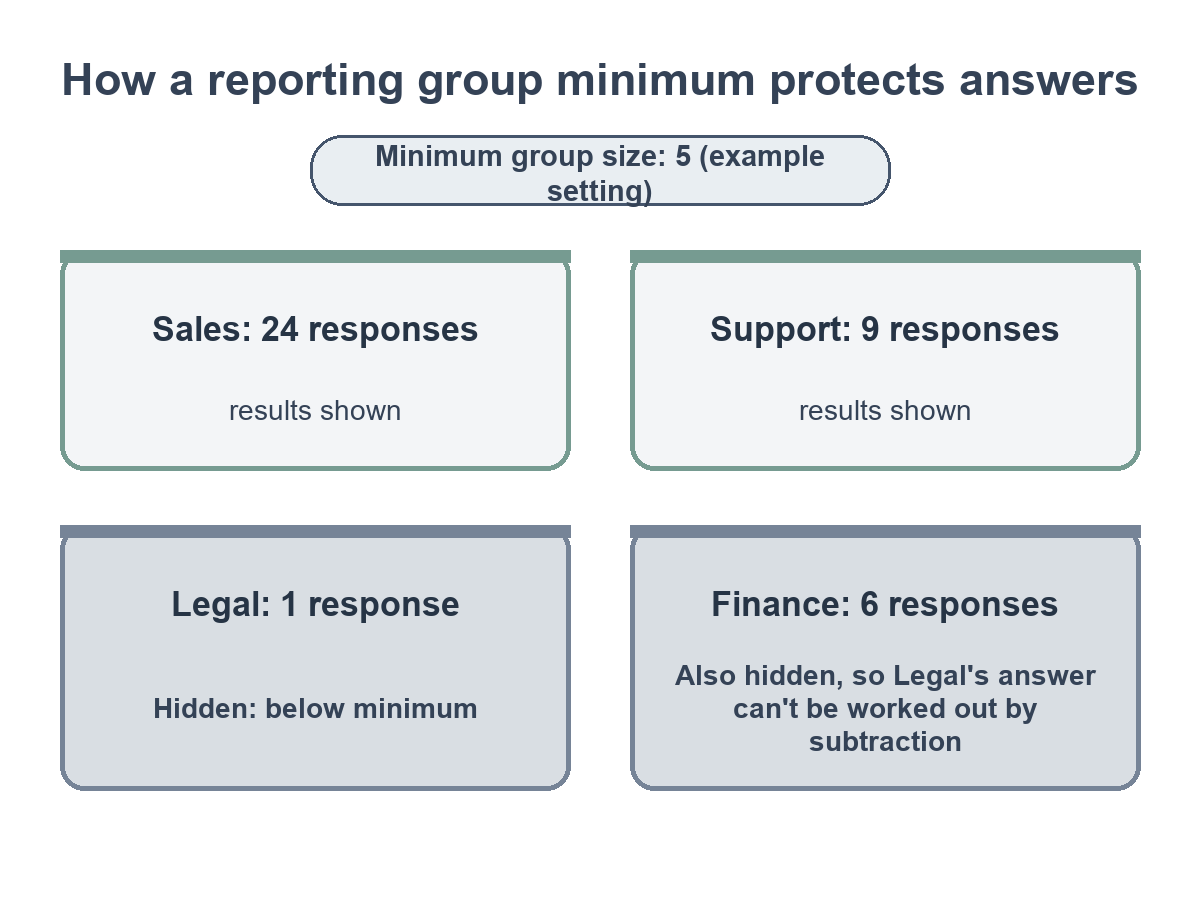
Software reviews rarely mention these settings, so you’ll have to ask. In every demo, check three things: the minimum group size, whether an admin can lower it, and whether open comments are held to the same minimum. A vendor that can’t answer quickly hasn’t thought much about the thing your employees care about most.
Acting on the results matters more than the survey
Gallup measured this years ago. In an August 2006 Gallup Business Journal article, its researchers sorted workgroups by how strongly they agreed that “action plans from the last survey have had a positive impact on my workplace.” Groups in the top quartile raised their engagement scores by an average of 10%. Groups in the bottom quartile saw their scores fall by an average of 3%.
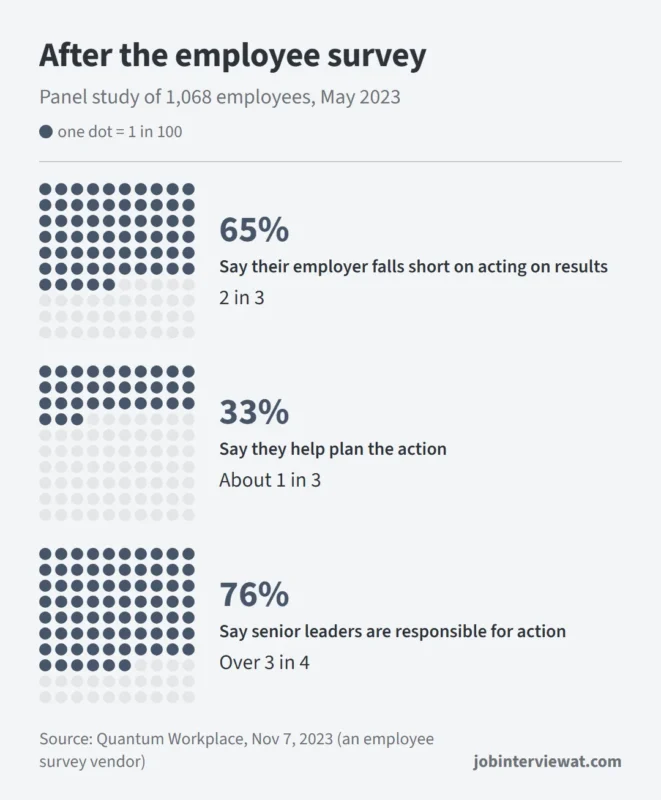
Newer numbers suggest most employers still miss that step. In a May 2023 panel study of 1,068 employees, Quantum Workplace found that 2 in 3 believe their organization falls short in acting on survey results. Only 1 in 3 said they’re involved in planning the action. Quantum Workplace sells survey software, so it has a stake in the answer. Still, the pattern matches what employees describe on their own.
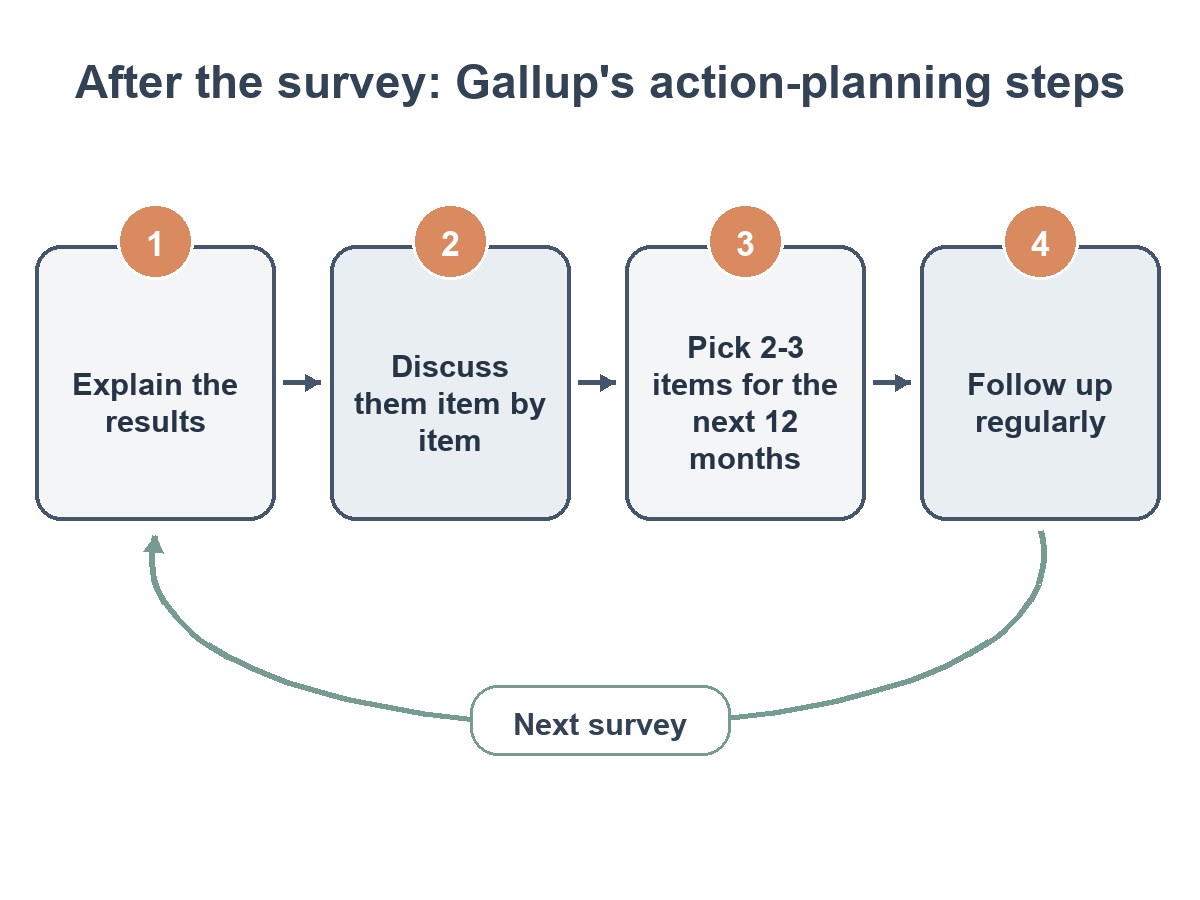
What does acting on results look like? Gallup’s 2006 article lays out a plain sequence for managers: explain the results, discuss them item by item, pick two or three items to work on over the next 12 months, then follow up regularly. Quantum Workplace named lack of time, resources and prioritization as the biggest barriers. Its advice was to pick fewer items, brainstorm actions with employees and report progress often.
Wording can matter too. In an October 2026 r/ChiefsOfStaff thread about annual survey results arriving too late, one commenter described a small change that worked for their team:
“One thing that helped us was framing it explicitly as ‘we want your specific improvement ideas’ not ‘we want your feedback.’ Feedback is vague but ideas are specific and actionable. That single language change doubled the quality of what people submitted.”
– r/ChiefsOfStaff, October 2026
That’s one team’s account, not a study. But it costs nothing to test. When you read reviews of listening tools, look for comments on action planning, idea routing and progress updates, not just survey design.
A performance tool won’t train your managers
Performance software records goals, check-ins and reviews. It doesn’t make the conversations any better. In a May 2026 r/humanresources thread comparing Lattice and Culture Amp, an HR professional at a 140-person company liked Lattice’s performance and compensation tools, then named the gap that was left:
“We’re working on increasing adoption of employee development tools, but that’s also a manager development opportunity. We need more manager training.”
– r/humanresources, May 2026
That’s a useful filter when you read reviews. If a reviewer says adoption is low, check whether they blame the product or their managers’ habits. Then keep one rule whichever tool you pick: answers from a confidential engagement survey shouldn’t feed anyone’s individual performance review. Employees need to know what’s collected, who can see it and how it’s used.
When an Integrated HCM System Makes Sense
Many employers already run an HCM system for employee records, org structure and other HR work. Before buying a separate engagement or performance tool, check what that system already includes. An integrated module can cut duplicate data entry, and changes to reporting lines flow through without manual updates.
But having a module isn’t the same as having the right one. A specialist listening platform may offer better survey analysis, benchmarking or confidentiality controls. A dedicated performance product may handle review cycles, goals and development plans with more flexibility. Compare what’s actually available, including extra licensing, implementation and integration costs.
| Organizational need | What to examine |
|---|---|
| Employee listening across multiple locations | Survey access, language support, reporting permissions and confidentiality controls |
| Regular performance conversations | Review flexibility, goal tracking, feedback records and manager usability |
| Employee recognition | Recognition methods, participation, reward administration and program costs |
| Integration with existing HR records | Data synchronization, access management and administrative responsibilities |
| Long-term program development | Configuration options, reporting flexibility, vendor support and contract terms |
Factor in who will run the system, too. A specialist product may be stronger in one area but need more integration work. An HCM module may be easier to maintain but offer fewer options. Test both with demos built on your real processes, not a count of features.
Interviewing for an HR Role? Expect Questions on These Tools
If you’re applying for an HR generalist, HRIS or people-operations job, this topic can come up in the interview itself. Gusto’s published list of HR generalist interview questions includes these four:
- “How do you support employee engagement and retention initiatives?”
- “How do you measure the success of HR initiatives, such as training programs or employee engagement activities?”
- “What steps do you take to ensure confidentiality when handling sensitive employee information?”
- “What’s your experience with implementing or updating HRIS systems?”
A feature list won’t answer any of them. The interviewer wants to hear the problem, the choice and the result, in that order. So start with what the tool was meant to fix, like frontline staff skipping the survey or reviews that kept slipping. Say how you chose it: which review sites you read, and whether you filtered reviews by company size. Mention a confidentiality setting you used, such as a minimum group size. Then finish with what changed after the survey and how employees heard about it.
Example answer (rework it around your own experience): “At my last job, our engagement survey went out by email, and warehouse staff barely answered. I compared two survey tools, read reviews from companies our size, and we picked one that could send surveys by text and held results until five people in a group had replied. After the next survey, we shared the top three issues within a month and posted progress every quarter. I measured success by whether those issues came up less the following year, not only by the response rate.”
For more on what hiring teams look for in these jobs, see our guide to what HR departments expect when hiring for people-focused careers. If the role leans on data, our piece on how HR analytics can help you hire smarter covers the metrics side.
Keeping Employee Experience at the Center of the Decision
Review sites and specialist research help HR teams find products, compare what they do and spot implementation problems early. That’s the first half of the decision. The second half is whether the organization will protect people’s answers, act on what it learns and train managers to use the tool well.
Start with the employee experience you want to improve. Then judge each product by how well it supports that work, rather than letting its feature list decide what matters.