

The Home Depot assessment test is a 53-question screener. It appears during the online application for hourly store and distribution center roles, mixes workplace scenarios with agree-or-disagree statements, and the careers site gives you 96 hours to finish once you start.
Skip the hunt for an answer key. The questionnaire scores four traits and compares your answers against each other, so a copied list of “correct” choices produces exactly the too-perfect pattern that screening systems are tuned to catch. Understanding the four traits and a few answering rules gets you further.
There is also a fact the answer-key pages leave out: many applicants never receive the assessment at all.
What the Home Depot Assessment Test Covers
Home Depot’s official assessment page lays out the format: 53 questions, entirely text-based, with no sound or video required. Most items ask you to rate your agreement with statements about how you work, and the questions map to four areas.
| Trait | What Home Depot says it measures |
|---|---|
| Professional Experience | Your work or school history |
| Customer Focus | How you would treat customers in a retail setting |
| Responsibility | Whether you complete tasks reliably and on time |
| Learning Potential | Your willingness to pick up new things |
Two logistics details matter more than they look. You have 96 hours from the moment you start, and you can stop and restart as many times as you like inside that window, so nobody needs to finish in one nervous sitting. And one set of responses counts toward multiple hourly roles, including Store, MET, and distribution center positions, which means you are not asked to retake it for every application.
The published sample questions show the tone. One reads, “When we ask your most recent manager, how quickly will they say you respond to customer requests?” Another describes a manager creating a new policy you think will slow down your work and asks what you would most likely do.
Who Actually Receives the Assessment
Not every applicant sees the test, and this is where most of the confusion online comes from. Applicants on r/HomeDepot describe applying to several part-time roles and checking the careers portal for days, waiting for an assessment that never appears. Current employees in the same threads explain that the invitation goes out by email only when you land in the qualified pool for a specific opening.
“I got an email saying Id be selected if I met qualifications. Nothing about an assessment though.”
– r/HomeDepot (1 upvote)
The format is in flux too. Employees on r/HomeDepot recently described a pilot version of the assessment being handed to people who already work there, framed as voluntary, to help screen future hires. So the version you get may differ from the one a friend took a year earlier.
If no assessment shows up, your application is still alive. On Indeed’s company FAQ, a Home Depot department supervisor answered the exact worry directly: being told you did not have to take the test does not mean you were rejected. Some hires go straight from application to a phone call.
The Question Types, With Worked Examples
Customer scenarios
These put you mid-task and interrupt you with a person. A typical setup: you are stocking shelves on a deadline and a frustrated customer walks toward you. The options range from finishing your aisle first to stopping immediately.
Work it through from the store’s point of view. Freight can wait ten minutes; a customer who feels ignored leaves and tells people. The strong answer stops, greets the customer, either solves the problem or walks them to a teammate who can, and then goes back to the shelves. Any option that has you completing the task while a person waits is the classic disqualifier on retail screeners, and applicant write-ups of this test say the same thing.
Manager-reference and honesty items
Several items open with “When we ask your most recent manager…” and then ask how that manager would rate your speed, professionalism, or reliability. The framing is deliberate. It presumes your claims could be checked, which pressures you toward the rating your boss would honestly give rather than the flattering one.
Answer these as your manager on an average Tuesday, not your manager writing a retirement toast. If you rate yourself top-of-scale on every reference item and then hesitate on a scenario about staying late to help a customer, the mismatch is visible. Applicants without work history can substitute a teacher, coach, or project lead, and the official page says so explicitly.
Work-style agree-disagree items
The bulk of the 53 questions are statements you rate on an agreement scale: how you approach a new task, whether you double-check work, how you react when a policy annoys you. The same underlying trait gets probed several times in different wording.
That repetition is the test inside the test. Decide who you are before you start, a dependable person who likes helping people and follows rules even when they seem slow, and answer every rephrased version as that same person. Contradicting yourself across items reads worse than any single humble answer.
Three Rules That Decide Your Score
Everything applicants report about passing reduces to three habits. First, customer first: whenever a scenario forces a choice between a task and a person, help the person. Second, consistency: repeated items exist to compare against each other, so a stable, honest self-portrait beats a heroic but contradictory one. Third, commitment: on agree-disagree scales, pick the strong end you actually believe. A column of middle-of-the-scale answers looks evasive, and situational-judgment screeners across retail treat neutrality as a non-answer.
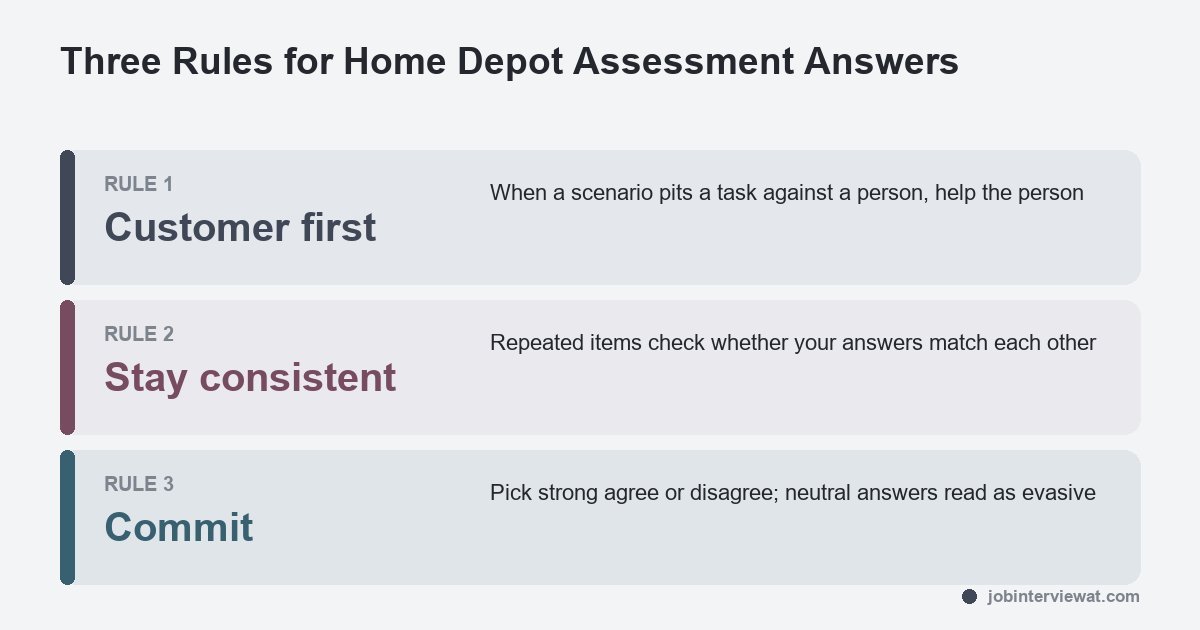
Notice what is missing from the list: product knowledge. Nothing in the questionnaire asks you to name a drill bit. Familiarity with home improvement helps in the interview, but the screener is measuring temperament.
What a Fail Looks Like, and the Retake Question
Home Depot never sends a score. A fail usually looks like silence: the application status changes to no longer under consideration, or nothing happens while other applicants get interview calls. The pilot thread on r/HomeDepot included one darkly funny data point about how sharp the cut can be.
“I took it. Supposed to help screen and hire new people. Based off my answers I won’t be hired at HD. Too bad I already work there.”
– r/HomeDepot, November 2025 (10 upvotes)
On retakes, separate two things. Within a single attempt, the 96-hour stop-and-restart window is official and generous. A second attempt after a weak result is murkier: Home Depot publishes no retake window, and because one response set covers multiple hourly roles, a poor sitting can follow you across applications for a while. Treat the first attempt as the one that counts.
After the Assessment, the Interview Decides
Clearing the screener earns you a phone call or an in-store interview, and that conversation carries more weight than the questionnaire ever did. The interview probes the same four traits out loud, with a manager watching how you actually talk about customers. The Home Depot interview questions guide walks through the questions applicants report most and how to build answers for them, so move your preparation time there once the assessment is submitted.
Two screening facts to know before you apply. Home Depot hires at 18 and up, so age gets checked before any test appears. And the assessment measures temperament, not your record; background checks happen later in the process, and the jobs that hire felons guide covers how big-box retailers tend to handle criminal records at that stage.
If you are applying to several chains at once, the Walmart assessment test follows the same situational-judgment logic, so one honest prep session covers both applications.
FAQ
Does Home Depot still have an assessment test?
Home Depot still documents a 53-question online assessment for hourly store and distribution center roles on its careers site. It is sent selectively, though, so many applicants finish an application and never see one, and current employees confirm that skipping it does not mean rejection.
How do I pass the Home Depot assessment?
Passing the Home Depot assessment test comes down to choosing the customer in every scenario, answering repeated items consistently, and committing to strong agree or disagree ratings instead of neutral ones. Rate the manager-reference questions the way your actual boss would, because inflated self-ratings clash with scenario answers.
Can you retake the Home Depot assessment?
Home Depot publishes no retake policy for a completed assessment. Once you start, you can stop and restart freely for 96 hours, and one finished response set covers multiple hourly roles, so a genuinely fresh attempt generally means waiting and submitting a new application.
How long does the Home Depot assessment take?
Applicants report finishing the 53 questions in roughly 20 to 30 minutes. Nothing is timed per question, and the 96-hour completion window means you can split it across sittings if you need to.