

CVS employee benefits depend on your hours, and the posting says which set applies. We opened 177 CVS Health postings on November 12, 2026. The 110 full-time ones list medical, dental, vision, paid time off and retirement savings. The 67 part-time ones list dental, vision, wellness resources and employee discounts, and name no medical coverage at all.
Those postings cover 127 locations in 30 states, from store associate and beauty consultant to pharmacy technician and shift supervisor. Every one of them sends you to the same place for detail, a portal called Benefits Moments, and our count comes from reading all 177.
What the CVS benefits page lists
Start with the official version. The CVS Health careers site lists ten core items: competitive pay, medical, dental and vision coverage, tuition assistance, supplemental health plans, life and disability insurance, a 401(k) savings plan, an employee stock purchase plan, paid time off and paid parental leave.
Two of those come with real numbers. “Eligible colleagues enjoy 30% off CVS Health store brands and 20% off other non-sale items,” the page says, and confidential counseling runs 20 sessions per issue at no cost. Virtual primary, acute and mental health care sit alongside it.
The education line is where CVS spends more than most retailers do. Tuition reimbursement covers degree and non-degree programs, a partnership with Career Online High School gets you an accredited diploma for free, and colleagues’ children can apply for an annual college scholarship.
Which of those ten apply to you? It depends on your program, your hours and, in a union store, your contract.
Then come the caveats, and you should read them twice. “Eligibility and coverage effective dates may vary by program.” If a union contract covers your store, that agreement sets eligibility instead of the page. Neither line says what you personally get, so our next stop was the postings themselves.
What the 177 postings actually promise
So which version is in your posting? All 177 carry a benefits paragraph, and CVS writes it in two shapes.
The full-time one promises “a comprehensive benefits package designed to support the physical, emotional, and financial well-being of colleagues and their families,” then names medical, dental and vision coverage, paid time off, retirement savings options, wellness programs “and other resources, based on eligibility.”
The part-time version is shorter and quietly different. It offers “a range of benefits and programs,” and the list runs dental, vision, wellness resources, employee discounts, “access to certain voluntary benefits, and other programs.” Eligibility there rides on “hours worked.” Medical isn’t in that sentence.
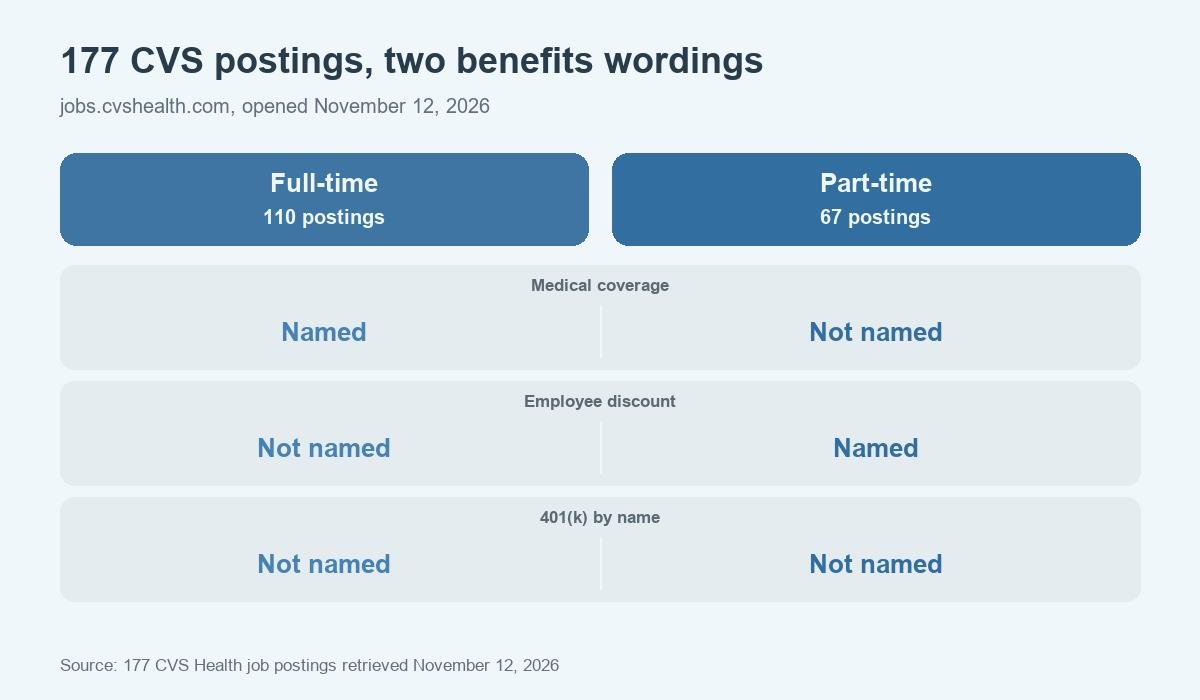
Two silences are worth knowing before an interview.
None of the 177 postings writes “401(k),” even though the benefits page lists a 401(k) savings plan; the wording stops at “retirement savings options.” And no posting gives a discount figure, though 71 of them mention a discount in some form.
Method: we read each description, its stated pay range and its anticipated weekly hours, then counted the benefit terms by hand. It’s a snapshot of open roles on one day, not a census, and a thin posting can still sit on a full package.
The two wordings, though, are CVS’s own.
Part-time is where the line falls
Part-time is the split that changes your answer. In 54 of the 67 part-time postings, CVS states anticipated weekly hours between 12 and 29. The full-time ones sit at 40 hours, with a few at 45.
That 29-hour ceiling matters because of a federal rule. Under the Affordable Care Act, an employer with at least 50 full-time employees has to offer minimum essential coverage to anyone averaging 30 hours a week or more, as HealthCare.gov defines the term. A posting that tops out at 29 hours sits just under it.
So what does a part-time offer actually include? You can count on dental, vision, the store discount and the wellness programs. Don’t treat medical coverage as an assumption, and ask before you accept. If a union contract covers your store, that document may answer it differently.
Where does that leave you if you want medical coverage? Ask the recruiter which plans your hours qualify for, and get the answer in writing.
Get your scheduled hours in writing too, and don’t rely on a verbal promise. A part-time role that drifts toward 30 hours can change what you qualify for, and the posting you applied to won’t be rewritten when it does.

What the pay range says
Pay is the part CVS publishes in full, and it doesn’t come with benefits attached. All 177 postings carry the line “The typical pay range for this role is,” followed by two dollar figures, plus a note that the range covers “all positions in the job grade” and that the offer depends on experience and geography.
| Role | Postings opened | Median range in those postings |
|---|---|---|
| Store Associate | 37 | $16.90 – $22.30 |
| Beauty Sales Consultant | 26 | $19.00 – $28.00 |
| Pharmacy Technician | 19 | $16.50 – $25.00 |
| Shift Supervisor | 9 | $17.30 – $24.00 |
Store Associate shows the spread you’d expect. The postings we opened reported starting points from $15.00 to $20.11, and the median posting reported $16.90 to $22.30.
Why the spread? Location moves that range more than the title does, so two associates in the same role can be advertised a few dollars apart, and there’s no way to tell from the title alone. Benefits sit outside the number, which is why a higher hourly rate without medical and a lower one with it are closer than they look. Run the math on your real hours before you compare rates.
Where your real numbers live
Benefits Moments is where the actual menus live, and every posting points there. It’s behind a colleague login, so ask the recruiter for the printed summary instead: plan tiers, the cost per paycheck and the hours each program requires.
There are four things worth asking before you accept, and none of them needs a benefits textbook to answer:
- Which plans your scheduled hours qualify you for.
- When coverage begins after your start date.
- What the 401(k) match is, since no public page states one.
- Whether the store discount applies to sale items, because the benefits page gives that rate two ways.
Bonuses are the other line CVS doesn’t spell out. Fifteen of the 177 postings say the role “is eligible for a CVS Health bonus, commission or short-term incentive program,” and they’re mostly pharmacist, nurse and corporate positions. None of the 37 Store Associate postings carries that sentence.
“Hourly FT employees are no longer eligible for HSA.”
– r/CVS, November 2026 (10 upvotes)
That thread is colleagues comparing 2027 coverage, and it’s the clearest sign the menu shifts year to year. CVS hasn’t published the health savings account change, so take it as a colleague report and confirm it at enrollment. If you’re still deciding whether the store is worth applying to, our CVS interview questions page covers the job tryout that comes after the application.
CVS employee benefits FAQ
Do part-time CVS employees get medical insurance?
None of the 67 part-time postings we opened names medical coverage in its benefits sentence, so you can’t read it as a promise. They promise dental, vision, wellness resources, employee discounts and access to some voluntary benefits, “depending on hours worked and eligibility.” Ask about medical for your own store and your scheduled hours instead of assuming either way.
Does CVS match 401(k) contributions?
CVS confirms a 401(k) savings plan exists and doesn’t go further. No match percentage appears on the benefits page or in any of the 177 postings, which use the phrase “retirement savings options.” Ask HR for the match formula and the vesting schedule, so you’re not guessing before you build a budget.
How much PTO does CVS give?
CVS doesn’t publish a vacation figure. Postings promise paid time off without stating hours, and colleagues on r/CVS report vacation accruing after six months of service. Some states also require paid sick leave on top of whatever the company grants, so check your own state’s rule.
Does CVS Health give bonuses to employees?
Fifteen of the 177 postings we opened carry a bonus, commission or incentive line, mostly pharmacist, nurse and corporate roles. None of the Store Associate postings does. If a bonus matters to you, ask whether your role has one and what it’s measured on.
What is the CVS employee discount?
The benefits page says eligible colleagues get 30% off CVS Health store brands and 20% off other non-sale items. Elsewhere on the same page it reads “up to 30% on most non-prescription items,” so expect exclusions by category. For a look at how a flat retail version of the same perk works, see our Target employee discount breakdown.