

The Amazon assessment test changes with the role you chose. A warehouse applicant, a marketing manager, and a software engineer all hear the same phrase from Amazon, yet they sit through three very different screenings, and one of them may sit through none at all. So which screening are you actually walking into?
That’s the mismatch to settle before you spend a weekend on practice questions. Most prep sites describe one giant exam because a scary exam sells prep packs, but that one-size exam doesn’t exist. Amazon itself, on its official assessments page, treats assessments as a role-dependent step with tips, logistics, and what follows them.
One boundary first: the online tests around your application are the subject here. The behavioral interview that comes later runs on different fuel, and our Amazon Leadership Principles questions guide handles that stage separately.
Which Amazon assessment test will you get?
Your track decides the test. Hourly warehouse applicants often get little beyond the application itself, corporate applicants get the Work Style Assessment and often a Work Sample Simulation, and technical or managerial tracks get role-specific exams on top.
| Track | What you face | Reported length | What it screens |
|---|---|---|---|
| Warehouse / fulfillment (hourly) | Application steps, sometimes a short virtual job preview | Minutes, when it appears | Availability, basic fit, willingness to follow procedure |
| Corporate / office | Work Style Assessment, often plus Work Sample Simulation | About 15 min; simulation about 50 min | Personality against the Leadership Principles; workplace judgment |
| Area Manager / Operations | Multi-module manager assessment | Varies by module set | Metrics reading, prioritization, team decisions |
| Maintenance technician | Ramsay-style mechanical and electrical exam | About 2.5 hours | Print reading, electrical theory, control circuits |
| Software engineer (SDE) | Coding OA plus Work Style sections | Varies; applicants report about 90 min of coding | Data structures, problem solving, LP alignment |
The timing figures are applicant- and vendor-reported; Amazon doesn’t publish them. JobTestPrep, a test-prep vendor, puts the Work Style Assessment at about 15 minutes and the Work Simulation at around 50, and lists the maintenance exam at 75 multiple-choice questions over roughly 2.5 hours. Treat every number as a planning estimate, because Amazon adjusts formats and doesn’t announce the changes.
How do you know which one landed on you? The invitation email names the assessment, and that email outranks every prep-site syllabus.
If the email doesn’t name a test and you applied hourly, there’s probably no scored test waiting.
Warehouse and hourly jobs: less test, more tightening
Is there an assessment for Amazon warehouse jobs at all? For years the honest answer was that the “test” barely existed. Many people on r/AmazonFC describe picking a shift, confirming they can lift and stand, watching a short job preview, and getting a start date. Some sites added a brief sorting-style task or scenario questions; plenty of applicants report seeing no scored assessment at all.
If you were bracing for a math-and-logic gauntlet before a packing job, relax; there isn’t one at most sites. Nobody fails their way out of a fulfillment center offer because they forgot algebra.
Recent threads complicate the easy version, though. Applicants now describe a longer funnel with recorded responses and tougher screening than the old click-through flow, and one of those reports deserves quoting at full strength:
“You’re not going to find any legitimate responses on here because the average employee is too dumb to think critically about your question. Amazon has increased the difficulty of the initial interview assessment(s) in an effort to curb hiring. AI is now a huge part of it, along with your recorded verbal responses and a more stringent personality test. It is easier to get rejected and more difficult to get hired. They do not hire “anyone with a pulse.” Expect a lot more people to fail. Failing d…” (excerpt — 941 characters in full)
– r/AmazonFC, August 2026 (7 upvotes)
That’s one worker’s take, and others in the same thread shrug that the questions are basic math and that hiring stayed loose. The fair conclusion sits in the middle. Hourly hiring is still the lightest screening Amazon runs, but the days of a ten-minute application are fading at some sites, so give the process an honest hour and answer the scenario questions with the customer in mind.
Walmart runs the opposite play, screening warehouse and store applicants with a scored personality test, which is why our Walmart assessment test guide looks so different from this section.
Hourly screening leans on the background check far more than on any quiz. If your record is the part you’re worried about, our guide to jobs that hire felons covers how Amazon’s warehouse screening treats past convictions.
Corporate roles: Work Style Assessment and Work Sample Simulation
Office and professional applicants meet the two assessments Amazon documents most openly. The Work Style Assessment is a personality measure built on the company’s 16 Leadership Principles, and the Work Sample Simulation drops you into a fake workday of emails, chats, charts, and decisions.
A Work Style pair, worked through
The Work Style format pairs two statements and asks which is more like you. A typical pair looks like this:
- Statement A: “I openly acknowledge when a colleague’s help made my work better.”
- Statement B: “I prefer to solve problems on my own before involving anyone.”
Which would you choose? Neither answer’s wrong on its face. But JobTestPrep’s worked example for a near-identical pair maps both statements to the principle Earn Trust, noting that Amazon favors people who are vocally self-critical and who credit help publicly, so leaning toward statement A matches the culture the test was built to detect.
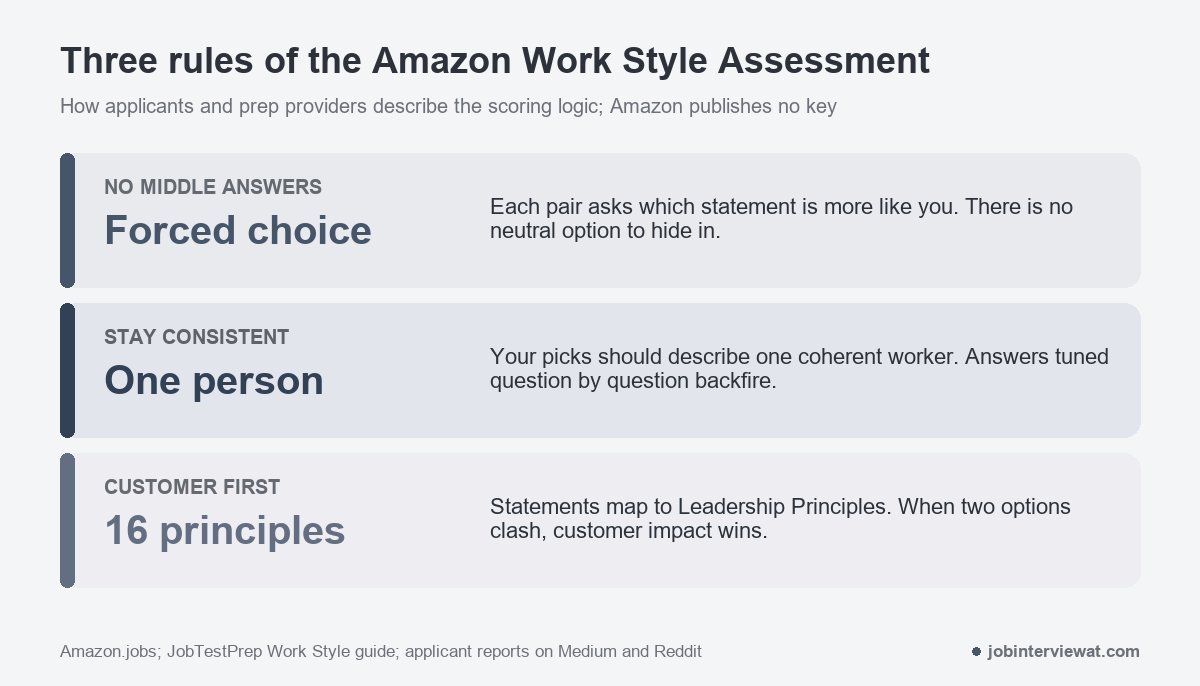
Three rules govern the whole exercise. There’s no neutral option, so every pair forces a lean. Your answers should describe one coherent worker, because a profile tuned answer-by-answer contradicts itself. And when two decent options clash, the one serving the customer or the team wins, since the scoring frame is the Leadership Principles, not general niceness.
A simulation scenario, worked through
The Work Sample Simulation runs closer to a role-play than a quiz. JobTestPrep’s sample scenario opens with a colleague’s document containing a metrics error that could misstate customer costs, then asks you to rate responses such as “email Samuel about the specific issue and cc the team lead” from ineffective to highly effective.
Notice what the scenario is really weighing. Flagging the error protects the customer, naming it specifically respects the colleague, and looping in the lead shows ownership without drama. Rate the responses like someone who cares whether the customer gets overcharged, and the simulation mostly scores itself.
One applicant detail worth keeping: Laura Mitchell, writing on Medium about her Amazon screening, described a 90-minute technical section followed immediately by the personality test, walked out convinced she’d failed both, and passed.
Her advice for the personality portion was to answer quickly and honestly because gaming it tends to backfire. Fatigue is baked into the format, so don’t schedule the assessment at the end of a long day.
Area Manager, maintenance tech, and SDE tracks
Manager applicants get the widest battery. JobTestPrep describes Area Manager candidates facing modules called Working With the Team, Working With Metrics, Work Style, and Work Experiences, with Operations and Pathways candidates adding a planning module. The metrics module is the one to respect: its sample question hands you a five-month product sales table and asks which product belongs on the homepage, which is pure careful-reading under time pressure.
Maintenance technicians face the most technical exam in the family. It’s a Ramsay Corporation-style mechanical test, and JobTestPrep lists it at 75 multiple-choice questions over about 2.5 hours, spanning print reading, electrical theory, control circuits, power tools, and preventive maintenance. If you haven’t touched ladder logic since trade school, this is the one track where paid practice arguably earns its fee.
Software engineers get the coding OA, generally hosted on platforms like HackerRank, with two coding problems plus Work Style sections for interns and new grads. The format keeps drifting, too. A recent r/leetcode poster described drawing one data-structures problem and one web-dev problem with an AI assistant, a shape older guides don’t mention, so trust your invitation over any third-party syllabus.
Failing, retakes, and the stage after
Yes, you can fail, and Amazon won’t hand you a score. Rejections after an assessment don’t come with feedback; they tend to arrive as a generic “not moving forward” email, which is why the failure threads on r/AmazonFC run long on guesswork:
“Yes the process has changed a lot the last few years. They are a lot more like applying for a Walmart warehouse now. What used to be a 10 minute process to get a job is now an hour or more.”
– r/AmazonFC, September 2026 (2 upvotes)
Retake windows are the murkiest part of the whole subject. How long until the system lets you try again? Amazon publishes no universal waiting period, and applicant threads disagree on how long the lockout lasts, with the reported window varying by role and by how the previous attempt ended. Plan as if your first sitting is your only sitting for that posting.
Sit once, and sit prepared.
What happens after a pass? Hourly applicants move to background check and a start date. Corporate and technical applicants move to phone screens and interview loops, where the same Leadership Principles come back as behavioral questions with a human interviewer in the room. That interview stage rewards prepared stories over test-taking instinct, and it’s exactly what our Leadership Principles questions guide was written for.
Amazon assessment test FAQ
Does Amazon have an assessment test?
Amazon uses online assessments for many roles, documented on its amazon.jobs assessments page, but there’s no one universal exam. Corporate, manager, technician, and software tracks each get their own format, while many hourly warehouse applicants see no scored test at all.
What is the Amazon Work Style Assessment?
The Work Style Assessment is Amazon’s personality screen: pairs of statements where you choose which is more like you, taking about 15 minutes by prep-vendor estimates. It’s scored against the 16 Leadership Principles, so consistent, customer-first answers matter more than polish.
Is there an assessment for Amazon warehouse jobs?
Many Amazon warehouse applicants get no scored assessment, just application steps and sometimes a short virtual job preview. Recent applicant reports describe some sites adding recorded responses and scenario questions, so budget an hour and don’t rush the questions if they appear.
Can you fail the Amazon assessment?
You can fail any scored Amazon assessment, and rejection arrives without a score or explanation. Amazon doesn’t publish a retake policy, and applicant reports on the lockout period conflict, so treat the first attempt as the one that counts.