

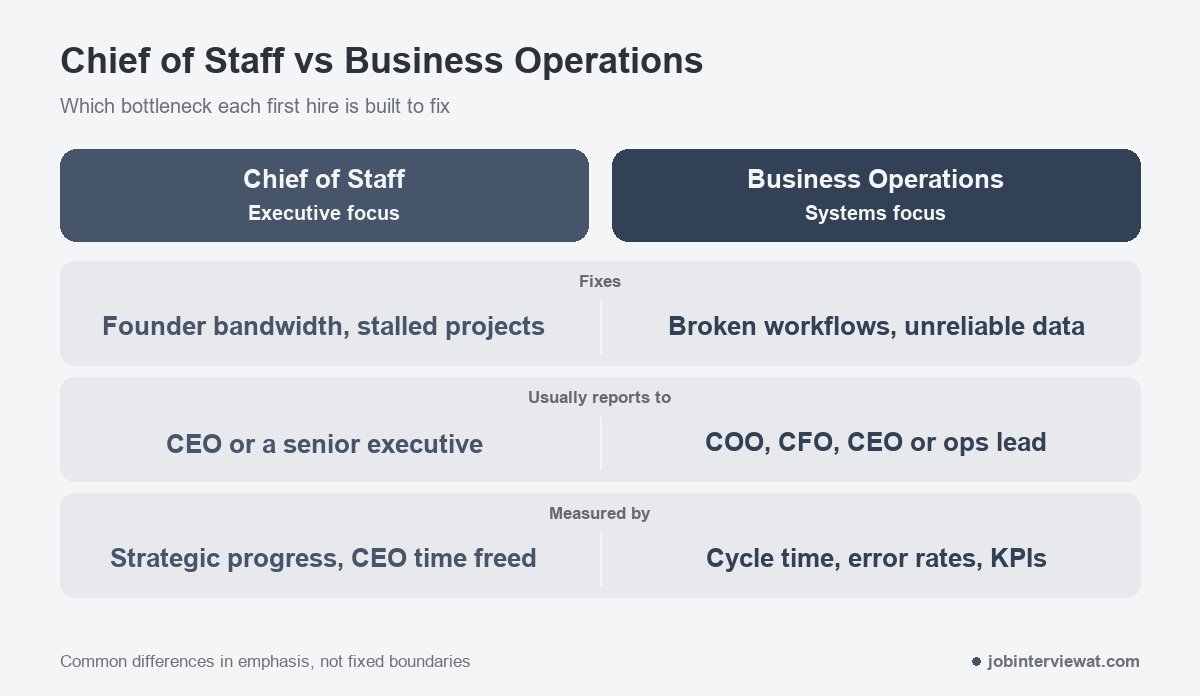
Chief of staff vs. business operations comes down to one question: is your startup slowed by the founder’s limited time, or by broken systems? A Chief of Staff fixes the first. A Business Operations hire fixes the second by improving processes, reporting and the systems that have to keep working as the company scales past what you can watch yourself.
You’ll usually hit this point when you can’t manage everything yourself anymore. Strategic projects compete for attention, departments drift out of sync, and small inefficiencies start slowing progress. Which problem is costing you more right now? Hire for the wrong one and you’ll get overlapping responsibilities without solving the one that matters.
What Does a Chief of Staff Do vs. a Business Operations Leader?
A Chief of Staff extends the CEO’s reach across strategy and leadership, while a Business Operations leader improves how the company runs day to day. Both work across departments, but their reporting lines and priorities can differ a lot.
Chief of Staff Responsibilities
A Chief of Staff works closely with the founder, CEO or another senior executive to make leadership more effective. The role usually centers on coordinating strategic priorities across the company, though some Chiefs of Staff also manage teams or hold operational duties.
Typical chief of staff responsibilities include:
- Coordinating strategic initiatives that involve several departments.
- Preparing leadership meetings and tracking important decisions.
- Supporting board communications and investor-related planning.
- Improving communication between executives and functional leaders.
- Managing special projects that need executive oversight.
A startup Chief of Staff isn’t an executive assistant with a bigger title. Some administrative coordination comes with the job, but the position needs strategic judgment, a feel for how the organization works, and the ability to influence decisions. The goal is to keep leadership focused on the work that creates the most business value.
Business Operations Responsibilities
Business Operations, often shortened to BizOps, focuses on how the company runs. Depending on scope and seniority, the role may be titled Manager, Director or Head of Business Operations, and those titles don’t carry identical authority. The job combines analytical problem-solving, process improvement and cross-functional execution.
Common business operations responsibilities include:
- Finding inefficient workflows and operational bottlenecks.
- Building performance dashboards and reporting systems.
- Standardizing processes across departments.
- Improving resource allocation and operational efficiency.
- Running initiatives that support sustainable growth.
An October 2025 commenter on r/startups summed up BizOps as “internal consulting” that takes on cross-functional problems, with examples like “Our onboarding process sucks, fix it.” Business Operations people can also shape strategy, lead planning and advise executives. The balance of analysis, process ownership and execution depends on what the company needs.
Chief of Staff vs Business Operations: Key Differences
The table below shows common differences in emphasis, not fixed boundaries. Either role can mix strategy, analysis and execution.
| Category | Chief of Staff | Business Operations |
|---|---|---|
| Primary objective | Improve executive effectiveness and strategic alignment | Improve business processes and operational performance |
| Reporting structure | Usually reports directly to the CEO or a senior executive | Often reports to the COO, CFO, CEO or operations leadership |
| Main focus | Strategic priorities and leadership coordination | Operational efficiency and scalable execution |
| Decision-making | Influences executive decisions and acts within delegated authority | Recommends and implements operational decisions within assigned authority |
| Daily activities | Leadership meetings, strategic projects, executive follow-ups | Workflow analysis, reporting, process improvement |
| Collaboration | Works closely with executives and department leaders | Works across operational and functional teams |
| Success measures | Strategic progress, leadership alignment, executive capacity | Process efficiency, execution quality, operational key performance indicators (KPIs) |
| CEO relationship | Usually a close strategic partner | May work with the CEO but often supports broader operational needs |
These lines aren’t absolute. In smaller startups, both positions may involve strategic planning, problem-solving and project management. The difference that matters is the problem each person is mainly responsible for solving.
When Should Your Startup Hire a Chief of Staff First?
Hire a Chief of Staff first when your own limited time, not a broken process, is what’s holding back company-wide execution, and your department heads can already run their teams.
Picture a growing software startup with capable department heads and several delayed strategic initiatives. The CEO spends much of the week running leadership meetings, settling competing priorities, preparing investor updates and chasing unfinished projects. Each department works reasonably well, yet company-wide decisions move slowly.

A Chief of Staff could fix this by organizing executive priorities, setting up accountability and keeping strategic projects moving. One founder who hired a first Chief of Staff between Series A and Series B described the brief like this:
“I should be doing 10 different things, but I can only focus on the top 3. Your job is to do a 70% good job on the other 7.”
– r/startups, July 2024
Other signs a Chief of Staff may be the better first hire:
- Leadership teams often disagree about priorities.
- Strategic projects stall because nobody coordinates them.
- The CEO spends too much time following up on executive decisions.
- Board preparation and investor communication eat up leadership attention.
- Cross-functional initiatives lack clear executive-level coordination.
You want candidates who can work through ambiguity, communicate well with senior leaders and hold people accountable without formal authority. Whether you assess candidates internally or work with an executive recruiting firm, the evaluation should test those abilities against the startup’s actual leadership challenges.
When Should You Hire a Business Operations Leader First?
Hire a Business Operations leader first when your biggest problems are inefficient systems rather than executive coordination, meaning work gets done but slowly, twice, or with numbers nobody trusts.
Imagine an ecommerce startup with fast customer growth. Sales are rising, but fulfillment teams rely on disconnected spreadsheets, customer information doesn’t match across tools, and departments duplicate each other’s work.

As the CEO, you know where the company is headed. The trouble is running everyday work reliably as order volume grows.
Who owns fixing that today? Problems like these need someone who clearly owns operational systems, whether that’s a Business Operations leader or a broader role. A Business Operations Manager could analyze existing workflows, set up consistent performance reporting and introduce processes that handle higher volume.
Signs your startup needs Business Operations leadership:
- Departments use inconsistent processes or performance metrics.
- Repetitive manual tasks take up a lot of employee time.
- Operational problems keep coming back without a permanent fix.
- Managers lack reliable data for decisions.
- Existing systems struggle to support growth.
- Nobody clearly owns cross-functional process improvements.
The right Business Operations hire should make operations easier to see and make sure each change produces a measurable result.
How Startup Stage and Team Structure Affect the Decision
Base the decision on how complex your organization is, not on your funding round or headcount alone. The same title solves different problems at 10 people than it does at 150.
Early-Stage Startups
In an early-stage business, founders usually handle strategic planning and operational execution themselves. A specialized leadership hire may be premature if the workload doesn’t justify it, and a flexible generalist with strong analytical and project management skills may give you more right away.
Not everyone thinks an early Chief of Staff makes sense at all. One r/startups commenter in October 2024 called the role “very much luxury to smaller organisations.” Still, even a small startup may need dedicated executive support if you’re juggling complex partnerships, fundraising or several strategic initiatives at once.
Growing Startups
As departments expand, coordination and operational complexity grow with them. A company with unclear workflows may benefit most from a Business Operations Manager. A business with established processes but overloaded executives may gain more from a Chief of Staff.
Scaling Startups
Larger organizations may eventually need both. The Chief of Staff coordinates executive priorities while Business Operations leaders build and improve the processes behind company-wide execution.
Before you choose either position, answer five questions honestly:
- Is the biggest bottleneck executive capacity or inefficient operational systems?
- Are strategic initiatives delayed because leadership teams aren’t aligned?
- Do recurring workflow problems affect everyday performance?
- Who currently owns operational decisions and process improvements?
- Does the company need stronger executive coordination, better operating systems, or both?
Those answers make a more dependable hiring framework than picking a role by company size.
Hiring Your Chief of Staff or Business Operations Leader
Start recruiting with clearly defined outcomes, not a broad job description, because you can’t score candidates against a goal you haven’t written down. For a Chief of Staff, prioritize strategic thinking, executive communication, adaptability and experience coordinating initiatives across departments. For a Business Operations Manager, focus on analytical ability, process improvement experience, performance measurement and operational execution.
Interview Questions for Chief of Staff Candidates
1. “Tell us about a time you aligned multiple teams around a difficult strategic decision.” Look for stakeholder management, clear communication and the ability to settle competing priorities.
2. “How would you prioritize five urgent initiatives competing for the CEO’s attention?” Strong candidates explain how they weigh business impact, urgency, dependencies and how much the CEO needs to be involved.
3. “Describe a strategic project you managed without direct authority over the teams involved.” Listen for real examples of influencing others, keeping people accountable and delivering results.
Interview Questions for Business Operations Candidates
1. “How would you identify the biggest operational bottleneck in a growing startup?” Candidates should talk about gathering reliable data, mapping workflows, speaking with stakeholders and finding root causes before recommending changes.
2. “Describe a process you improved and how you measured its success.” Look for a clear account of the original problem, the changes made and the result.
3. “What would you do if three departments reported conflicting performance numbers?” A strong answer covers data definitions, reporting sources, ownership and consistent measurement.
Use Practical Assessments
Structured interviews give every candidate for the same role the same job-related questions and score the answers on the same standards. The U.S. Office of Personnel Management’s structured interview guidance says all candidates get the same predetermined questions in the same order, rated on the same scale.
Practical exercises add another way to judge how candidates think. If you’re hiring a Chief of Staff, give candidates a hypothetical scenario with conflicting executive priorities and ask for a coordination plan. For Business Operations, hand candidates sample operational data and ask them to spot inefficiencies and recommend improvements.
Score everyone applying for the same position on the same criteria: analytical thinking, communication, prioritization and execution. I helped introduce a new interview score sheet at Walmart, and the rule I’d pass on is to write those criteria down before the first interview, not after the candidates start to blur together. It makes the decision rest on evidence instead of impressions.
Interviewing for One of These Roles? Pin Down the Job First
If you’re the candidate, the founder’s framework works in reverse: find out which problem they’re hiring you to solve before you accept. The title alone won’t tell you, and a former Chief of Staff put the range bluntly:
“Chief of staff can mean different things different places. Basically everything from EA to mini CEO. I have been one and I was clear I would not be an assistant and would be Director of operations.”
– r/startups, October 2025
The same commenter said they could only set that boundary because they’d worked with founders before and were recruited into the role. Use the final round to ask what a first-time hire usually can’t:
- “What’s the one problem you want this person to fix in the first 90 days?”
- “Who will I report to, and which decisions can I make without checking with you?”
- “How much of the week is scheduling, notes and inbox work?”
- “How will you measure whether this hire worked?”
Say “I’d like to understand which problem this role owns,” not “Is this just an assistant job?” The first reads as judgment; the second reads as worry. For more end-of-interview questions that fit a senior role, see our list of questions to ask at the end of an interview.

Can One Person Handle Both Roles?
Some startups combine Chief of Staff and Business Operations duties into one position. Can it work? Yes, when the organization is small, leadership needs are still changing and operations are manageable enough that one person can see all of it. A hybrid hire might coordinate executive planning while also building reporting systems and improving internal workflows.
Combining the positions has risks, though. Strategic priorities may compete with urgent operational work, and employees may not know who owns which decisions or which projects come first.
Before you create a hybrid position, define:
- The person’s primary responsibility and reporting relationship.
- Which decisions they can make on their own.
- How strategic and operational priorities will be balanced.
- What measurable outcomes will decide success.
A hybrid role works best when its duties are designed on purpose, not piled on whenever another department needs help. As operational demands grow, you may need to split it into two jobs.
What Success Should Look Like in the First 90 Days
Hiring the right person is only the start. How will you know at day 90 that it’s working? Set measurable expectations for the first three months. The plans below are illustrations; adjust the order to the role’s authority, resources and immediate needs.
Chief of Staff: First 90 Days
- Days 1–30: Learn executive priorities, meet department leaders, find communication gaps and review existing strategic initiatives.
- Days 31–60: Set clearer leadership meeting routines, tighten executive follow-ups and coordinate one high-priority cross-functional project.
- Days 61–90: Show stronger accountability, better strategic coordination and more consistent follow-through on leadership decisions.
Possible success measures include fewer unresolved executive action items, clearer project ownership and more CEO time for high-value work.
Business Operations: First 90 Days
- Days 1–30: Review workflows, set baseline performance metrics and identify recurring operational problems.
- Days 31–60: Prioritize improvement opportunities, clarify process ownership and put one operational change in place.
- Days 61–90: Measure that change’s impact, make reporting more consistent and plan how to tackle the next bottlenecks.
Useful metrics include process cycle time, reporting accuracy, error rates and manual work eliminated. Not every improvement will land within 90 days. The point is to make operations visible, show early progress and create accountability for longer-term results.
Making the Right First Leadership Hire
So which one first? It comes down to what limits your startup right now. If leadership coordination, executive bandwidth and strategic follow-through are the main problems, a Chief of Staff may be the stronger investment. If inefficient workflows, unreliable reporting and operational bottlenecks are slowing growth, a Business Operations leader may deliver more right away.
Don’t hire by job title or startup trend. Define the business problem you need solved, evaluate candidates against specific responsibilities and set measurable expectations from day one. The best first hire is the person equipped to solve the constraint that matters most.
Chief of Staff vs. Business Operations FAQ
Is a chief of staff the same as an executive assistant?
No. A Chief of Staff may handle some coordination, but the role is built around strategic judgment: running priorities across departments, preparing leadership decisions and keeping executive projects moving. Titles vary by company, so check the actual duties in the job description and interview.
What’s the difference between BizOps and RevOps?
BizOps works on cross-functional problems across the whole company, such as workflows, reporting and process ownership. One r/startups commenter in October 2025 described RevOps as focused on the revenue pipeline: the tools and data behind sales, marketing and customer success.
When is it too early to hire a chief of staff?
It’s usually too early when the founder can still coordinate the company directly and the workload doesn’t justify a dedicated role. A flexible generalist often helps more at that stage, unless the founder is already stretched across fundraising, partnerships and several strategic projects at once.