

The Home Depot interview is easy; the assessment filters. Entry-level applicants describe in-person conversations so light that current associates joke about them, because the screening already happened inside the online application: a situational-judgment and personality assessment that takes twenty to thirty minutes and cannot be paused. Prepare for the Home Depot interview questions below, but give the assessment the respect the interview gets elsewhere.
Leadership roles run the opposite way. Department supervisor candidates face structured behavioral panels where every prompt starts with tell-me-about-a-time, a completely different preparation problem, so associate prep and supervisor prep are treated here as the two separate tracks they are.
For the neighboring orange-vs-blue application, Lowe’s runs a similar assessment-first process; inside general retail, the Walmart interview guide covers the closest comparison with a heavier interview round.
The real filter is the assessment, not the interview
Home Depot screens applicants with an online assessment during the application: situational judgment scenarios about customers and coworkers, plus personality questions, completed in one sitting of roughly twenty to thirty minutes. Applicants who clear it describe callbacks arriving anywhere from days to two or three weeks later, and an in-person conversation that current associates summarize like this:
“Can you work this schedule? Perfect. You’re hired.”
– r/HomeDepot, March 2026 (22 upvotes)
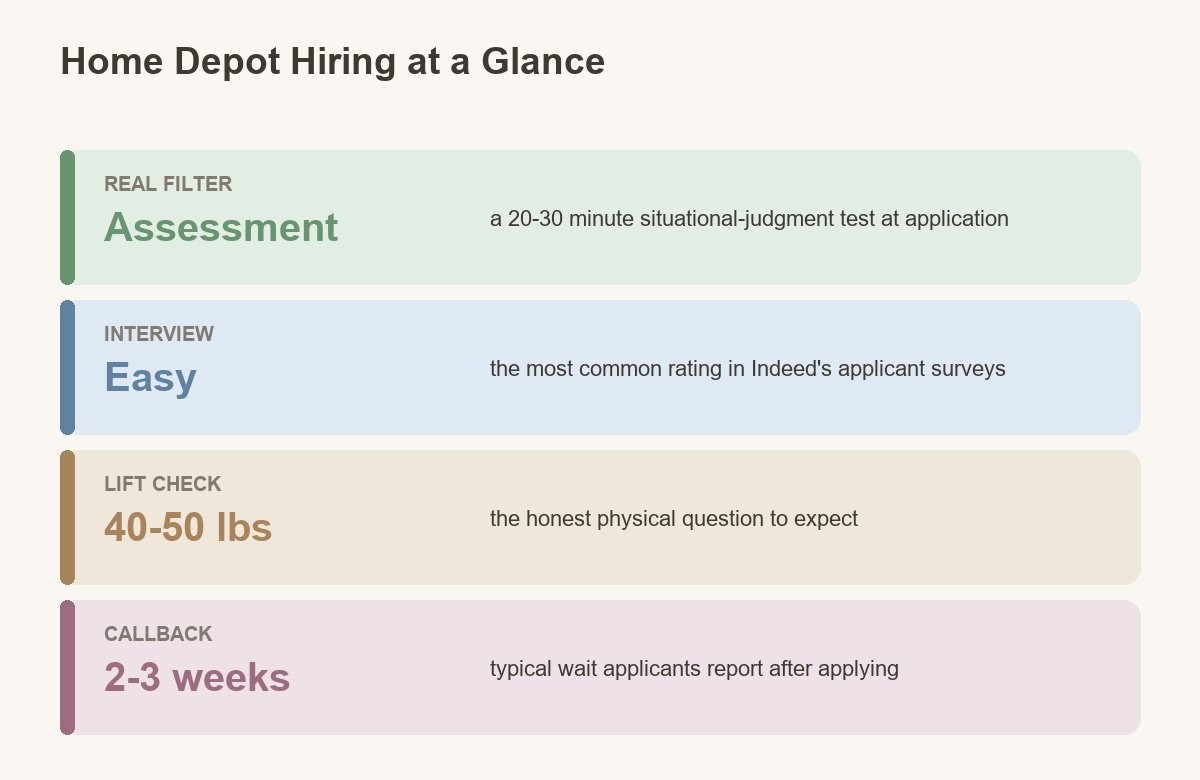
Take the assessment seriously in three specific ways. Sit down once with thirty quiet minutes, because progress does not save. Answer the customer scenarios as the most patient version of yourself, consistently, since contradictory answers are what sink personality screens. And keep your availability wide in the application itself; associates say the schedule question decides more entry offers than anything said face to face.
The Home Depot interview questions to prepare for
Eight prompts cover the associate and cashier conversation: tell me about yourself, why Home Depot, your availability, whether you can lift forty to fifty pounds, helping a customer who does not know what they need, a teamwork moment, a time you missed a deadline, and your own questions.
1. Tell me about yourself
Three sentences, ending on the job. Any hands-on background belongs here: DIY projects, a summer on a framing crew, fixing your own car. This is the store where hobby experience counts as work experience.
2. Why do you want to work at Home Depot?
Sample answer: “Honestly, I am the person friends text photos of their broken faucet to, and I like being useful that way. Working here means doing that all day with better inventory behind me. I also know most supervisors started on the floor, and I would rather grow somewhere that promotes its own people.”
3. What is your availability? Can you work more than 20 hours a week?
The twenty-hour question is real and shows up in applicant reports, because part-time schedules flex hard around weekends and truck days. Give your full window, flag the immovable blocks, and volunteer weekend openness if you have it.
4. Can you lift 40 to 50 pounds repeatedly?
A bag of concrete weighs more than a bag of groceries, and the question is honest, not rhetorical. Say yes only truthfully, mention any proof, and state limits plainly; freight and lumber assignments depend on the answer.
5. A customer describes a project but has no idea what to buy. What do you do?
Sample answer: “Ask questions before touching a shelf: what are they fixing, what does the damage look like, have they done anything like it before. Then walk them to the aisle, put the two real options in their hands, and explain the difference in one sentence each. If it is beyond me, I find the associate who knows, and I stay to learn the answer myself. Nobody should leave with the wrong part twice.”
6. Tell me about a time you worked as part of a team
Pick a short-handed shift or a group project where you saw the gap and filled it unprompted. Four beats, shared result at the end.
7. Was there a time you missed a deadline?
This one appears in applicant reports and rewards honesty with a fix attached: what slipped, why, what you changed so it stopped happening. Claiming you never missed one reads worse than owning one.
8. Do you have questions for us?
Ask which department they would start you in and what separates associates who move up fast. Short, genuine, and it plants the growth flag the next section explains.
Department supervisor interviews: the other Home Depot
The DS and leadership interview is a structured behavioral panel built on the STAR format: situation, task, action, result, prompt after prompt. Current supervisors advising candidates say the stories must be concise and complete, and that vague answers draw feedback as unhelpful as not enough meat on the bone.
“Practice some stories using the STAR method. If you interview well but someone’s been in the pipeline for this position, they’ll volunteer you to be on the VOA, Oursafety team or be an associate coach. They want to give you a platform to influence and be respected if you need some visibility.”
– r/HomeDepot, January 2026 (4 upvotes)
Two lessons hide in that advice. Prepare five STAR stories covering leadership, conflict, safety, coaching, and a metric you moved, each told in ninety seconds. And read the pipeline honestly: losing a DS interview to someone already groomed for the slot is common, and the consolation assignments named above are the actual path to winning the next one.
Internal candidates should treat the interview as a formality in neither direction. Associates report strong floor reputations losing to better-told stories, because the panel scores what it hears, not what it remembers.
Frequently asked questions
How do you prepare for a Home Depot interview?
Block thirty quiet minutes for the online assessment first, since it filters more applicants than the interview. Then prepare short answers on availability, lifting, and one customer story, and arrive in clean casual clothes ready to talk about anything you have ever built or fixed.
How do you impress a Home Depot interviewer?
Wide availability, comfort with physical work, and one specific story of helping a confused customer cover what the interview actually measures. Mentioning a real project you have done, with the products involved, lands better here than polished corporate answers.
What is a red flag in a Home Depot interview?
Narrow availability announced late, hedging on the lifting question, and complaints about previous employers are the reliable killers. The interview is short, so a single sour note occupies a large share of it.
How long does it take to hear back from Home Depot?
Applicants commonly report two to three weeks between applying and the interview call, then fast decisions afterward, sometimes same-day. A quiet month usually means the store filled its slots; reapply when the posting refreshes.