

An onboarding checklist for hourly and store hires works best when it’s ordered by the dates you can’t move. USCIS requires Form I-9 Section 1 by the first day of work for pay and Section 2 within 3 business days, and federal law gives you 20 days to report the hire to your state.
Everything else on the onboarding checklist, from the welcome text to the 90-day review, is a house rule you set yourself. Put those items around the legal dates, and spend most of your effort on the first week, because an hourly hire who’s confused about the schedule or the first paycheck can simply stop showing up.
Onboarding checklist deadlines at a glance
Day 1 here means the first day of work for pay, which is how USCIS defines the hire date. Rows marked “law” carry a federal deadline; rows marked “house rule” are recommended practice for an hourly team, and you can move them.
| When | Task | Owner | Law or house rule |
|---|---|---|---|
| Day -7 to Day 0 | Signed offer with rate, title and start time; first-shift details sent by text | Hiring manager | House rule |
| Day -7 to Day 0 | Form W-4 and state withholding form sent; I-9 Section 1 can be done once the offer is accepted | HR or store admin | House rule (timing) |
| Day 1 | I-9 Section 1 signed by the employee | New hire | Law (USCIS) |
| Day 1 | Clock-in number works, first week’s schedule handed over, a named person to follow | Shift lead | House rule |
| Day 3 | I-9 Section 2 completed with the employee’s original documents | Employer | Law (USCIS, 3 business days) |
| Day 7 | First check-in: schedule, pay day, questions | Manager | House rule |
| Day 20 | New hire reported to the state where the person works | HR or payroll | Law (federal; some states sooner) |
| Day 30 | First review: goals and feedback | Manager | House rule |
| Day 90 | Last review: past probation, or a written plan | Manager | House rule |
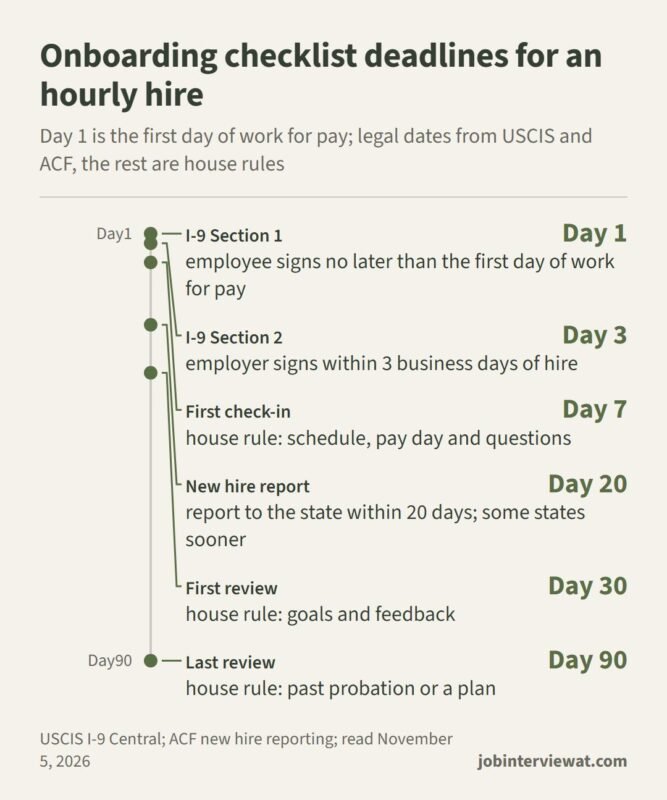
The two legal sources are short and worth reading once. USCIS sets the I-9 Section 2 deadline of 3 business days, and the Administration for Children and Families says employers must report new and rehired employees within 20 days of hire, adding that some states require it sooner. Check your own state’s new-hire site before you copy Day 20 into your template.
Before the first shift: day -7 to day 0
Most first-day problems start in the week before it. Send the paperwork early, confirm the details that make someone show up on time, and keep it short enough to finish on a phone.
An HR lead at a 140-person company described the same split in r/humanresources in June 2026: three buckets, “pre-start (day -7 to day 0), week one, and first 90 days,” with the offer letter signed and the I-9 and W-4 sent out before day 1. The poster called pre-start “the highest leverage” of the three.
For an hourly hire, the pre-start list is:
- The offer in writing: hourly rate, title, part-time or full-time, and the first shift’s date and start time.
- Where to go: the entrance to use, where to park, and the name of the person who’ll meet them.
- What to wear and bring: dress code, safety shoes if the job needs them, and the documents for I-9 Section 2.
- Forms to start early: Form W-4, which the IRS says lets the employer withhold the correct federal income tax, your state’s withholding form, and direct deposit.
- Section 1 of the I-9, if they’re ready: USCIS allows it any time after the offer is accepted.
Send it by text if that’s how the person answered you during hiring. A long email to an address they check once a week won’t get read before Monday. If your store hands out a welcome kit, the corporate gift companies for new-hire kits page compares vendors for new-hire welcome kits.

Day one: paperwork, a clock-in that works, and one person to follow
Day one has one legal job and three practical ones. The legal job is I-9 Section 1, which the employee must sign no later than the first day of work for pay.
Section 2 is yours, and the clock starts the same day. USCIS gives the example directly: if your employee began work for pay on Monday, you must complete Section 2 by Thursday of that week. Ask the new hire to bring their documents on day one so you aren’t chasing them on day three.
The practical jobs are the ones hourly hires remember: a clock-in number that works on the first try, the next two weeks of shifts in hand, and someone to ask when the register freezes or a pallet arrives early.
Name one person for that, by name, on the first shift. A “buddy program” on paper doesn’t help a new cashier at 4 p.m. on a Saturday; the shift lead standing ten feet away does. If you run a structured orientation, the Walmart orientation breakdown shows how one large retailer packs day one, and you can borrow its order.

The first week decides whether an hourly hire comes back
For hourly staff, the first week matters more than the 90-day plan. An hourly hire who’s unsure about the schedule or the pay doesn’t have to resign; they can just stop picking up shifts, and you may not hear why.
When I helped rework Walmart’s recruitment, job-hopping was one of the problems we worked on, alongside cost per hire and a new interview score sheet. The lesson I’d pass on is plain: the score sheet already tells you what this person needs. If the candidate said they can’t close on school nights or rely on a bus, put that into the first week’s schedule instead of finding out on Thursday.
Hold the first check-in on day 7 and keep it to three questions:
- Is the schedule you have the one discussed in the interview?
- Do you know when and how you’ll be paid, and has your direct deposit gone through?
- What’s one thing you still don’t know how to do?
The pay question is the one managers skip. A new hire who doesn’t know whether payday is weekly or every two weeks will plan around the wrong date. Say this: “Your first check lands on [date], and it covers [these days].” Not this: “Payroll will sort it out.”
Days 30, 60 and 90: three short reviews
The 30-60-90 rule means scheduling three check-ins at 30, 60 and 90 days, each with a goal set at the one before. For an hourly role, keep each one to fifteen minutes on the floor or in the office.
- Day 30: can they run their station without help, and are there training modules still open?
- Day 60: what can they take on next, such as opening, closing or a second department?
- Day 90: are they through your probation period, or do they need a written plan with dates?
A manager in r/managers put the purpose of these meetings well in December 2025:
“My golden rule is no new hire should fail probation without enough warning to fix any problems. That’s why we have set goals and regular meetings.”
– r/managers, December 2025 (7 upvotes)
Write down what you agreed at each review. If someone isn’t going to make it past day 90, the notes from day 30 and day 60 are what make that conversation fair.

Rules that change the list: minors and short jobs
Two kinds of hires change the dates. The first is a 14- or 15-year-old. Under the Department of Labor’s YouthRules, they can work 3 hours on a school day and 18 hours in a school week, between 7 a.m. and 7 p.m. (9 p.m. from June 1 to Labor Day). Build the first week’s schedule inside those limits before you hand it over; state rules can be stricter, and some states also require a work permit. The jobs that hire at 16 list shows how large chains set their own minimum ages.
The second is a job that lasts less than 3 days, such as a one-weekend event or inventory count. USCIS says that if the job lasts less than 3 days, you must complete Section 2 no later than the first day of work for pay, so the Day 3 row on your checklist moves to Day 1.
A seasonal hire who stays longer than that follows the normal checklist. Rehires count too: the ACF rule covers new and rehired employees, so a returning holiday worker goes back into the new-hire report.
Onboarding checklist questions
What is the 30-60-90 onboarding rule?
The 30-60-90 onboarding rule is a plan with check-ins at 30, 60 and 90 days, each setting the goal for the next. It’s a management practice, not a legal requirement; the legal onboarding deadlines fall in the first 20 days.
What are the four phases of onboarding?
The four phases of onboarding are usually listed as pre-boarding before day one, orientation on day one, training in the first weeks, and the transition to full duties around day 90. For hourly hires, the first week deserves its own phase.
Is there an onboarding checklist template for Word or Excel?
An onboarding checklist template in Word or Excel can start from the deadline table above: copy the four columns (when, task, owner, law or house rule) into a sheet and add a “done” column with a date. Add a row for your state’s new-hire report deadline if it’s shorter than 20 days.
What documents does a new hire bring on day one?
A new hire brings the original documents they chose from the Form I-9 Lists of Acceptable Documents, so the employer can complete Section 2 within 3 business days. Tell them in the offer message which lists apply, so they don’t arrive with photocopies.