

Jobs with medical assistant certification start with the obvious one: medical assistant, in a doctor’s office, hospital clinic or urgent care. The same credential also gets you considered for phlebotomy, front desk, medical records and EKG work, and most of those pay within about a dollar an hour of each other.
That’s the part most job lists leave out. We pulled the May 2025 federal wage figures for each role, plus where the 817,870 medical assistants in the US actually work. The certificate opens the clinic door. It doesn’t, on its own, raise your pay much, so it helps to know which door you want before you apply.
Jobs with medical assistant certification and what they pay
Here are the roles certified MAs are hired into or move toward first, with the national median pay from the Bureau of Labor Statistics. The medians come from the May 2025 Occupational Employment and Wage Statistics survey, which we pulled on November 14, 2026.
| Role | Median hourly | Median yearly | What it usually takes beyond the MA credential |
|---|---|---|---|
| Medical assistant | $21.97 | $45,690 | Nothing extra; this is the job the credential is built for |
| Phlebotomist | $21.75 | $45,230 | Blood draw practice; some employers and states want a separate phlebotomy credential |
| Medical secretary or administrative assistant | $22.08 | $45,930 | Scheduling, insurance and billing software skills |
| Pharmacy technician | $22.00 | $45,750 | Often a state registration or pharmacy tech certification |
| Dental assistant | $23.11 | $48,070 | Dental training; rules vary by state |
| Medical records specialist | $24.59 | $51,140 | Coding knowledge; a coding credential is often requested |
| Medical receptionist | $18.27 | $38,010 | Nothing extra; the clinical skills go unused |
Look at how tight the first five rows are. A phlebotomist’s median is 22 cents an hour below a medical assistant’s, and a pharmacy technician’s is 3 cents above. So moving sideways rarely buys you a raise. Medical records is the exception, at $2.62 an hour more, because coding is a skill fewer people bring.
The receptionist row is the trap. Front desk jobs at clinics will take your application gladly, but you’d be earning $3.70 an hour less than the MA median for work that doesn’t use your clinical training. Want to see what an hourly offer means over a year? Our hourly to salary calculator converts it in a few seconds.
Where certified medical assistants work, and what each setting pays
Most of the openings are in physician offices. The same BLS survey counts 452,150 medical assistants there, which is 55% of everyone in the job. Hospitals employ 139,070, about 17%, and outpatient care centers employ 85,840, about 1 in 10.
Pay shifts by setting more than by job title:
- Outpatient care centers: $48,560 median, the highest of the large settings.
- Hospitals: $46,910.
- Offices of physicians: $45,520.
- Offices of other health practitioners (chiropractors, optometrists, podiatrists and similar): $38,400.
That last gap is worth noticing. An MA in an outpatient center earns a median $10,160 a year more than one in a chiropractic or similar office. If two offers look alike, the setting is often the reason one pays more.
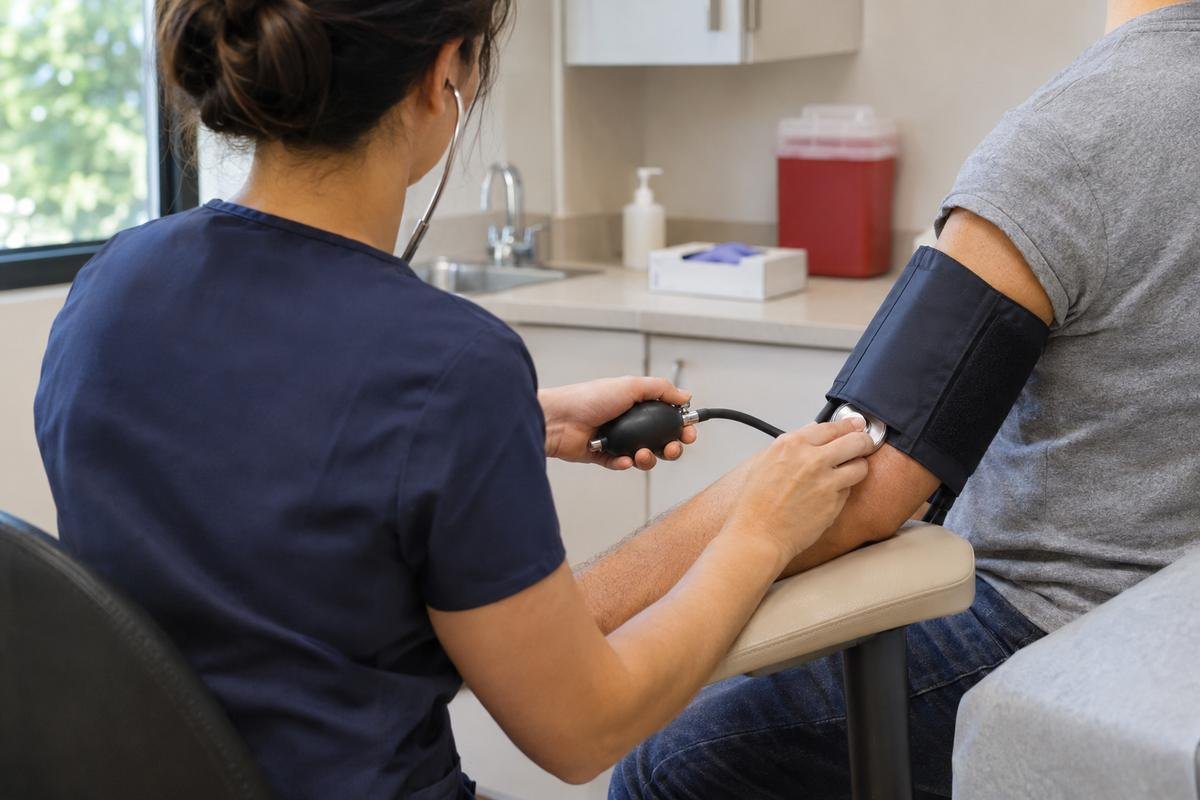
Demand is steady too. The BLS Occupational Outlook Handbook projects 12% employment growth for medical assistants from 2024 to 2034, with about 112,300 openings a year on average.
Which medical assistant certification employers ask for
Four national credentials show up on most postings. They aren’t interchangeable in how you qualify, and that decides which one you can sit for.
- CMA (AAMA) from the American Association of Medical Assistants. You must be a student or graduate of a program accredited by CAAHEP or ABHES. The exam fee is $125 for AAMA members and $250 for nonmembers, per the AAMA eligibility page.
- RMA from American Medical Technologists. You can qualify through an accredited program with at least 720 hours of instruction, including 160 hours of externship, or through 3 years of MA work within the past 7 years. The application fee is $150.
- CCMA from the National Healthcareer Association. You qualify with a training program finished in the last 5 years, or a high school diploma plus 1 year of supervised MA work in the last 3 years.
- NCMA from the National Center for Competency Testing. It takes graduates of NCCT-authorized schools, or 1 year of full-time MA experience in the past 5 years.
Which one do employers prefer? It depends on the employer, so check five local postings before you pay for an exam. In one May 2026 r/MedicalAssistant thread, the most upvoted reply put the CCMA first:
“First, you need your CCMA license by taking the NHA exam. Without that, you can’t be hired as a CMA. If you are hired, most of the time you will make terrible pay and you’ll need to get your license without ~90 days (depending on the state).”
– r/MedicalAssistant, May 2026 (22 upvotes)
That’s one person’s market, and the wording mixes up credentials, but the point holds: some employers hire uncertified MAs only on the condition that you certify soon after. Another reply in the same thread said you can get hired without it, just not usually by a hospital system. If you already work in a clinic, the work experience routes for the RMA, CCMA and NCMA mean you may not need to go back to school.
For more credentials that raise pay, see our list of certifications that pay well.
Getting your first medical assistant job without experience
New grads get stuck in the same place: postings ask for a year of experience you can’t get without a job. A few habits help.
Apply to clinics directly. Large job boards bury a new grad’s application under hundreds of others. A September reply in a thread from a certified MA with no experience put it plainly:
“I wouldn’t use indeed. I would go to every nearby clinics website and apply through their careers page. If it’s small and they don’t have a careers page, send an email with your resume and state your interest. A nonprofit clinic or urgent care will be most willing to teach on the job”
– r/MedicalAssistant, September 2026 (2 upvotes)
Start with urgent care. Another reply in that thread said urgent cares usually hire new grads, and the same reply above named nonprofit clinics as the places most willing to teach on the job. Use your externship site too. You already know the staff, and they’ve seen you work.
Then show the interviewer you’ll stay. Small practices worry about training someone who leaves within a year. One hiring MA said so outright in May: they pass over anyone who is pre-med or still in school, because they don’t want to train someone who leaves after a gap year. If you do plan on nursing school later, say so honestly, and give a timeline of two years or more. “I want to get good at clinical work here first” is a better answer than a vague “I’m keeping my options open.”
Your resume matters less than your externship hours, but it still has to get past the screener. Our guide to building a strong healthcare resume covers how to list clinical skills when you have little paid experience.
Jobs that pay more, and the school they take
If pay is the goal, the MA credential is a starting point, not an endpoint. The roles that pay meaningfully more all need another program:
- Licensed practical or vocational nurse: $30.96 median hourly, $64,400 a year. You’ll need a practical nursing program and the NCLEX-PN licensing exam.
- Surgical technologist: $31.08 hourly, $64,650 a year, after a surgical technology program.
- Cardiovascular technologist or technician: $35.73 hourly, $74,310 a year. Many MAs already run EKGs, but these roles need formal cardiovascular training.
The LPN median is $8.99 an hour above the MA median, which is roughly the gap between a clinic job and a job you can build a household budget on. Is going back to school worth it for you? Work a year as an MA first. You’ll know by then whether you like patient care enough to invest in it, and you can ask your employer whether it offers tuition help.
Jobs with medical assistant certification: FAQ
What are the top 3 strengths of a medical assistant?
Accuracy, calm with patients and steady speed. Vitals, injections and charting all have to be right the first time, nervous patients need someone who stays even, and a busy clinic runs on staying on schedule. In an interview, give one real example of each from your externship rather than listing adjectives.
Why do people quit medical assisting?
Pay comes up often in r/MedicalAssistant threads. The national median is $21.97 an hour, which isn’t far from what some retail and warehouse employers advertise for jobs that need no credential. Others leave for nursing or other programs once they know they like patient care. Ask about the patient load per provider in your interview so you know what a normal day looks like.
Can you work remotely with a medical assistant certification?
Sometimes, but rarely as a new grad. Remote roles such as scheduling, prior authorization and telehealth support usually ask for clinic experience first, which one r/MedicalAssistant reply called a catch-22. Plan on a year or two in person before you look.
Which medical assistant certification pays the most?
No federal data splits MA pay by credential, so any ranking you read is a guess. What does change pay is the setting, as the BLS figures above show, and whether an employer requires a credential you have. Pick the one your local employers name in their postings.