
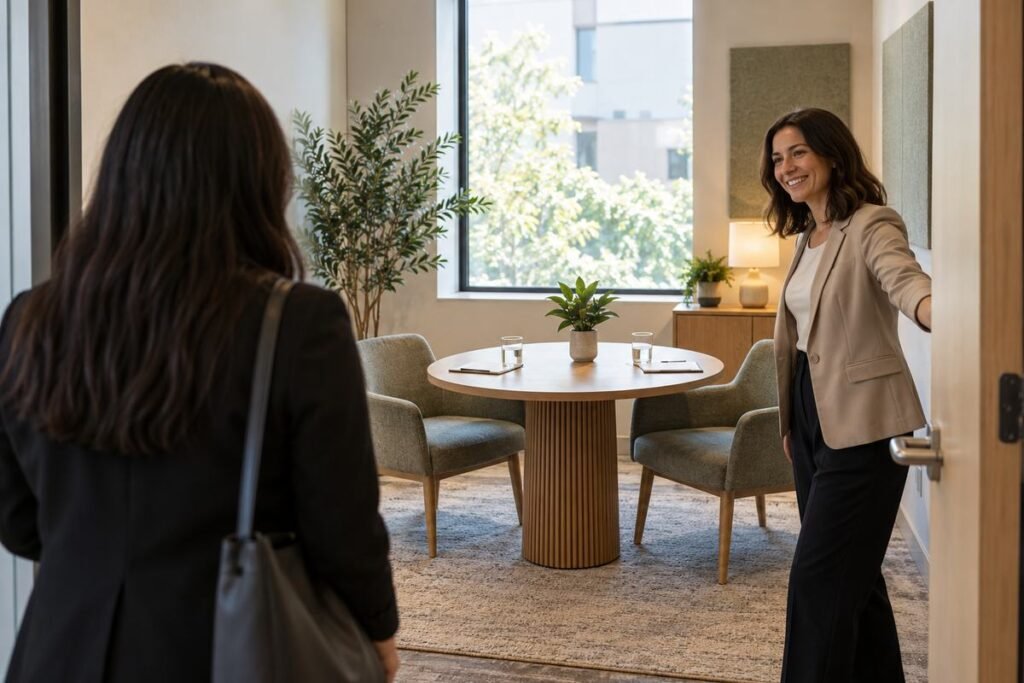
A good interview room is private, sized for the format, arranged so the candidate isn’t facing a row of interviewers, comfortable, tidy and tested before anyone arrives. If you don’t have a room like that, you can rent one by the hour. It matters because the candidate is judging your company while you judge them.
Most interview advice is written for candidates: what to say, how to dress, how to follow up. The room gets little attention, yet it’s the first part of your hiring process a candidate experiences in person, after the job posting and the scheduling emails.
Why the interview room matters to the candidate
When a candidate arrives, they’re evaluating you as much as you’re evaluating them. They notice how they were greeted, whether anyone expected them, and whether the room looks ready for this conversation or left over from the last meeting.
That impression starts before the room. In a September 2026 r/recruitinghell thread, a student described walking out of a spa receptionist interview three minutes in, after a long walk with no sidewalk and a cold greeting; the post drew more than 4,900 upvotes. The top reply, with 3,370 upvotes, read:
“First question should always be “any difficulties finding us?” Which can lead to friendly suggestions of best routes.”
– r/recruitinghell, September 2026 (3,370 upvotes)
A cluttered room, a stuffy temperature and a glass wall onto a noisy floor say something about how a company runs. So does a quiet, clean room with water on the table. You’re assessing them, and they’re assessing you.
The eight elements of a good interview room
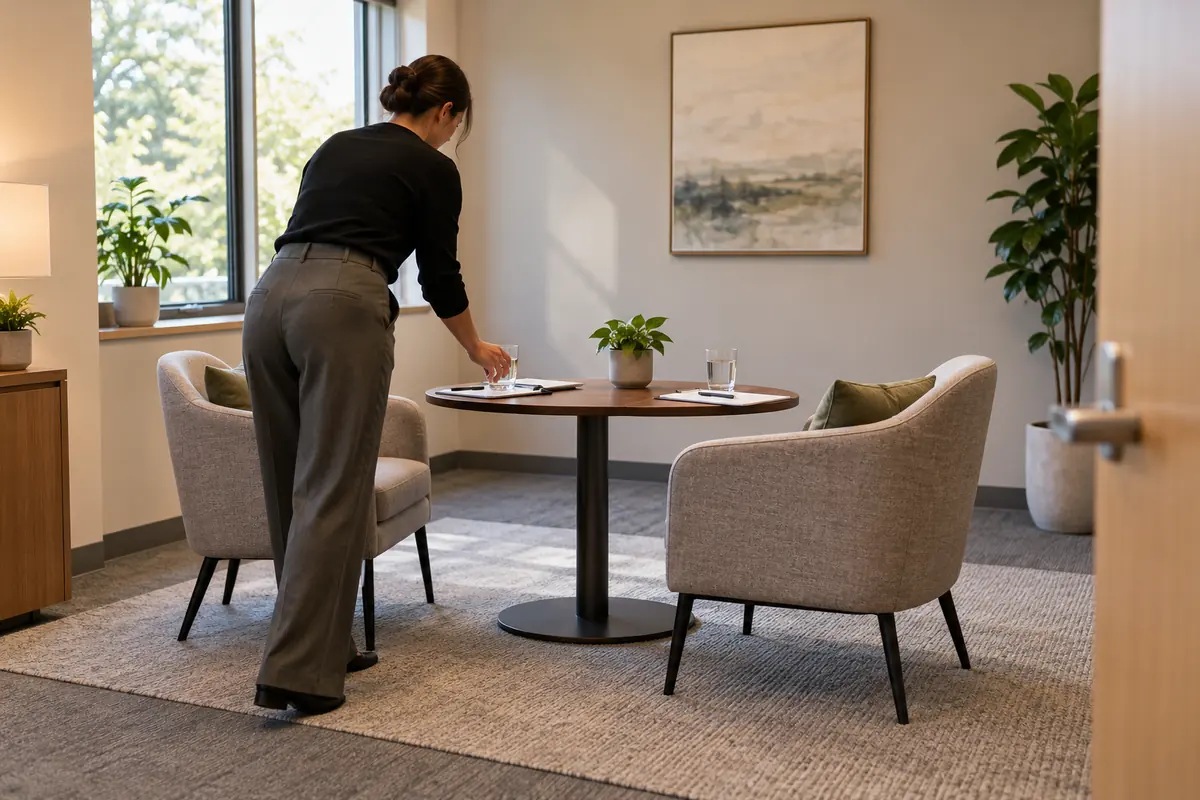
None of these cost much. Most come down to checking the room before the candidate does.
1. Acoustic privacy
This is the most important one. Candidates talk about pay, past employers and sometimes personal circumstances. If they can be overheard, or can hear the meeting next door, you won’t get their most honest answers.
Walls and a door that closes properly are the baseline. Is a glass meeting room good enough? Not for interviews: anyone walking past can see who’s in the chair, however good the room looks.
2. The right size for the format
A one-on-one screen and a four-person panel need different rooms. A boardroom that seats twelve feels oddly formal for a two-person conversation. Which room should you book? The smallest one that seats everyone without crowding, not whatever was free on the booking system.
3. Seating that fits the conversation
A long table with the panel on one side and the candidate alone on the other sets up an interrogation. Candidates say so. In a March 2026 r/interviews post about panel interviews, the poster described the room this way:
“I walk in, and there’s a panel that was set up like I was about to testify before Congress.”
– r/interviews, March 2026 (76 upvotes)
For most interviews, a round table, or panel members seated at an angle to the candidate rather than straight across, makes for a more natural conversation. If you must use a long table, sit the panel along the corner and the candidate at the side, not the far end.
4. Light
If you have a choice of rooms, pick the one with windows. If you don’t, turn off the harshest overhead lights and use whatever softer lighting the room has. Make sure the candidate isn’t facing straight into a bright window, where they’ll squint at your silhouette.
5. A temperature that holds
A room that starts out fine can get warm after forty minutes with three or four people in it. That’s more than a minor annoyance: a hot room wears down everyone’s patience, yours included. Check the thermostat before the candidate arrives, not when someone starts fanning themselves.
6. Water on the table
Put water out for everyone. Why bother? It saves the candidate from asking, and it signals that someone prepared the room for this conversation.
7. Technology tested in advance
How early should you test the video link? About fifteen minutes before the start: check the call, the camera and the audio. Ten minutes of troubleshooting at the beginning eats into the interview and rattles the candidate before the first question.
8. A clean room
Clear the table and wipe the whiteboard. Leftover notes from another meeting tell the candidate this room wasn’t set up for them, and they can expose information you don’t want visitors to see.
Make the room accessible
An interview room has to work for candidates with disabilities. The EEOC’s guidance on job applicants and the ADA lists, among the reasonable accommodations employers may need to provide, making sure “interviews, tests, and other components of the application process are held in accessible locations.”
In practice, that means a route without steps from the entrance to the room, space for a wheelchair at the table, and a nearby accessible restroom. The same guidance says applicants need to tell the employer they need an adjustment, so make that easy. One line in the invitation, such as “Let us know if you need any accommodation for the interview,” does it. If your usual room can’t meet a request, switch rooms or rent one.
Long interview days and back-to-back rounds
A room that’s fine for 30 minutes can be hard going for three hours. In an April 2026 r/recruitinghell post, a candidate described three interviews in the same office room, 1.5 hours straight with no break, and the post drew 110 upvotes. A reply with 71 upvotes described a company that ran all-day interviews with 13 to 15 interviewers over eight hours, interviews during lunch included, and then hired no one from that round.
If you run a multi-round day, plan it like a day, not a meeting:
- Put a short break between rounds and say where the restroom is.
- Refill the water, and offer something to eat if the day runs past lunch.
- Rotate the interviewers, not the candidate, so they’re not walking between rooms.
- Book the room for the whole block so nobody knocks halfway through.
Hybrid and video panels
More panels now include someone on a screen. In an October 2026 r/interviews post, a candidate for a mid-level operations job said six people, including two VPs, would interview them by video. One reply put it bluntly: “that’s a whole boardroom for a job that barely clears 60k.”
If you can, keep the panel to the people who need to be there. Panels aren’t the default everywhere, either: at Lowe’s, Glassdoor reviewers tag a one-on-one interview almost four times as often as a group panel, as our Lowe’s interview questions guide shows. When you do need a remote panelist, set the room up for them too. Put the screen where the candidate can see the remote person without turning away from the people in the room, use a microphone that picks up the candidate’s voice clearly, and make sure the remote panelist can see the candidate’s face, not the back of a laptop.
When your space isn’t adequate, rent one
Not every company has a dedicated interview room. Startups, growing teams and businesses with small offices often find their meeting rooms are too small, not private enough, or booked on interview days. The fix is to rent a room for the interview.
For businesses that don’t have a dedicated interview room, coworking spaces can be a practical alternative. They provide a professional setting without the need to maintain a permanent office. For example, businesses in Melbourne can explore flexible workspace options at https://www.servcorp.com.au/en/coworking/locations/melbourne/. Servcorp’s Melbourne coworking plans list access to meeting rooms among their inclusions. When choosing a location, check that private meeting rooms are available so interviews can take place without distractions.
For companies hiring in Singapore, The Work Project lists 10 meeting room locations across Singapore that can be booked by the hour or day on a pay-as-you-go basis. It says each room has AV equipment, high-speed Wi-Fi and on-site hospitality support, and it describes its hospitality as “conceived by hoteliers.” For an interview, that means someone greets your candidate and the room is ready when they walk in.
When does renting make sense? Usually when:
- Your meeting rooms are regularly booked on interview days.
- Your space doesn’t give enough privacy for confidential conversations.
- You’re a remote or hybrid company without a permanent office.
- You’re hiring for a role where candidates will look closely at how you operate.
- You’re running a multi-round interview day and need one room all day.
Weigh a few hours of room hire against the cost of reopening a search if your top candidate turns the offer down.
The pre-interview room checklist
Run through this before every candidate arrives. The first five match the figure.
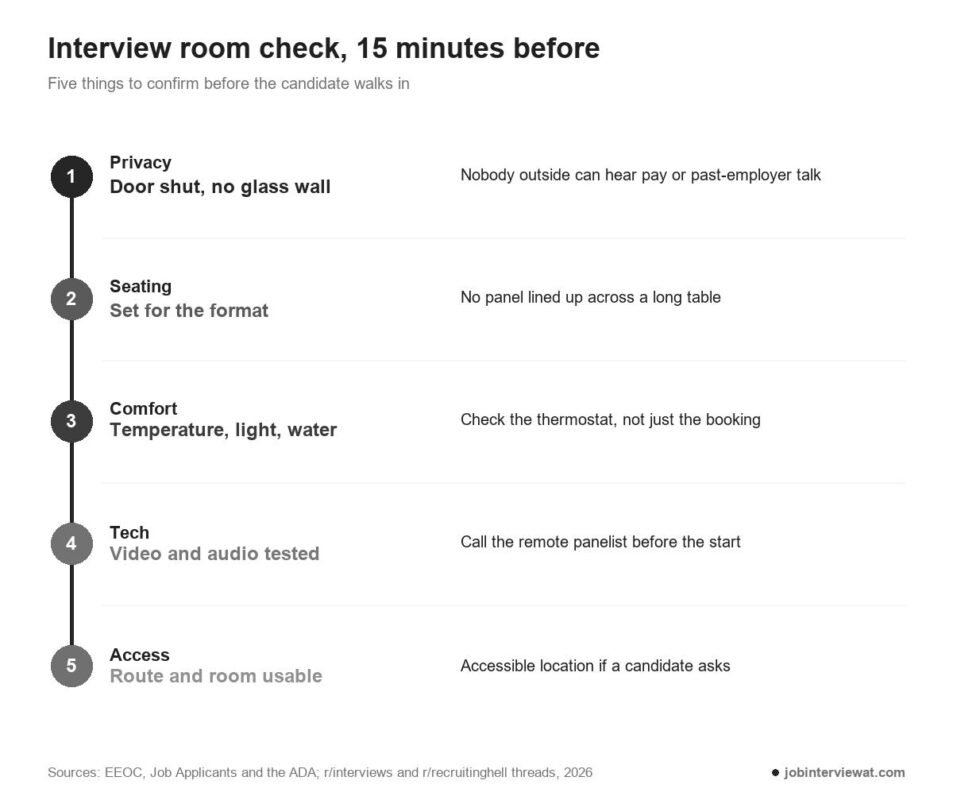
- Door closes properly and nobody outside can hear the conversation.
- Seating arranged for this interview’s format.
- Temperature comfortable, harsh overheads off.
- Video and audio tested, if anyone joins remotely.
- Route and room accessible, and any accommodation request handled.
- Table cleared and whiteboard wiped.
- Water on the table.
- Your notes and the job description reviewed, so you start ready.
What the room tells you as a candidate
If you’re the one being interviewed, the room is information. Notice whether reception expected you, whether the room was ready or someone had to clear it, and whether anyone asked how the trip in went. Small things like these can reflect how organized the team is day to day.
Don’t read too much into one detail, though. A cramped room at a growing company isn’t a warning sign, but a disorganized arrival plus a panel that hasn’t read your resume is worth noting.
You can also ask for what you need. If you need an accommodation, tell the employer before the day, since the EEOC guidance says the request starts with the applicant. In a long interview day, it’s fine to ask for a short break or a glass of water. In a panel, answer the person who asked, then glance at the others as you finish. For the questions themselves, our list of the most common interview questions and answers covers what each one is checking.
Interview room FAQ
How should an interview room be set up?
Choose a private room with a door, sized for the number of people, with seating at an angle rather than a panel lined up across a long table. Set the temperature, clear the table, put out water and test any video link before the candidate arrives.
Where should the candidate sit in a panel interview?
Seat the candidate where they can see every panel member without turning their head far, ideally at a round table or at an angle to the panel. Avoid putting them alone at the far end of a long table.
Does an interview room have to be accessible?
Yes, when a candidate needs it. The EEOC lists holding interviews in accessible locations among the reasonable accommodations employers may need to provide under the ADA. Ask candidates in the invitation whether they need any accommodation.
Can you rent a room just for interviews?
Yes. Some coworking providers rent meeting rooms by the hour or day; The Work Project, for example, lists pay-as-you-go booking in Singapore. Check that the room is private, has a door that closes, and has working video if a panel member joins remotely.