Amazon Leadership Principles Questions: The Ultimate Guide
Your technical skills got you the interview. But here’s a reality check most candidates miss: Amazon rejects a staggering number of applicants not for lacking coding ability, but for failing to demonstrate their Leadership Principles. This isn’t just another corporate checklist; it’s the DNA of how Amazon operates, innovates, and leads.
This guide cuts through the noise. We’ve analyzed the top-ranking articles, synthesized insights from ex-Amazon interviewers, and compiled a comprehensive playbook designed to do more than just help you survive the behavioral interview. It will equip you to master it. We’ll dissect all 16 Leadership Principles, provide over 80 role-specific questions, and reveal the preparation strategies that separate successful candidates from the rest.
By the end of this article, you will have a clear framework for building a powerful story bank, structuring your answers with the STAR method, and understanding the subtle cues that interviewers, including the pivotal ‘Bar Raiser,’ are trained to look for. This is your roadmap to turning abstract principles into compelling, concrete stories that prove you belong at Amazon.
What Makes Amazon’s Interview Process Different
While other tech giants heavily weigh technical prowess, Amazon places an unparalleled emphasis on behavioral interviews. Why? Because the Leadership Principles (LPs) are not just interview fodder; they are the operating system for every decision made at the company, from a new feature launch to a multi-billion dollar acquisition. An engineer doesn’t just write code; they obsess over the customer impact of that code. A manager doesn’t just delegate; they take ownership of the team’s failures and successes.
These principles were not born in a boardroom but were codified by Jeff Bezos from the company’s early days to scale its peculiar culture. They are the reason Amazon can innovate at such a rapid pace. In 2021, the list expanded from 14 to 16, adding “Strive to be Earth’s Best Employer” and “Success and Scale Bring Broad Responsibility,” signaling a renewed focus on employee well-being and societal impact.
The 16 Leadership Principles Explained
To truly master the interview, you must first understand the DNA of each principle. Below is a high-level overview to guide your thinking. We’ve grouped them into four logical categories to help you see the bigger picture.
Customer-Focused Principles
| Principle | Core Focus | Key Interview Theme |
|---|---|---|
| Customer Obsession | Starting with the customer and working backwards. | Demonstrating deep empathy and solving real user problems. |
Innovation-Focused Principles
| Principle | Core Focus | Key Interview Theme |
|---|---|---|
| Invent and Simplify | Creating novel solutions and reducing complexity. | Thinking outside the box and challenging the status quo. |
| Are Right, A Lot | Having strong judgment and good instincts. | Making sound decisions with incomplete data. |
| Learn and Be Curious | Continuously learning and exploring new possibilities. | Showing a passion for self-improvement and acquiring new skills. |
| Think Big | Creating and communicating a bold direction. | Developing an inspiring vision and taking calculated risks. |
Execution-Focused Principles
| Principle | Core Focus | Key Interview Theme |
|---|---|---|
| Bias for Action | Valuing calculated risk-taking and speed. | Making decisions quickly and acting with urgency. |
| Insist on the Highest Standards | Maintaining relentlessly high standards. | Refusing to compromise on quality and driving for excellence. |
| Dive Deep | Staying connected to the details and auditing frequently. | Getting into the weeds to understand the root cause of a problem. |
| Frugality | Accomplishing more with less. | Being resourceful and inventive within constraints. |
| Deliver Results | Focusing on key inputs and delivering with quality. | Overcoming obstacles and achieving goals. |
People-Focused Principles
| Principle | Core Focus | Key Interview Theme |
|---|---|---|
| Ownership | Thinking long-term and acting on behalf of the entire company. | Taking initiative beyond your defined role. |
| Earn Trust | Listening attentively, speaking candidly, and treating others with respect. | Being self-critical and building strong relationships. |
| Hire and Develop the Best | Raising the performance bar with every hire and promotion. | Recognizing and developing talent in others. |
| Have Backbone; Disagree and Commit | Challenging decisions respectfully and committing wholly once a decision is made. | Standing your ground based on data and conviction. |
| Strive to be Earth’s Best Employer | Creating a safer, more diverse, and more just work environment. | Leading with empathy and supporting employee growth. |
| Success and Scale Bring Broad Responsibility | Being humble and thoughtful about the secondary effects of actions. | Considering the broader impact on community and planet. |
How Amazon’s Interview Loop Actually Works
Understanding the battlefield is the first step to winning the war. Amazon’s interview process, known as the “loop,” is a series of 4-6 interviews, each lasting about an hour. Unlike other companies where you might meet a series of people who ask similar questions, Amazon’s loop is highly structured. Each interviewer is assigned 2-3 specific Leadership Principles to evaluate, ensuring comprehensive coverage without much overlap.
The loop typically includes a mix of your potential peers, your hiring manager, and a senior employee from a different team known as the “Bar Raiser.” While the world has shifted to virtual interviews, the core process remains the same in 2026. The key difference is the increased need for clear communication and demonstrating engagement through a screen.
The Bar Raiser: The Most Important Person in the Room
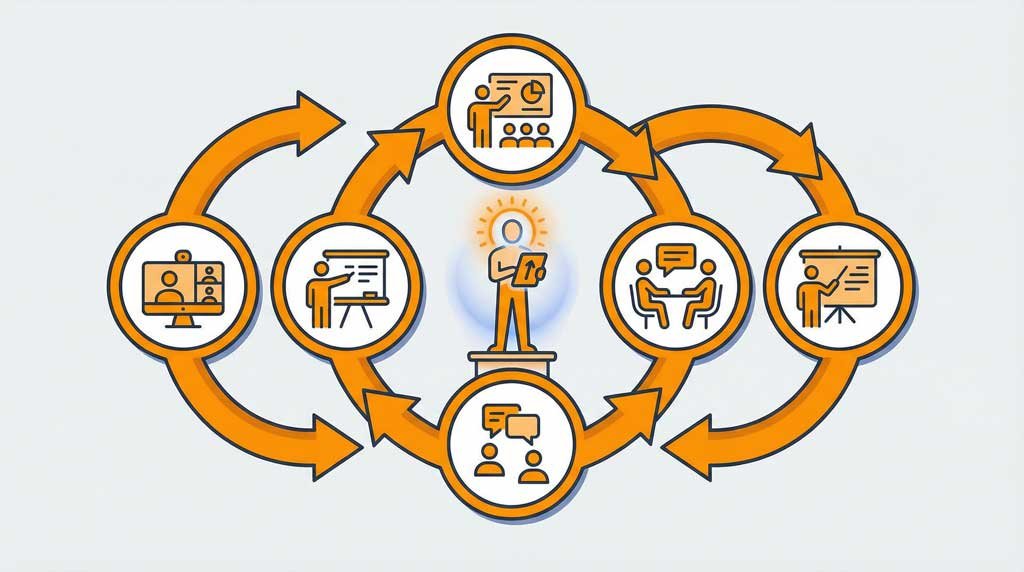
The Bar Raiser is a specially trained interviewer who serves as the steward of Amazon’s hiring standards. They have two primary functions: to ensure that every new hire is better than 50% of the current employees at that level (i.e., they “raise the bar”), and to guard against hiring biases. The Bar Raiser has veto power and can block a candidate even if the hiring manager wants to hire them. They are focused on long-term talent acquisition, not just filling an immediate need.
You may not know who the Bar Raiser is during your loop, but they are there. They will likely ask you some of the most challenging questions, probing deep into your examples to test the limits of your experience and alignment with the LPs.
What Interviewers Are Really Looking For
Interviewers are trained to look for more than just a good story. They are digging for data, scope, and impact. A story about improving a process is good; a story about improving a process that saved 500 person-hours per month and reduced error rates by 15% is great. They want to understand the scale of your work and the tangible results you delivered.
They are also looking for authenticity and self-reflection. An answer that is too polished or perfect can be a red flag. They want to hear about your mistakes and what you learned from them. This demonstrates the “Learn and Be Curious” and “Earn Trust” principles. Remember, they are hiring a human, not a robot.
for your own work?
- Tell me about a time you were dissatisfied with the status quo. What did you do?
- Give an example of a time you raised the bar for your team.
Think Big Questions
Leaders create and communicate a bold direction. Interviewers are looking for your ability to think beyond the immediate problem and envision a larger impact.
- Tell me about your most innovative idea.
- Describe a time you developed a vision for a project or team.
- Give an example of a time you took a calculated risk to achieve a big goal.
- How do you look around corners to anticipate future customer needs?
- Tell me about a time you had to persuade senior leaders to adopt your vision.
Bias for Action Questions
Speed matters in business. Interviewers want to see that you can act with urgency and make decisions without getting stuck in analysis paralysis.
- Tell me about a time you had to make a quick decision with incomplete information.
- Describe a situation where you took initiative to solve a problem rather than waiting for someone else to.
- Give an example of a time you had to work with a tight deadline.
- How do you balance the need for speed with the need for quality?
- Tell me about a time you took a calculated risk that paid off.
Frugality Questions
Accomplish more with less. Interviewers are looking for resourcefulness and creativity in the face of constraints.
- Tell me about a time you had to deliver a project with a very limited budget.
- Describe a situation where you had to be resourceful to solve a problem.
- Give an example of a time you saved the company money.
- How do you decide when to invest more resources versus being frugal?
- Tell me about a time you achieved significant results with a small team.
Earn Trust Questions
Leaders listen attentively, speak candidly, and treat others with respect. Interviewers want to see that you are self-critical and can build strong relationships.
- Tell me about a time you had to give someone difficult feedback.
- Describe a situation where you had to earn the trust of a skeptical colleague or team.
- Give an example of a time you were vocally self-critical.
- How do you build rapport with new team members?
- Tell me about a time you had to admit you were wrong.
Dive Deep Questions
Leaders operate at all levels and stay connected to the details. Interviewers are testing your ability to go beyond the surface and understand the root cause of issues.
- Tell me about the most complex problem you’ve ever worked on.
- Describe a situation where you had to use data to get to the bottom of an issue.
- Give an example of a time you found a critical detail that others had missed.
- How do you verify that a problem is truly solved?
- Tell me about a time you had to audit a process and what you found.
Have Backbone; Disagree and Commit Questions
Leaders are obligated to respectfully challenge decisions. Interviewers want to see that you can stand your ground but also commit to a final decision.
- Tell me about a time you disagreed with your manager.
- Describe a situation where you had to challenge a popular decision.
- Give an example of a time you had to commit to a decision you didn’t agree with.
- How do you handle conflict within your team?
- Tell me about a time you persuaded others to see your point of view.
Deliver Results Questions
Leaders focus on the key inputs and deliver with quality. Interviewers are looking for a track record of overcoming obstacles and achieving goals.
- Tell me about your proudest professional achievement.
- Describe a time you had to overcome a significant obstacle to complete a project.
- Give an example of a time you had to manage multiple competing priorities.
- How do you ensure you deliver high-quality results on time?
- Tell me about a time you had to motivate a team to deliver results under pressure.
Strive to be Earth’s Best Employer Questions
Leaders work to create a safer, more diverse, and more just work environment. Interviewers want to see your commitment to empathy and employee growth.
- Tell me about a time you helped a colleague grow in their career.
- Describe a situation where you promoted an inclusive environment.
- How do you make work fun for your team?
- Tell me about a time you had to support a team member through a difficult personal situation.
- Give an example of a time you advocated for a change that improved your team’s work environment.
Success and Scale Bring Broad Responsibility Questions
Leaders are humble and thoughtful about the secondary effects of their actions. Interviewers are looking for your awareness of broader impact.
- Tell me about a time you had to consider the unintended consequences of a project.
- Describe a situation where you had to make a decision that balanced business needs with social or environmental responsibility.
- How do you think about the long-term impact of your work?
- Give an example of a time you left a project or team in a better state than you found it.
- Tell me about a time you had to address a difficult ethical dilemma.
Most Commonly Asked Questions
While any principle is fair game, some questions appear more frequently. Be prepared for these:
- Tell me about a time you dealt with a difficult customer. (Customer Obsession)
- Tell me about a time you took on work outside your scope. (Ownership)
- Tell me about a time you disagreed with your manager. (Have Backbone)
- Tell me about a time you failed. (Are Right, A Lot / Learn and Be Curious)
- Tell me about your proudest achievement. (Deliver Results)
Role-Specific Variations
The principles are universal, but the context changes based on the role:
- Software Development Engineer (SDE): Expect more questions about “Invent and Simplify” (e.g., simplifying a complex architecture) and “Dive Deep” (e.g., debugging a difficult production issue).
- Product Manager (PM): Expect a heavy focus on “Customer Obsession” (e.g., using data to understand customer needs) and “Think Big” (e.g., defining a product vision).
- Technical Program Manager (TPM): Expect questions on “Deliver Results” (e.g., managing a complex project with multiple dependencies) and “Ownership” (e.g., driving a cross-team initiative).
Complete Question Bank: All 16 Principles
Customer Obsession Questions
Leaders start with the customer and work backwards. Interviewers want to see genuine empathy and user-focused problem-solving.
- Tell me about a time when you had to deal with a difficult customer.
- Describe a situation where customer feedback dramatically changed your approach.
- How do you prioritize when multiple customers have conflicting needs?
- Tell me about a time you went above and beyond for a customer.
- Give an example of when you had to say no to a customer request and why.
Ownership Questions
Leaders think long-term and act on behalf of the entire company. Interviewers are looking for initiative that goes beyond your job description.
- Tell me about a time you took on a task that was outside your defined role.
- Describe a situation where you saw a problem and took the lead to fix it.
- Give an example of a time you had to make a short-term sacrifice for a long-term gain.
- Tell me about a time a project you were on failed. What was your role in the failure?
- How do you ensure your work aligns with the company’s long-term goals?
Invent and Simplify Questions
Leaders expect innovation and always find ways to simplify. Interviewers want to see your ability to think creatively and reduce complexity.
- Tell me about a time you created a simple solution to a very complex problem.
- Describe a situation where you had to innovate to solve a problem.
- Give an example of a process you improved. What was the impact?
- How do you encourage innovation within your team?
- Tell me about a time you tried to simplify a process and failed. What did you learn?
Are Right, A Lot Questions
Leaders have strong judgment and good instincts. Interviewers are testing your decision-making process, especially with incomplete data.
- Tell me about a time you had to make a critical decision with limited information.
- Describe a situation where you had to rely on your judgment to make a call.
- Give an example of a time you were wrong. What did you do to correct it?
- How do you seek out diverse perspectives to improve your decisions?
- Tell me about a time your intuition led you to a better outcome.
Learn and Be Curious Questions
Leaders are never done learning. Interviewers want to see a genuine curiosity and a drive for self-improvement.
- Tell me about a time you had to learn a new skill quickly.
- Describe a situation where your curiosity led to a positive outcome.
- How do you stay up-to-date with industry trends?
- Give an example of a time you took on a role or project you knew nothing about.
- Tell me about the most important thing you’ve learned in the past year.
Hire and Develop the Best Questions
Leaders raise the performance bar with every hire. Interviewers are looking for your ability to recognize and cultivate talent.
- Tell me about the best hire you’ve ever made.
- Describe a time you had to mentor someone and what the outcome was.
- Give an example of a time you had to manage an underperforming employee.
- What do you look for when hiring someone for your team?
- How do you help your team members grow their careers?
Insist on the Highest Standards Questions
Leaders have relentlessly high standards. Interviewers want to see that you are not willing to compromise on quality.
- Tell me about a time you refused to let a project ship because it wasn’t good enough.
- Describe a situation where you had to push your team to deliver a higher quality result.
- How do you define “high standards”
Mastering the STAR Method
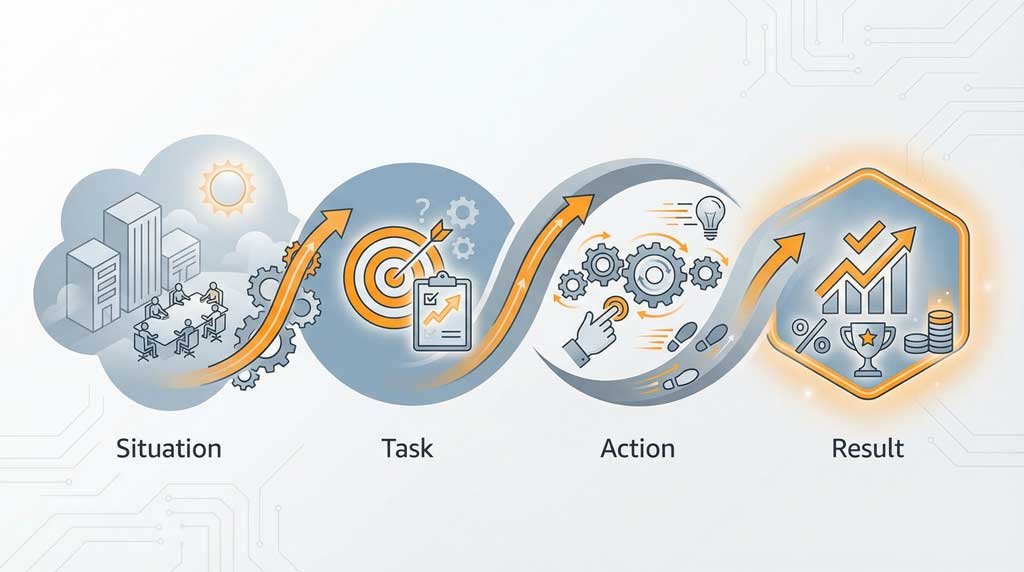
Knowing your stories is half the battle; structuring them effectively is the other half. Amazon interviewers are trained to listen for answers framed in the STAR method. It provides a clear, concise, and compelling narrative that demonstrates your experience and impact.

How to Structure Your Answers Using STAR
The STAR method is a simple yet powerful framework for answering behavioral interview questions:
- Situation: Briefly describe the context. What was the project, team, and challenge? (1-2 sentences)
- Task: What was your specific responsibility? What was the goal? (1-2 sentences)
- Action: What specific steps did you take? Focus on your individual contributions. This should be the longest part of your answer.
- Result: What was the outcome? Quantify your impact with metrics whenever possible. (2-3 sentences)
A common mistake is spending too much time on the Situation and not enough on the Action and Result. Your interviewer cares most about what you did and the impact it had.
Beyond Basic STAR: Adding Metrics and Impact
A good STAR answer tells a story. A great STAR answer proves its value with data. Instead of saying “I improved the process,” say “I improved the process, which reduced manual data entry by 10 hours per week and decreased the error rate by 25%.”
If you don’t have exact numbers, use estimates or ranges. For example, “I improved the website’s performance, which led to a significant increase in user engagement, likely around 15-20% based on our internal dashboards.” The key is to connect your actions to a measurable business outcome.
Two Complete STAR Answer Examples
Example 1: Customer Obsession
Question: “Tell me about a time you had to deal with a difficult customer.”
Situation: “I was working as a support engineer for a SaaS product. A major client, responsible for a significant portion of our revenue, was experiencing a critical bug that was disrupting their entire workflow. They were, understandably, very frustrated.”
Task: “My task was to not only fix the bug but also to manage the relationship with the client and restore their trust in our product.”
Action: “First, I established a dedicated communication channel with the client, providing them with hourly updates, even when I didn’t have a major breakthrough. I dove deep into their logs and was able to replicate the bug in our staging environment. I worked with the development team to push a hotfix, and I personally walked the client through the fix to ensure it resolved their issue.”
Result: “The bug was resolved within 24 hours. The client was so impressed with the level of support that they not only renewed their contract but also expanded their usage of our product, increasing their annual spend by 20%. I also created a new internal process for handling critical client issues to prevent similar situations in the future.”
Example 2: Ownership
Question: “Tell me about a time you took on work outside your scope.”
Situation: “Our team was preparing for a major product launch, and we discovered that our documentation was incomplete and not user-friendly. The technical writing team was overloaded, and this was a serious risk to a successful launch.”
Task: “Although I was a software engineer on the project, I knew that without good documentation, our product would fail. I decided to take ownership of the problem.”
Action: “I spent my evenings and a weekend rewriting the core sections of the documentation. I created code examples, added screenshots, and made a short video tutorial. I then worked with the tech writing team to get it reviewed and integrated into the official documentation site.”
Result: “The documentation was ready for launch. Post-launch, we saw a 40% reduction in support tickets related to the new features, which we attributed to the improved documentation. My manager recognized my initiative, and it led to me taking on more of a leadership role in subsequent projects.”
Strategic Preparation Guide: Your Path to Success
Effective preparation is not about memorizing dozens of stories. It’s about developing a flexible and powerful story bank that you can adapt to a wide range of questions. This strategic approach will save you time and build your confidence.
How to Prepare: Your Story Bank Strategy
The goal is not to have a unique story for every single one of the 80+ potential questions. That’s impossible and unnecessary. Instead, aim to develop 8-12 core stories from your career that are rich in detail, impact, and complexity. A single strong story can often be used to answer questions for 2-3 different Leadership Principles.
When selecting your stories, prioritize experiences that demonstrate significant impact, involved complex challenges, and are relatively recent. These stories should be your greatest hits—the projects you are most proud of and the challenges that taught you the most.
The Story Selection Matrix
Use a matrix to map your core stories to the Leadership Principles they demonstrate. This will help you see which principles are well-covered and where you might have gaps.
Story (Brief Title) Primary LP Secondary LPs Redesigned Checkout Flow Customer Obsession Invent and Simplify, Deliver Results Handled Production Outage Ownership Dive Deep, Bias for Action Mentored Junior Engineer Hire and Develop the Best Earn Trust Challenged Project Roadmap Have Backbone Are Right, A Lot, Think Big Preparation Timelines for Different Situations
Your preparation timeline will depend on how much notice you have. Here are three plans to guide you:
The 1-Week Crash Course
- Days 1-2: Deeply understand all 16 principles and the STAR method.
- Days 3-4: Brainstorm and develop 8 core stories. Write them out in STAR format.
- Days 5-6: Practice telling your stories out loud. Time yourself to ensure they are 3-5 minutes long.
- Day 7: Do a mock interview with a friend or colleague. Refine your answers based on their feedback.
The 2-Week Optimal Plan
- Week 1: Focus on story development. Brainstorm 15-20 potential stories, then select the best 10-12. Write them out in detail.
- Week 2: Focus on practice and refinement. Do multiple mock interviews. Practice handling follow-up questions. Record yourself to check your body language and tone.
The 1-Month Comprehensive Plan
- Weeks 1-2: Story collection and organization. Talk to former colleagues to jog your memory. Gather metrics and data to support your stories.
- Week 3: Intensive practice. Do mock interviews with people who have experience with Amazon interviews.
- Week 4: Final refinement. Focus on role-specific questions. Relax and build your confidence.
Common Mistakes and How to Avoid Them
Knowing what not to do is just as important as knowing what to do. Many talented candidates get rejected for avoidable mistakes. Here are the most common pitfalls and how to steer clear of them.
What Gets Candidates Rejected (And How to Fix It)
Mistake #1: Vague or Generic Answers
A common failure is speaking in generalities. Answers like “I’m a great team player” or “I always put the customer first” are meaningless without specific examples. Amazon’s entire process is designed to force you beyond these platitudes.
How to fix it: Every claim must be backed by a story. Use the STAR method to ground your answers in specific situations and actions.
Mistake #2: Focusing on “We” Instead of “I”
When describing a team project, it’s natural to say “we did this” or “we accomplished that.” However, the interviewer is hiring you, not your team. They need to understand your specific contribution.
How to fix it: Be the protagonist of your story. Use “I” statements to describe your actions. For example, instead of “we decided to change the architecture,” say “I analyzed the performance data and proposed a new architecture to the team.”
Mistake #3: Lacking Metrics and Measurable Outcomes
A story without a result is just an anecdote. An answer that ends with “the project was a success” is weak. Interviewers need to understand the impact of your work in concrete terms.
How to fix it: Before your interview, go back and gather the data. How much time or money did you save? By what percentage did you improve a metric? If you don’t have exact numbers, provide a well-reasoned estimate.
Mistake #4: Answers That Are Too Perfect
Candidates who only share stories of flawless success can come across as arrogant or lacking self-awareness. Amazon values learning from failure. If you can’t admit to a mistake, you’re not demonstrating the “Learn and Be Curious” or “Earn Trust” principles.
How to fix it: Prepare at least one story about a time you failed or made a significant mistake. Focus on what you learned from the experience and how you applied that learning later.
Mistake #5: Not Preparing for Follow-up Questions
A good interviewer will not just passively listen to your STAR answer. They will interrupt and ask probing follow-up questions to dive deeper. If you haven’t thought through the details of your story, you will get stuck.
How to fix it: For each of your core stories, anticipate the follow-up questions. What were the trade-offs? What would you do differently? What was the most difficult part?
Mistake #6: Explicitly Naming the Leadership Principle
Never start your answer with “Let me tell you about a time I showed Customer Obsession.” It sounds robotic and forced. The interviewer knows which principle they are asking about; your job is to tell a story that demonstrates it naturally.
How to fix it: Focus on the story. If you’ve chosen the right example and told it well, the connection to the principle will be obvious.
Mistake #7: Rambling Without Structure
Nervousness can cause candidates to ramble. Without a clear structure, your answer can become a confusing mess of details, and the interviewer will lose interest. Your key message will get lost.
How to fix it: Trust the STAR method. It’s your safety net. Before you start speaking, take a moment to structure your answer in your head: Situation, Task, Action, Result. This will keep you on track.
Red Flags Interviewers Watch For
- Blaming others for failures.
- Inability to provide details when asked.
- Claiming credit for the work of others.
- Lack of passion or enthusiasm.
- Giving answers that sound overly rehearsed.
Advanced Tips and Insider Strategies
Once you’ve mastered the basics, it’s time to elevate your game. These advanced strategies can be the deciding factor that sets you apart from other qualified candidates. They show a deeper level of preparation and a more nuanced understanding of Amazon’s culture.
Pro Tips from Successful Candidates
Handling “I don’t have experience in X”:
It’s possible you’ll be asked a question about a situation you’ve never encountered, such as managing a large budget or hiring a team. Don’t panic. The worst thing you can do is make something up. Instead, be honest and pivot. You can say, “I haven’t had the opportunity to do that in my career yet, but let me tell you about a time I had to manage a complex project with limited resources, which required similar skills in prioritization and trade-offs.” This shows honesty and the ability to think on your feet.
Using the Same Story for Multiple Principles:
This is an advanced technique that can be very effective when done right. A strong, complex story will naturally touch on multiple LPs. For example, a story about launching a new feature might demonstrate “Customer Obsession” (you solved a user problem), “Invent and Simplify” (you created a novel solution), and “Deliver Results” (the feature was launched on time and met its goals). The key is to tailor your telling of the story to emphasize the specific principle being asked about.
Handling Follow-up Questions and Diving Deeper:
Welcome follow-up questions. They are a sign that the interviewer is engaged. When they ask “What was the biggest challenge?” or “What would you do differently?”, it’s an opportunity to show self-reflection and depth. Be prepared to go one or two levels deeper than your initial answer. Have your data and details ready.
Virtual Interview Specifics (2026 Context):
In a virtual setting, clear communication is paramount. Look at the camera, not just the screen, to create a sense of eye contact. Use a good microphone and ensure you have a quiet, well-lit space. Over-communicate non-verbally with nods and smiles to show you are engaged. Test your technology beforehand.
Role-Specific Considerations
While the LPs are universal, the evidence you provide should be tailored to your target role:
- Software Development Engineer (SDE): Your stories should have a strong technical component. When talking about “Invent and Simplify,” discuss the architectural trade-offs. For “Dive Deep,” describe a complex debugging session.
- Product Manager (PM): Your stories should revolve around the customer and the business. For “Customer Obsession,” use data to show how you understand user behavior. For “Think Big,” articulate a compelling product vision.
- Technical Program Manager (TPM): Your stories should highlight your ability to lead complex, cross-functional projects. For “Deliver Results,” focus on how you managed dependencies and timelines. For “Ownership,” talk about how you drove alignment across multiple teams.
Seniority also matters. A candidate for a senior role (L6+) will be expected to provide examples of larger scope and impact. Their stories should involve more ambiguity, more strategic thinking, and influencing other teams or leaders.
Your Amazon Interview Questions Answered
- 1. How many Amazon Leadership Principles are there?
- There are 16 Amazon Leadership Principles. The list was updated from 14 to 16 in 2021 with the addition of “Strive to be Earth’s Best Employer” and “Success and Scale Bring Broad Responsibility.”
- 2. What is the STAR method?
- The STAR method is a framework for structuring your answers to behavioral questions. It stands for Situation, Task, Action, and Result. It helps you tell a clear, concise, and impactful story.
- 3. How long should my answers be?
- Aim for your answers to be between 3 to 5 minutes. This is long enough to provide sufficient detail and demonstrate impact, but not so long that the interviewer loses interest. Practice timing your stories.
- 4. Can I use the same story for multiple principles?
- Yes, absolutely. A strong, complex story will often demonstrate multiple principles. The key is to tailor your telling of the story to emphasize the specific principle the interviewer asked about.
- 5. What is a Bar Raiser at Amazon?
- A Bar Raiser is a specially trained, objective interviewer from outside the hiring team. Their role is to ensure every new hire “raises the bar” and to maintain a high hiring standard across the company. They have the power to veto a hiring decision.
- 6. Should I mention the principle name in my answer?
- No. Explicitly naming the principle (e.g., “Here is a time I showed Customer Obsession”) sounds robotic and unnatural. Your story should be compelling enough that the principle it demonstrates is obvious.
- 7. How many principles are tested in one interview?
- Typically, each interviewer in your loop will be assigned 2-3 Leadership Principles to focus on. Across the entire loop of 4-6 interviews, you can expect to be tested on most, if not all, of the principles.
- 8. What if I don’t have work experience for a principle?
- Be honest. Don’t invent an example. You can use experiences from school projects, volunteer work, or even personal life, as long as they are complex and compelling. You can also pivot to a related example that demonstrates similar skills.
- 9. How do I handle follow-up questions?
- View them as a positive sign of engagement. Be prepared to dive deeper into the details of your story. Anticipate questions about your thought process, the trade-offs you made, and what you would do differently.
- 10. What are the most important principles?
- While all 16 are important, “Customer Obsession,” “Ownership,” and “Deliver Results” are foundational to Amazon’s culture and are often tested heavily. However, you should be prepared for any of them.
- 11. How is virtual interviewing different?
- The format is the same, but the medium requires more conscious effort. Ensure you have a stable internet connection, good lighting, and a quiet background. Look at the camera to simulate eye contact and use non-verbal cues to show you are engaged.
- 12. How many stories should I prepare?
- Quality over quantity. Aim for 8-12 strong, detailed core stories. A single well-prepared story can often be adapted to answer questions about 2-3 different principles.
- 13. Can I use examples from school or volunteer work?
- Yes, especially if you are early in your career. The key is the complexity and impact of the story, not where it came from. A story about leading a complex university project can be more powerful than a simple task from a previous job.
- 14. What metrics should I include in my answers?
- Include any metrics that show the impact of your actions. This could be percentages (e.g., reduced error rates by 15%), time or money saved (e.g., saved 20 hours per week), or customer satisfaction scores. If you don’t have exact numbers, use well-reasoned estimates.
- 15. How do I know if my answer was good?
- A good sign is when the interviewer is engaged and asks probing follow-up questions. If they seem to be digging deeper, it means your story is interesting and they want to learn more. A short, polite “thank you” with no follow-up might indicate your answer was too brief or lacked substance.
Your Next Steps to Interview Success
You now have a comprehensive playbook for mastering Amazon Leadership Principles questions. You understand the principles, the structure of the interview, the questions to expect, and the strategies to prepare. You know how to craft compelling stories using the STAR method and how to avoid the common mistakes that trip up other candidates.
But knowledge is only potential power. The real work begins now. The path to success at an Amazon interview is paved with authentic, well-prepared stories. Your experiences, your challenges, and your triumphs are the raw material. Your task is to shape them into narratives that demonstrate you not only have the skills for the job but also the mindset of an Amazonian leader.
Start building your story bank today. Practice telling your stories until they feel natural and confident. Embrace the process of self-reflection. If you do, you will walk into your interview not with anxiety, but with the quiet confidence of someone who is prepared to show they belong. You are ready to raise the bar.