

Amazon STAR interview practice should help you explain a decision, answer questions about it, and keep the facts consistent. Start with an experience you know well, tell it from short notes, then use follow-up questions to find the part that needs checking or explaining.
A polished opening can still leave you stuck at “Why did you choose that approach?” Prepare the alternatives, constraints, and evidence behind your actions before you rehearse the story again.
Choose a question and a relevant story
Choose an episode in which your own responsibility and decisions are clear. A large project with a vague personal role gives you less to discuss than a smaller task you can explain accurately.
Begin with a behavioral question and the behavior it asks you to demonstrate. For an ownership question, look for a time you noticed a problem, took responsibility for a next step, and followed through. Use the Amazon Leadership Principles question bank to identify a relevant prompt; don’t force a story onto a question it doesn’t answer.
STAR stands for Situation, Task, Action, and Result. In its recruiting manager’s interview advice, Amazon recommends the framework, personal “I” statements, and data where applicable. Amazon also says STAR is a communication tool rather than something to memorize.
An internship, course project, volunteer assignment, or previous industry can give you material. Check the scope against the target job: the episode still needs to show the responsibility and judgment the question asks about. A title alone won’t establish that connection.
Amazon’s interview-loop guidance describes individual conversations with employees who assess different aspects of your skills and experience. Ask your recruiter about the format for your role. The exercises that follow are rehearsal suggestions, not an official Amazon question list or scoring system.
Make short notes and check the evidence
Write memory cues for the situation, your responsibility, your action, and the result, then add the reason behind a key decision. Keep the notes short enough to glance at; a script makes it harder to change direction when someone interrupts.
Build a story card before practicing aloud:
- Question: What behavior does the interviewer want an example of?
- Situation and task: What was happening, and what were you responsible for?
- Action and reason: What did you decide, what else could you have done, and why?
- Result: What changed, and how do you know?
- Learning: What would you keep or change next time?
Beside each outcome, write one of these evidence labels. These are private preparation notes, not labels to recite in the interview.
| If your outcome is… | Check before rehearsal | How to describe it |
|---|---|---|
| Measured | Confirm the measure, comparison period, and your contribution using records you are permitted to access. | Give the supported number and explain what was measured. Separate the team’s outcome from your part. |
| Observed but not measured | Identify what you directly saw or what someone actually confirmed. | Describe that observation. Don’t turn it into an invented percentage or time saving. |
| Unverified or remembered uncertainly | Check an appropriate record, narrow the claim, or choose a different episode. | State the limit of what you know. Leave out a number you cannot support. |
Put the card aside and tell the story aloud. Then check whether you gave yourself credit for a colleague’s decision or described a team result as your own. If the recording runs on, cut background the listener doesn’t need before trying to speak faster.
Keep confidential names, customer information, and internal documents out of shared practice material. You can explain the decision without uploading an employer’s records to a feedback tool.
Use follow-up questions to find what needs repair
Match each follow-up question to a detail you can check or a sentence you need to clarify. Rehearsing the same opening again won’t resolve a missing explanation of why you acted.
Ask a friend or coach to interrupt after a decision. When practicing alone, pause your recording there and answer a prompt before continuing. The questions in the table are editorial rehearsal prompts; they aren’t predictions of what a particular Amazon interviewer will ask.
| When you are asked… | Find the missing detail | Repair the answer |
|---|---|---|
| “What did you personally do?” | Your assignment, action, and authority versus a teammate’s. | Name your action and credit the person who approved or completed the other part. |
| “Why this approach rather than the alternative?” | The constraint and information available at the time. | Explain the option you rejected and the trade-off you accepted. |
| “How did you know it worked?” | A supported measure or a direct observation. | Name the evidence and its limits; remove any guessed uplift. |
| “What went wrong?” | A setback, missed assumption, or unresolved part. | Explain your response without quietly changing the original goal. |
| “What would you do differently?” | A lesson connected to the decision you described. | Name a specific change and the condition that would make it useful. |
After the rehearsal, ask the listener to identify one unsupported decision or unclear handoff. Revise that part of the story card and try again. Don’t add a step you never took just because it would make the answer sound stronger.
Test one decision in the volunteer example
A useful practice answer separates the speaker’s decision from someone else’s authority and states the limits of the result. The following volunteer scenario is fictional: it demonstrates the structure, not an accomplishment to borrow.
Suppose a student coordinating an event’s volunteer rota discovers that two volunteers cannot cover their shifts. For this example, assume the student can propose a new rota, but the event lead must approve changes.
A vague response would be “We worked together and made the event a success.” The listener still doesn’t know what the student decided.
A more specific illustrative answer would be:
“I was responsible for coordinating the rota. When the volunteers withdrew, I checked which tasks needed cover before the event opened. I proposed moving available volunteers onto those tasks and asked the event lead to approve the change. I then confirmed the revised assignments with the volunteers. The opening tasks were covered, but I didn’t measure whether the change affected waiting times.”
A follow-up could be “Why did you move existing volunteers instead of recruiting replacements?” In this fictional version, assume the event was about to open and no replacements had confirmed availability. The student could explain:
“I knew who was already available, so I proposed covering the opening tasks with that group. Waiting for unconfirmed replacements risked leaving those tasks uncovered. I couldn’t approve the rota change myself, which is why I took the proposal to the event lead.”
Work from the constraints in your own experience. Replace the fictional approval process, timing, and outcome with facts you can explain; for a workplace story, check who proposed, approved, executed, and measured each part.
Repeat Amazon STAR interview practice with a different question
Use a second question and a different episode to check whether you can repeat the process without forcing one story to fit everything. Change one weak section at a time so you can hear what the revision fixes.
An optional 40-minute session could look like this. The allocation is a planning example, not an Amazon requirement or a proven optimum.
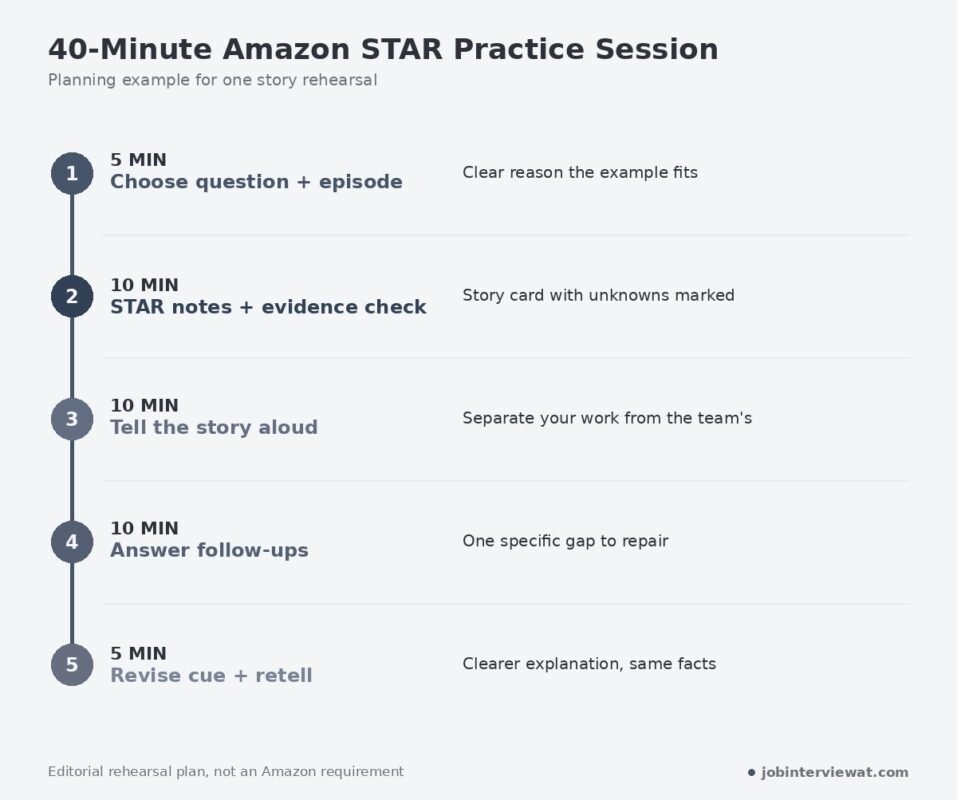
| Time | Practice task | Finish with |
|---|---|---|
| 5 minutes | Choose a question and a relevant episode. | A clear reason the example answers the question. |
| 10 minutes | Make brief STAR notes and check the decision evidence. | A story card with any unknowns marked. |
| 10 minutes | Tell the story aloud and compare it with the facts. | A clear distinction between your work and the team’s. |
| 10 minutes | Answer follow-ups about alternatives, results, setbacks, and learning. | One specific gap to repair. |
| 5 minutes | Revise the relevant cue and retell that part. | A clearer explanation without changing the facts. |
Spend longer checking a story if the follow-ups expose details you can’t recall accurately. Before moving on, check that you can identify your contribution, explain a rejected alternative, support the outcome, and discuss an unresolved issue or lesson. Those are rehearsal checks, not a hiring score.
Decide whether feedback needs a person or a tool
Choose feedback that addresses the gap you found. A story-selection problem calls for checking relevance; difficulty answering interruptions calls for spoken practice.
For paid support, Day One Careers offers amazon interview preparation through its Interview Preparation System. The provider describes a combination of a course, AI Story Review, and personal coaching. Its AI tool reviews prepared written stories rather than simulating a live spoken interview, so use spoken practice separately when follow-up delivery is the problem.
Start with Amazon’s own guidance and a practice partner if that meets your needs. Treat a third-party provider’s feedback as preparation advice, not Amazon’s assessment of your candidacy. Whether feedback comes from AI or a person, reject suggested achievements, actions, or metrics that weren’t part of your experience.
Questions about Amazon STAR interview practice
What should I say if I cannot remember the exact result?
Describe an outcome you can support and state what you didn’t measure. Check an appropriate record if available; otherwise, use a narrower observation or another story rather than inventing a number.
Can I use a student or volunteer example for a senior role?
Choose the example that demonstrates the scope the question asks about. A volunteer episode may explain a decision clearly, but don’t present it as proof of large-scale organizational leadership if it doesn’t show that responsibility.
Does behavioral practice also prepare me for an Amazon assessment?
Behavioral story practice doesn’t replace preparation for a separate assessment or role-specific exercise. Check your recruiter instructions and the role-by-role Amazon assessment guide, then make a separate plan for any coding, system design, or functional work your process requires.