

The certifications that pay well fastest are a Class A CDL, CompTIA A+, and a phlebotomy credential: each takes about three months and leads into work with a Bureau of Labor Statistics median between $43,660 and $61,550. Wait six months and pharmacy tech, Security+, medical coding, HVAC, and a real estate license open up. Give it a year and LPN, surgical tech, and radiologic tech move the median into the $60,000 to $79,000 band.
Sorting by time matters more than sorting by headline salary. Most people reading this are choosing between three months of lost income and twelve, and the biggest numbers on any certification list belong to credentials that assume years of experience you may not have yet.
One more thing the salary lists leave out. Across roughly fifteen years of hiring for a Fortune 500 company, I watched a fresh certification win an interview about as often as it lost one, and the difference was never the paper itself. It was whether the candidate could answer two or three plain questions about it. So each entry below carries the salary, the time, the cost, and what an interviewer will ask you once the credential is on the table.
“Trying to figure out the best path without going back to college What certifications or licenses have actually helped you get a good-paying job? CDL, trades, tech… what’s worth it?”
– r/careerguidance, March 2026 (91 upvotes)
What the salary figures mean before you compare them
Every salary in the tiers below is the May 2024 national median from the Bureau of Labor Statistics unless a certifying body is named instead, and a median covers everyone in the occupation, including people twenty years in. Your first offer will usually sit below it. Treat the median as the number you grow into over three to five years, and treat the entry figure, where I give one, as the offer to expect in month one.
Cost is the exam fee from the certifying body’s own price page. Training on top of that ranges from free vendor courses to community-college programs in the low thousands, and I say which is which.
The full list at a glance
| Tier | Certification or license | Median pay (BLS, May 2024) | Exam or licensing cost |
|---|---|---|---|
| ~3 months | Class A CDL | $57,440 (heavy truck drivers) | State fees plus a training program |
| ~3 months | Phlebotomy technician (CPT) | $43,660 | About $125 exam |
| ~3 months | CompTIA A+ or Google IT Support | $61,550 (computer support specialists) | Roughly $506 for two A+ exams; Google cert about $49/month |
| ~3 months | Property & casualty insurance license | $60,370 (insurance sales agents) | State exam and pre-licensing course, low hundreds |
| ~6 months | Pharmacy technician (CPhT) | $43,460 | $129 exam |
| ~6 months | CompTIA Security+ | $124,910 (information security analysts, all levels) | About $392 exam |
| ~6 months | Medical coder (CPC) | $67,260 certified average (AAPC 2026 survey) | $425 to $675 exam |
| ~6 months | HVAC technician with EPA 608 | $59,810 | Exam under $100; program in the low thousands |
| ~6 months | Real estate license | $58,960 (agents and brokers) | Varies by state, typically several hundred |
| ~1 year | LPN / LVN | $62,340 | NCLEX-PN plus a 12-month program |
| ~1 year | Surgical technologist | $62,480 | Program of 12 to 24 months |
| ~1 year | Radiologic technologist (ARRT) | $78,980 | Accelerated 12-month or 2-year program |
Certifications you can earn in about 3 months
The three-month tier is where the trade-off is sharpest: the credentials are cheap and quick, and the interview does more of the work because you have no track record behind the paper.
Class A commercial driver’s license
Heavy and tractor-trailer truck drivers earned a median of $57,440 in May 2024 according to the BLS Occupational Outlook Handbook, and the entry-level education line on that page reads “postsecondary nondegree award,” which in practice means a CDL school. Since February 7, 2022 the Federal Motor Carrier Safety Administration has required anyone seeking a first Class A or B CDL to complete Entry-Level Driver Training from a registered provider, so the informal “my uncle taught me” route is gone.
Full-time programs run three to seven weeks; community-college and evening versions stretch to about three months. Many carriers pay for the school in exchange for a commitment of a year or so, which is the cheapest way in if you can live with the contract.
What interviewers ask CDL holders:
- “Walk me through your pre-trip inspection.” They want the order you check things in, not a list. Skipping the air-brake test is the classic miss.
- “How would you handle a delivery window you know you will not make?” Recruiters at carriers listen for whether you call dispatch before the window closes, and for how you talk about hours-of-service limits.
- “Tell me about your driving record.” Say the ticket before they find it.
Phlebotomy technician (CPT)
Phlebotomists earned a median of $43,660 in May 2024 per the BLS, and the credential most hospital labs ask for is the Certified Phlebotomy Technician from the National Healthcareer Association, whose exam fee is about $125. Training programs run eight to sixteen weeks and include a set number of supervised draws, which is the part that separates one applicant from another.
Phlebotomy pays the least of the twelve credentials listed. It earns its place because it is a hospital badge in under four months, and hospitals promote from inside far more than they hire lab and patient-care staff from outside.
What interviewers ask:
- “How many successful draws did you log in training, and how many sticks does it usually take you?” Have the number.
- “A patient tells you they faint at needles. What do you do before you draw?” Positioning, warning them, watching color, and knowing where the emergency call button is.
- “What is your order of draw?” This gets asked verbatim, and hesitating on it ends interviews.
CompTIA A+ or the Google IT Support certificate
Computer support specialists earned a median of $61,550 in May 2024 according to the BLS, and help desk is still the widest door into IT for someone with no degree. CompTIA A+ takes two exams (Core 1 and Core 2) at roughly $506 total and most people pass after six to twelve weeks; the Google IT Support Professional Certificate on Coursera runs about $49 a month and takes three to six months self-paced. Employers accept either, and I have seen candidates walk in with both.
Entry offers commonly land in the $40,000 to $60,000 range depending on metro, which the median masks. The AWS Certified Cloud Practitioner ($100 exam, two to six weeks of study using Amazon’s free training) is a sensible add-on in the same quarter, but on its own it does not get anyone hired.
What interviewers ask A+ holders:
- “A user says their laptop is slow. What is the first thing you check, and the second?” The right shape is a sequence, and the wrong shape is “reboot it.”
- “How would you explain to a non-technical caller why you need them to restart?” Help-desk hiring managers weigh this above the technical answer.
- “Which ticketing system have you used, even in a lab?” Name it, even if it was a free-tier trial you set up yourself.
Property and casualty insurance license
Insurance sales agents earned a median of $60,370 in May 2024 per the BLS, and a state P&C license needs only a pre-licensing course of around 20 to 40 hours plus a state exam, both usually in the low hundreds of dollars. It was the first suggestion in the r/careerguidance thread quoted above, and for good reason: agencies and carriers hire licensed people into service and sales roles constantly, and much of the work is remote.
The catch is that pay is heavily commission-based on the sales side, and pure customer-service seats start lower than the median.
What interviewers ask:
- “Explain the difference between an actual cash value and a replacement cost policy to a first-time homeowner.” A licensing-exam concept turned into a customer sentence.
- “How do you handle a policyholder angry about a rate increase?” They want de-escalation, then a fact about why rates move.
- “Are you willing to add a life and health license within the year?” Say yes if it is true; it doubles what an agency can sell through you.
Certifications you can earn in about 6 months
The six-month tier trades one more season of study for credentials that carry a defined scope of practice or a recognized exam, so interviewers ask fewer “can you do this at all” questions and more “show me you know the rules” ones.
Pharmacy technician (CPhT)
Pharmacy technicians earned a median of $43,460 in May 2024 per the BLS, and the Pharmacy Technician Certification Board charges $129 to apply and sit the exam. Retail chains and hospitals both hire on it, and hospital and specialty pharmacies pay meaningfully above the retail counter. Programs run four to nine months depending on state hour requirements, and some states let you train on the job at a chain that reimburses the exam.
What interviewers ask CPhT holders:
- “A prescription looks like it could be for two different drugs. What happens next?” Stop, do not guess, escalate to the pharmacist. Every other answer fails.
- “How do you handle a customer whose insurance rejected the claim while a line is forming?” Retail managers hire on this one.
- “What is the difference between a Schedule II and a Schedule IV drug in how you handle it?” A straight exam question that checks whether the study stuck.
CompTIA Security+
Information security analysts earned a median of $124,910 in May 2024 per the BLS, but that figure covers senior and specialized people, and Security+ alone will not put you in it. Junior SOC and security-support seats commonly open between $60,000 and $85,000. The exam is about $392, renews every three years, and most people study six to twelve weeks; the “six months” here assumes you are pairing it with A+ or a help-desk job first, which is the path hiring managers expect to see.
Security+ is also on the Department of Defense baseline list, so it opens contractor roles that will not read a resume without it.
What interviewers ask:
- “An employee reports a phishing email they clicked. What are your first three steps?” Contain, preserve evidence, escalate; the order matters.
- “Explain the difference between symmetric and asymmetric encryption to me as if I ran the warehouse.” Every security interview I sat in included a translation test like this.
- “What was on the practice-exam domain you scored lowest on?” Honesty here reads as maturity.
Medical coder (CPC)
Certified medical records specialists averaged $67,260 a year in the AAPC 2026 salary report, against $55,721 for uncertified peers, and BLS puts the overall median for medical records specialists at $50,250. The distance between those figures is the credential premium, one of the clearest of the twelve. The CPC exam runs $425 for AAPC members and $675 otherwise, and a self-paced course to prepare for it takes most people four to eight months.
Two cautions. Fresh CPCs carry an apprentice designation (CPC-A) until they log experience, and entry offers reflect that; and this is the field where remote work is common, so competition for the fully remote seats is national.
What interviewers ask:
- “Code this visit note out loud.” A short chart, on paper, in the room. Practice narrating your logic, not just the code.
- “How do you handle a physician whose documentation does not support the level billed?” Query the provider; never upcode, never silently downcode.
- “Which specialty did you practice most, and which would you avoid?” Nobody expects breadth from a new coder; they want self-knowledge.
HVAC technician with EPA Section 608
Heating, air conditioning, and refrigeration mechanics earned a median of $59,810 in May 2024 per the BLS. Federal law requires the EPA Section 608 certification for anyone who handles refrigerants, the exam typically costs well under $100, and a six-month certificate program at a community college or trade school gets you both the card and the hands-on hours a shop wants to see. If the trades in general appeal to you, the notes on moving into a trade career cover how to pitch a mid-career switch to a shop owner.
What interviewers ask:
- “A homeowner says the AC runs but does not cool. Talk me through your diagnosis.” They are checking whether you start with airflow and filters before touching refrigerant.
- “How do you handle a customer who thinks the repair quote is too high?” Small-shop owners hire the person who can explain a bill.
- “Are you comfortable in attics in August?” It sounds like a joke and it is not; say yes only if it is true.
Real estate license
Real estate sales agents and brokers earned a median of $58,960 in May 2024 per the BLS, but the spread around that median is wider than for any other line here because income is commission. Pre-licensing runs 60 to 180 hours depending on state, and total licensing cost typically lands in the several-hundred-dollar range before brokerage and association fees.
Interviewers here are brokers deciding whether to sponsor you, and they ask two things: how many months of expenses you have saved, and how you plan to find your first ten clients. Have concrete answers to both or wait a tier.
Certifications that take about a year
The one-year tier is healthcare-heavy because that is where a twelve-month program buys a licensed scope of practice, and licensed scope is what moves the median above $60,000 without a bachelor’s degree.
Licensed practical or vocational nurse (LPN/LVN)
LPNs and LVNs earned a median of $62,340 in May 2024 per the BLS, after a state-approved program of about twelve months and the NCLEX-PN exam. Long-term care hires LPNs in volume, hospitals less so, and many LPNs use the license as a paid bridge to an RN program.
What interviewers ask LPN candidates:
- “A resident’s blood pressure is well outside their normal. Who do you notify and how fast?” Scope of practice, in a scenario.
- “Tell me about a clinical rotation where you disagreed with a plan of care.” They want to hear you raised it through the right channel.
- “How do you handle a family member who is angry at the nursing station?”
Surgical technologist
Surgical technologists earned a median of $62,480 in May 2024 per the BLS. Programs run twelve to twenty-four months, and the twelve-month certificate versions usually require prior healthcare exposure, which is one reason phlebotomy or CNA work often comes first.
Interviewers ask about sterile technique breaks (“you touched the edge of the field, what now”), instrument counts, and how you handle a surgeon who is short with you. The right answer to the last one is that you keep the count.
Radiologic technologist (ARRT)
Radiologic technologists earned a median of $78,980 in May 2024 per the BLS, the highest figure in the one-year tier, but most programs are two-year associate degrees ending in the ARRT exam. Accelerated twelve-month options exist for people with prior credits, which is the route one Salt Lake City commenter pointed a stuck 34-year-old toward:
“I would consider looking into being a radiology tech. Usually 18-24 months of school for an associates and the ARRT exam afterward. The U offers an accelerated 12 month program you could look into. I don’t know how much time you might have to work through education, but it may be possible. I looked at job listings at Intermountain recently, and pay ranges 60-90k depending on experience. Pretty good bang for your buck for likely low cost (I think tuition with the U is 6k for their program) and r…”
– r/Salary, May 2026 (45 upvotes)
Interviewers ask rad tech graduates about positioning for a specific view, how they handle a patient who cannot hold still, and radiation-dose reasoning for pediatric or pregnant patients. All three come straight from clinicals, so keep a short list of cases from your rotations.
If you hold a bachelor’s degree
Two credentials that need a degree but no specific major reward the year of study better than most of the above. The Project Management Professional requires 36 months of leading projects, costs $425 for PMI members and $675 otherwise per PMI, and BLS puts project management specialists at a $100,750 median. On the finance side, the CMA takes about a year of part-time study; what employers look for behind a CMA or CIPS is covered separately.
How an interviewer reads a certification that is only weeks old
An interviewer treats a new certification as a claim to be tested, and the test has three passes that take under five minutes combined.
First, is it current: the exam date, the renewal cycle, and whether the version you passed matches what the posting names (Security+ has had several editions, and CDL rules changed in 2022). Second, did you use it: one task, one lab, one shift, one supervised draw where the material came up, told in under a minute. Third, can you explain one term from the exam to someone outside the field without reaching for jargon.
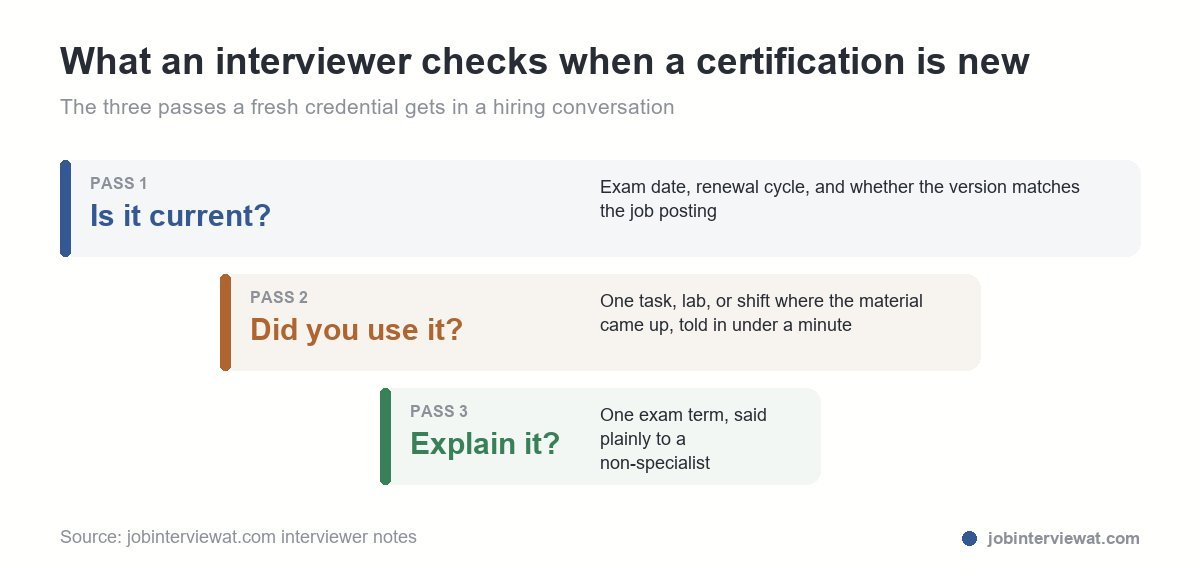
Pass two decides most outcomes. Candidates who studied from a video course and sat the exam the next week fail it because they have no story yet, and the interviewer hears “I have the paper” where they hoped to hear “I have done the thing once.” The fix costs a weekend: a home lab for A+ or Security+, a volunteer clinic day for phlebotomy, ride-alongs for HVAC, an unpaid coding practicum through your course provider. Then the certification question is answered by the story, and the rest of the interview goes back to the fifteen questions everybody gets asked, which you should prepare the same way.
The other pattern I saw repeatedly: candidates hiding a certification because it was “only” a CNA or “only” a P&C license. Put it on the resume. Interviewers read a completed credential as evidence you finish things, and for a career changer that is the exact doubt they are trying to resolve. More on that shift lives in the career change and upskilling section.
Common questions about certifications that pay well
What is the highest paying certification?
Skillsoft’s 2024 IT Skills and Salary survey lists AWS Certified Security – Specialty as the highest-paying certification at an average of $203,597, followed by Google Cloud Professional Cloud Architect at $190,204 and CISSP at $168,060, according to Skillsoft’s published ranking. Every one of them assumes years of prior IT experience; CISSP formally requires five. For someone starting from zero, the highest-paying certification reachable inside a year is the ARRT radiologic technologist credential at a $78,980 median.
What are the easiest certifications to get that pay well?
The easiest certifications that still pay near or above $57,000 are the Class A CDL, a state property and casualty insurance license, and CompTIA A+, each obtainable in roughly three months with no prerequisites beyond a high school diploma. “Easy” here means short and low-cost, not effortless: the CDL skills test and the A+ exams both have meaningful failure rates, and the pay depends on passing an interview afterward, which is why each entry above lists the questions to expect.
What can I learn in 3 months to get a job?
In three months you can complete CDL training, a phlebotomy program, CompTIA A+, or a state insurance pre-licensing course, and all four have employers hiring on the credential alone. Pick the one whose interview you can already picture yourself passing: if talking to strangers drains you, choose phlebotomy or A+ over insurance; if you cannot be away from home overnight, skip the CDL.
How to make $100,000 a year with no degree?
Reaching $100,000 without a degree usually means stacking a certification path over several years: BLS medians already above that line include information security analysts at $124,910 and project management specialists at $100,750, and neither occupation requires a specific degree in practice, though PMP does need 36 months of documented project work. Faster routes exist in commission sales (real estate, insurance) and in owner-operator trucking, but those depend on volume rather than a credential, and the median earner in each is well below six figures.