
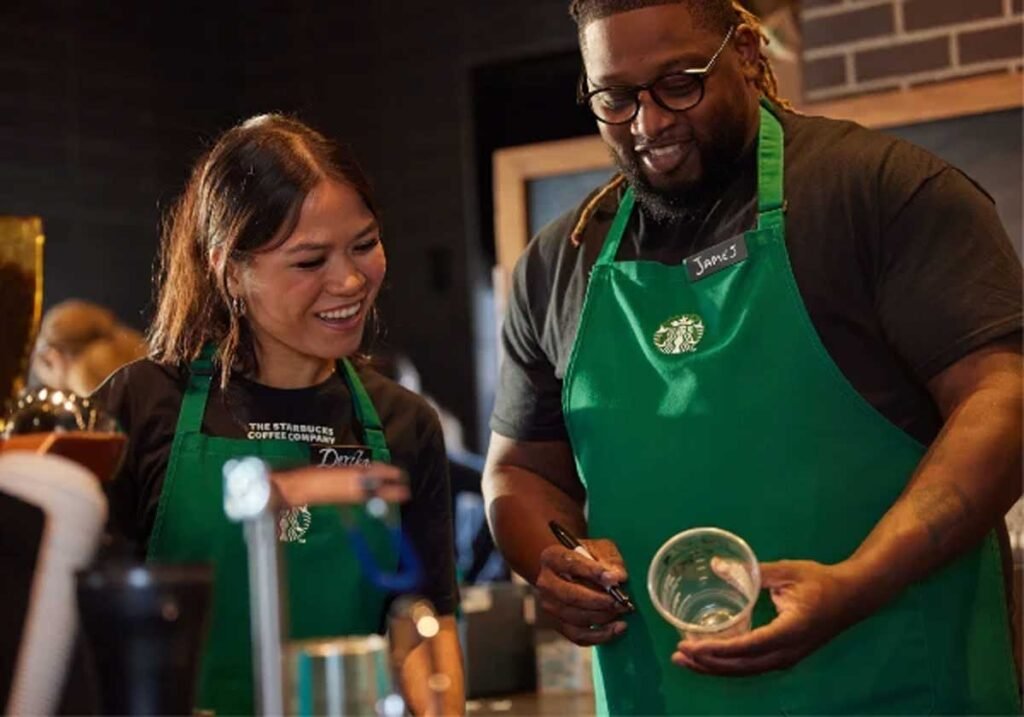
Starbucks employee benefits switch on at about 20 hours a week. Retail hourly partners who are paid at least 160 hours across two consecutive months qualify for medical, dental, and vision plans, full tuition for a first bachelor’s degree online at Arizona State University, stock grants, a 401(k) match, and a stack of perks from a free weekly pound of coffee to twenty therapy sessions a year, all listed on the company’s careers site. That threshold is the whole reason the package is famous: most retailers gate the same benefits behind full-time status.
Employees call the package the reason they stay.
The most-upvoted benefits post on r/starbucks this year is a seven-year partner urging coworkers to actually enroll, because the company itself frames the total value at roughly $30 an hour with benefits included and too many baristas leave pieces unclaimed. The catalog below is organized around that problem: what exists, when it turns on, and which pieces people forget.
Benefits explain why the interview draws crowds; the Starbucks interview guide covers the conversation that guards them.
Eligibility: the 20-hour line and the 90-day clock
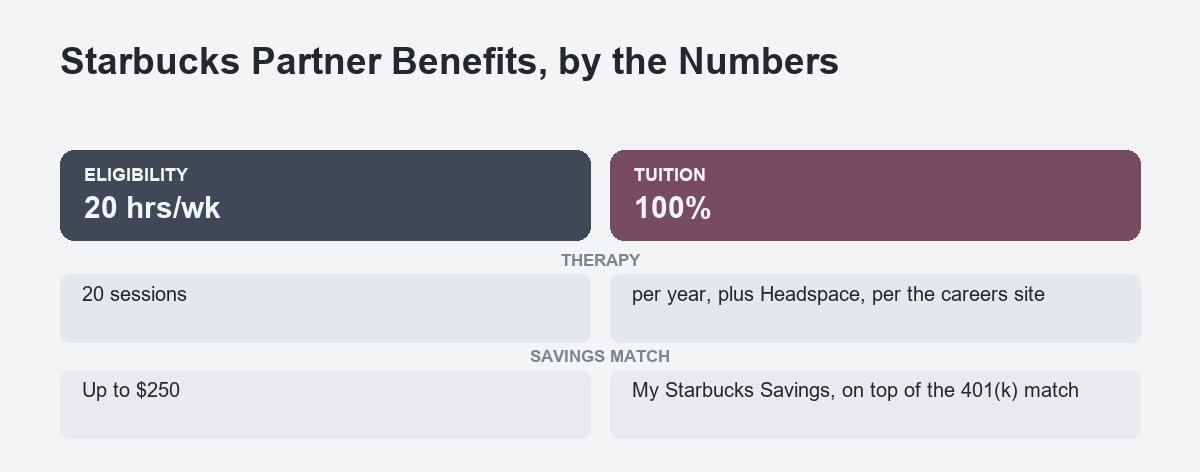
Retail hourly partners become benefits-eligible after being paid at least 160 hours over two consecutive calendar months, the equivalent of 20 hours a week, and keep eligibility by holding about 240 paid hours per quarter, according to the company’s own eligibility page. Retirement and stock purchase open on a separate clock, at 90 days of employment for partners 18 and older.
Two practical consequences. New hires should watch their scheduled hours during the first two months, because a slow start delays every benefit behind it. And partners who drop under the quarterly threshold can lose coverage, which is the trap seasonal schedules set; asking for enough hours is a benefits decision, not just a paycheck one.
The Starbucks employee benefits catalog
The package groups into health, money, education, and perks. Every item below appears on the company’s careers site or its benefits portal; details like plan costs vary by state and enrollment choices.
| Category | What partners get | Worth knowing |
|---|---|---|
| Health | Medical, dental, vision plans; 20 therapy sessions a year plus Headspace; paid parental leave; fertility, adoption, and surrogacy support; life and disability options | Therapy sessions cover family members too, and partners consistently name them as the most-forgotten benefit |
| Money | 401(k) match; My Starbucks Savings match up to $250; Bean Stock grants; a discounted stock purchase plan; student-loan tools; the CUP Fund for emergencies | Bean Stock is free equity that vests over about two years; the CUP Fund is partner-funded grants for crises |
| Education | Full tuition for a first bachelor’s degree online at ASU, 140+ programs, with credit-conversion costs covered for partners who do not initially qualify | The careers site says nearly 90% of U.S. stores have at least one partner enrolled |
| Perks | 30% partner discount, a free pound of coffee or box of tea weekly, free drinks and a food item on shift, Spotify Premium, retailer discounts, up to $1,000 nonprofit match | Free-drink details vary by store policy; the weekly coffee markout is the perk veterans call underused |
Read across the rows and the pattern is that almost nothing here is gated behind full-time status. The same 20-hour partner qualifies for the tuition program and the stock grants that a corporate employee elsewhere would need a salaried badge to touch.
The benefits partners forget to use
The gap between what exists and what gets used is wide enough that veterans post reminders about it:
“This company claims to pay baristas an equivalent of $30/hour with benefits factored in, so use them all to your advantage! One of the reasons I still work here after 7 years is for the benefits. When I hear my coworkers talk about not using certain ones because they don’t know how or didn’t know it existed I immediately send them to the right resources to get started. Obviously, what you choose to opt in for depends on you and your personal choices and circumstances, but it is \*so\* worth it….”
– r/starbucks, May 2026 (337 upvotes)
The replies name the confusion precisely: partners with Fidelity accounts they do not understand, stock balances they did not know they held, 401(k) contributions set at the default and never revisited. A coworker in the same thread explained the equity in plain terms:
“You can get stocks 2 ways from working at Starbucks. “Bean Stock” aka RSUs – Starbucks basically gives you free stock each November. I believe for retail partners these are a 2 year vest. Let’s say Starbucks grants you 6 shares in November 2025. You’d get 3 shares in November 2026 and 3 shares in November 2027. You’d also get another grant in November 2026 they’ll vest over the following 2 years. When the stocks vest, they get deposited to your Fidelity individual account. You get these stocks….”
– r/starbucks, May 2026 (13 upvotes)
Three items top the forgotten list. The twenty therapy sessions, because partners assume mental-health coverage means a copay rather than free visits. The weekly coffee markout, because it requires remembering to claim it. And the My Starbucks Savings match, free money on top of the 401(k) that requires opting in. A new partner who sets up all three in week one has captured most of the value coworkers leave behind.
Pay versus benefits: the honest math
The hourly wage alone sits in ordinary food-service territory, and the searches asking whether baristas make $20, $25, or $30 an hour conflate two numbers: the base rate, which lands well under those figures for most new baristas, and the total-compensation claim the company makes with benefits included. Both are real; they measure different things.
The comparison worth doing depends on what you would use. A student who takes the ASU tuition and the therapy sessions is being paid something no fast-food competitor matches. A partner who never enrolls in anything is earning barista wages and leaving the premium on the table, which is exactly the situation the veterans above keep posting about.
Frequently asked questions
Does Starbucks pay $30 an hour?
Not as a base wage; the $30 figure is the company’s total-compensation estimate with benefits factored in, as employees themselves point out. Hourly barista pay runs well below that and varies by market, while the benefits close the gap only for partners who enroll.
Do Starbucks workers get free drinks?
Yes: partners get free drinks and a food item during shifts under store markout policy, a 30% discount otherwise, and a free pound of coffee or box of tea every week. Exact on-shift allowances vary by store, so ask your manager on day one.
Do part-time Starbucks employees get benefits?
Yes, and that is the package’s defining feature: retail partners averaging about 20 hours a week, measured as 160 paid hours across two consecutive months, qualify for health insurance, ASU tuition, stock, and the rest. Retirement and stock purchase open at 90 days for partners 18 and older.
How do partners enroll in Starbucks benefits?
Enrollment runs through the partner benefits portal after eligibility triggers, with a window to elect health plans and separate setup for Fidelity retirement and stock accounts. Veterans recommend enrolling in the savings match and booking the first therapy session in week one, before the window slips.