
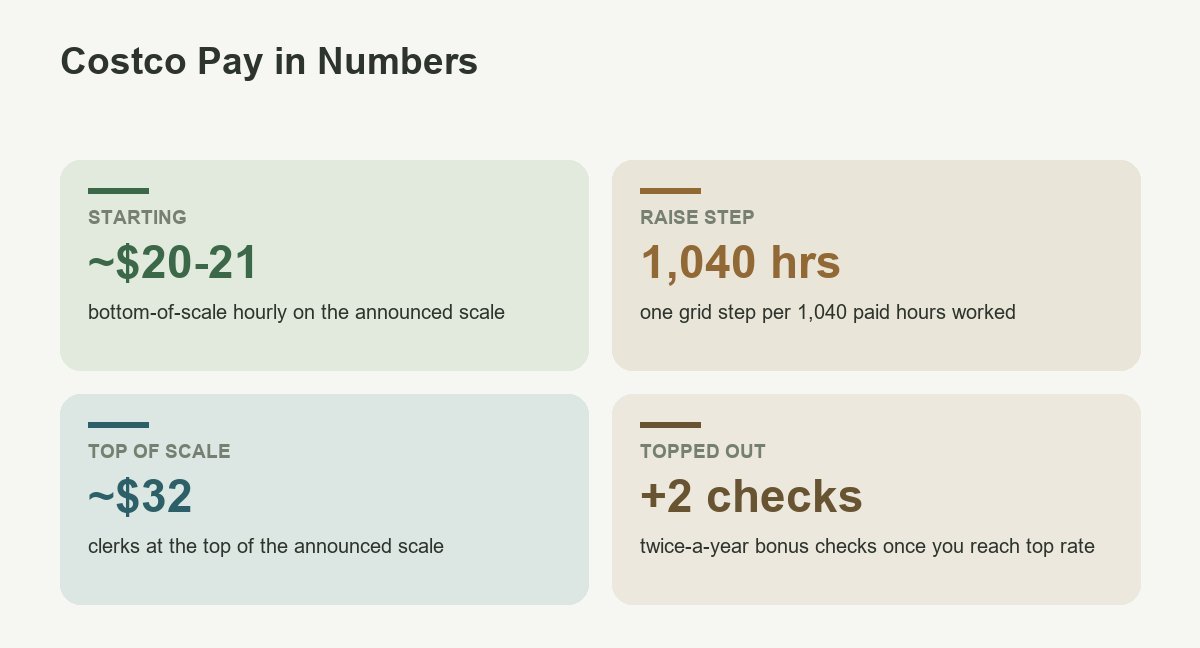
Costco starting pay runs about $20 to $21 an hour. CBS News reported bottom-of-scale assistants at $20 and clerks at $21 under the company’s latest announced scale, and new hires climb from there on a fixed grid: one raise for every 1,040 paid hours until topping out around $32. Exact figures shift by role, state, and the March adjustments Costco makes most years, so treat every number here as the announced scale plus employee reports, not a quote for your warehouse.
The number that matters more than the starting wage is the grid behind it.
Almost nobody explains the 1,040-hour system to new hires, which is why the most-upvoted pay question on r/CostcoEmployee is a veteran asking what happens after the last step. The grid, the top-out bonus checks, and the position differences below are the parts the salary aggregators skip.
Pay is also half the reason getting hired is competitive; the Costco interview guide covers the two-round, candidate-pool process guarding these wages.
What Costco starting pay actually is
New hourly hires start at the bottom of Costco’s pay scale: about $20 an hour for assistant roles and $21 for clerk roles under the raise CBS News covered, which also put top-of-scale clerks near $31.90. Employee reports through 2026 track slightly higher numbers arriving with each March adjustment.
Three things move your personal number. Role family matters, since clerks outearn assistants at every step. State and local minimums push bottom-of-scale up in some markets, which is why applicants comparing notes across states see different offers for the same job. And the annual March adjustment means a posting you read in February may understate what you would earn by summer.
Against the rest of retail, the floor alone clears most competitors’ ceilings, which is the honest reason every opening draws a crowd.
The 1,040-hour raise grid, explained
Costco raises hourly pay on a schedule, not on performance reviews: every 1,040 paid hours, roughly six months of full-time work, moves you one step up the grid automatically. The steps are large enough that employees track them the way other workplaces track promotions, and the system runs until the grid ends.
“Next month I will have completed my last 1040 hours on the hourly rates grid and my wage will be $26.50. What happens next? How do I eventually reach top wage? I can’t find any info on how I’ll eventually be making top rate or how long it will take.”
– r/CostcoEmployee, May 2026 (129 upvotes)
The answers in that thread map the rest of the climb: after the grid’s final step, employees jump to their role’s top rate, and coworkers described that jump as the biggest single raise of the run.
“That’s for service clerks. Assistants go from 26.50- to 31.20 than in march next year to 32.90 or something. People who work a lot of hours eventually get the extra 2 paychecks twice a year. My bf has worked at our Costco for 24 years and is a cashier so makes 32.90 and then gets bonuses checks”
– r/CostcoEmployee, May 2026 (16 upvotes)
Those extra paychecks are the topped-out perk: long-tenured employees at top rate report semi-annual bonus checks that veterans describe reaching several thousand dollars each. Do the arithmetic across a career and the grid explains something the starting wage cannot: why the people ringing you up have been there twenty years.
Pay by position: who starts where
Starting pay lands differently by department, and the grid tops out differently too. The ranges below combine the announced scale with employee and aggregator reports; your posting decides. Licensed and skilled departments run their own, higher grids, which is why a tire-center opening and a cart opening at the same warehouse advertise different rates.
| Position family | Where it starts | Worth knowing |
|---|---|---|
| Assistants (front end, carts, food court) | About $20/hr | Most first jobs land here; food court runs nonstop, and internal transfers open after 90 days |
| Service clerks (cashier, membership) | About $21/hr | The classic climb-the-grid career track |
| Specialty departments (meat, bakery, tire) | Above clerk scale | Skill roles carry their own higher grids |
| Pharmacy, optical, hearing aid | Well above store scale | Licensed roles priced against healthcare, not retail |
| Supervisors and salaried managers | Salaried | Promoted almost entirely from the floor |
The practical takeaway for applicants: the entry gap between departments is small next to the grid gap, so take the opening you can get, then transfer inside once the 90-day window opens.
Employees advising new food court hires say exactly that.
The benefits that change the math
The hourly number understates the package.
The raise announcement CBS covered also added vacation time for first-year employees and stretched the ladder to six weeks for thirty-year veterans, on top of the health coverage and retirement matching that hourly staff qualify for at thresholds most retailers reserve for managers.
For a first-job applicant comparing offers, the comparison worth writing down is total-package-per-year against the fast-food alternative, not hourly against hourly. A dollar less per hour with real insurance, guaranteed grid raises, and topped-out bonus checks wins over any wage that never moves.
Frequently asked questions
Is Costco actually paying $30 an hour?
At the top of the scale, yes: the announced raise put top clerks near $31.90 and top assistants above $30, and company statements say most hourly employees now earn over $30 with tenure. New hires start around $20 to $21 and climb the grid to get there.
What Costco position pays the most hourly?
Among store roles, licensed positions like pharmacy technicians and opticians top the hourly list, followed by specialty departments like meat cutting. Among the big hourly families, service clerks out-earn assistants at every step of the grid.
How often does Costco give raises?
Every 1,040 paid hours, which full-time employees hit roughly twice a year, plus the scale-wide adjustments Costco has announced most Marches. The raises are automatic grid steps, not performance negotiations.
Does Costco starting pay vary by state?
Yes; higher state and local minimum wages push bottom-of-scale up in some markets, so an Arizona posting and a Minnesota posting can open at different rates for the same title. The grid structure stays the same everywhere; only the entry point shifts.