
In-N-Out usually interviews you twice before an offer. The first round is a casual conversation that employees openly call a vibe check; the second goes deeper and ends in a decision, often within a day or two. The In-N-Out interview questions themselves stay simple, because the company hires attitude and trains everything else.
Simple does not mean easy to win. The chain pays better than nearly every fast-food rival, its employment page leads with higher starting wages and paid vacations, and every store sits in a small footprint of western states. High pay plus few locations equals a stack of applications for every apron.
Store associate roles are the focus here. If you are spreading applications across fast food, the Chick-fil-A interview guide covers the other famously selective counter-service employer, where the test is culture rather than pace.
Why getting hired at In-N-Out is hard
The difficulty is competition, not the conversation. Wages start well above minimum, raises and promotions run on a posted ladder, and associates stay for years, so each opening draws applicants from every other counter job in town. Managers can afford to wait for the candidate who beams through both rounds and offers wide availability.
That math cuts both ways. A store that just opened, or one bleeding hours to a graduating class, moves much faster. Applicants report everything from a same-week offer to total silence after a strong interview, and the variable is almost always the store’s staffing week, not the candidate.
How the two interviews work
Round one is short, friendly, and diagnostic: a store manager checks energy, smile, availability, and a few service basics, usually inside fifteen minutes. Round two revisits the same ground with more specifics, sometimes with a different manager, and carries the decision. A high schooler who landed the job describes the shape:
“I’m also a high school student and got the job after two interviews, so (unless it’s just my location) I don’t think your age will be a negative factor! Anyway, the first interview was very chill and mostly just a “vibe check.” He did ask me a few job related questions like: “what does customer service mean to you?” “Why should we pick you instead of another candidate?” “Are you able to work under fast paced/very busy work conditions?” (I also gave an example as to why I am capable instead of j…”
– r/innout, July 2026 (2 upvotes)
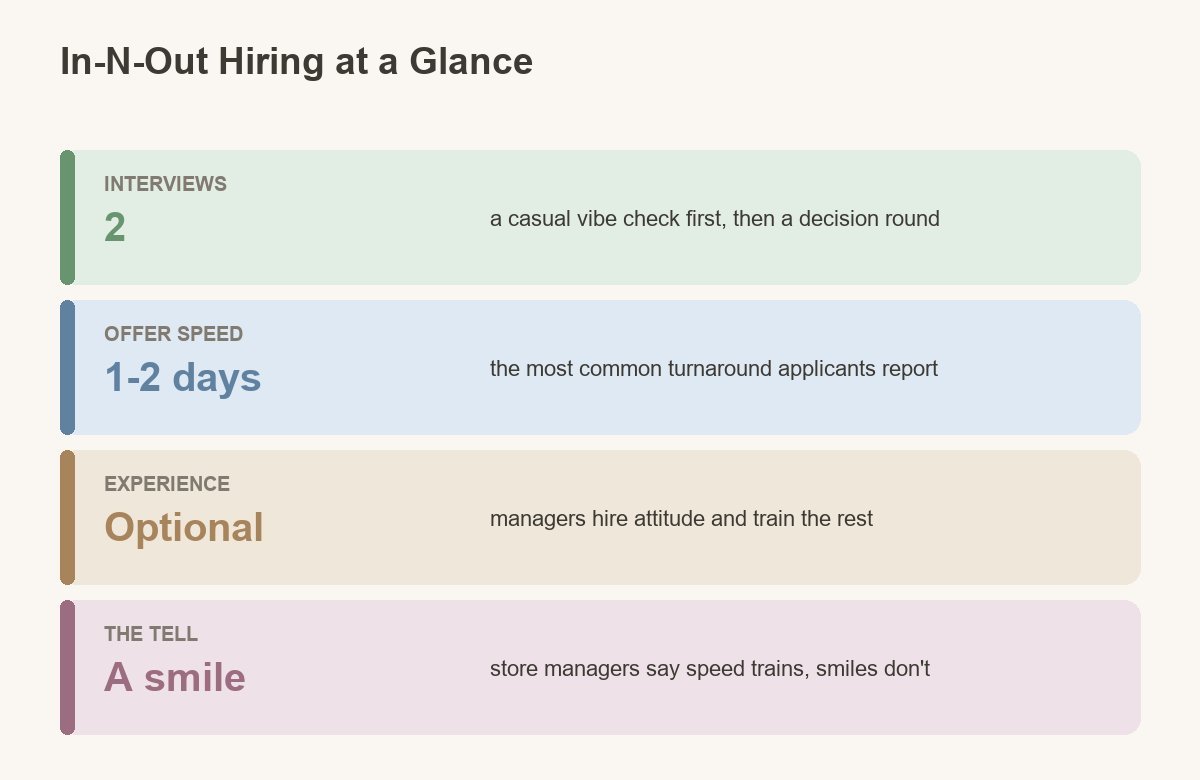
Getting called back for round two is a strong sign, not a formality. Treat it as the same interview with the volume up: same energy, more specific stories, and a cleaner answer on availability. If the first manager asked about a rush, arrive with a second example ready, because repeating the identical story reads as thin. A California food handler card is worth mentioning if you hold one, though nobody expects it before training. Offers most often land within a day or two of the second conversation, so keep your phone answered that week.
The In-N-Out interview questions to prepare for
Eight prompts cover both rounds: tell me about yourself, why In-N-Out, what customer service means to you, whether you handle a rush, why you over other candidates, where you see yourself in three to four years, a leadership or team moment, and your availability.
1. Tell me about yourself
School, activities, and anything fast-paced counts as experience here. A shift on a snack bar, a season of varsity anything, or first chair in the marching band all prove you perform under pressure on a team.
2. Why do you want to work at In-N-Out?
Managers hear the-burgers-are-great daily.
Point at the pace, the pay ladder, or the crew energy instead.
Sample answer: “Three reasons, honestly. Every time I come through the drive-thru the line is huge and it still moves, and I want to work somewhere that runs that well. I know the pay and the raise ladder beat everywhere else I could apply. And every crew member I have ever talked to at the window actually seems glad to be there, which tells me more than any job posting could.”
3. What does customer service mean to you?
Sample answer: “Making the thirty seconds someone spends with me the easiest part of their day. At the window that means getting the order right, being genuinely friendly instead of scripted, and fixing any mistake immediately without making the customer negotiate for it. Fast counts as friendly too; nobody feels served while stuck in a line.”
4. Can you handle a fast-paced, very busy shift?
Say yes with evidence: a dinner rush you worked, a tournament day, a kitchen you helped during a slam. One concrete scene beats any adjective, and interviewers ask the follow-up either way.
5. Why should we pick you instead of another candidate?
Sample answer: “You can teach me the board and the register, but you will not have to teach me to be friendly at hour six of a shift, because that is just how I am wired. I show up early, I keep my energy up when it gets loud, and my availability covers your closing shifts. I am also planning to stay, not passing through a semester.”
6. Where do you see yourself in three to four years?
The chain promotes from within on a published level system, so interest in moving up the ladder is the right register. Honest school plans work fine too when paired with staying on through them.
7. Tell me about a time you led or carried a team
Captaining anything, training a new coworker, or organizing the group project nobody wanted to run all work. Keep it to four beats and end with what the team got done.
8. What is your availability?
Wide and honest wins. Current associates advise listing every hour you can genuinely work, including full weekends, because daytime-plus-weekend openness separates candidates more than any answer; the company’s own employment page promises schedules that flex around school, so a real constraint stated plainly costs less than applicants fear.
What actually decides it: the smile, stated outright
A genuine, sustained smile decides more In-N-Out interviews than any prepared answer, according to the employees who sat through them. Ask what got them hired and the responses converge with unusual consistency on that one physical fact, straight from store managers themselves.
“It’s all about your smile! Many SMs have told me they can train new employees to work faster, but they can’t teach them how to have a convincing smile. I got hired after my second interview. Good luck!”
– r/innout, June 2026 (4 upvotes)
Crew members repeat the same point in rougher terms: enthusiasm carries a mediocre answer, and a flat delivery sinks a good one. Walk in like you are meeting a friend’s parents, chat with the person, and let the prepared stories surface inside a conversation instead of as recitations.
Grooming earns a mention because the company holds a famously clean-cut standard: tidy natural hair, minimal jewelry, and a pressed appearance fit the uniform you are asking to wear. Dress one notch above the job in clean business casual and you have matched the room.
Frequently asked questions
How do you answer why you want to work at In-N-Out?
Name something operational you admire plus something you want: the pace of the line, the posted raise ladder, the crew culture. One sentence of genuine observation about your local store beats a paragraph about liking Double-Doubles.
Why is it hard to get hired at In-N-Out?
Pay above nearly every fast-food competitor, promotion from within, and a limited number of stores mean each opening draws a crowd, and low turnover keeps openings rare. The interview is friendly; the applicant pool is the obstacle.
What should you wear to an In-N-Out interview?
Clean business casual with tidy, natural-colored hair and minimal jewelry matches the company’s clean-cut uniform standard. A collared shirt and plain pants are plenty; the smile you wear matters more than the shirt.
Do you need experience to get hired at In-N-Out?
No. Most successful applicants interview with less than a year of work history, and managers say plainly that they train speed and skills. School activities, sports, and any fast-paced environment count as evidence you can keep up.