

A new grad nursing resume is one page, opens with your name and RN license status, and treats clinical rotations as work experience. That order matters more than any template. Hospital recruiters open a new-graduate file to answer two things in the first pass: can this person legally start on the unit, and where have they touched patients. Put those two answers above the fold and the rest of the page has a chance to be read.
Most first drafts I have seen do the opposite. They lead with an objective paragraph about passion for patient care, bury the license line under certifications, and describe rotations as “completed clinical hours in med-surg.” Below is the section-by-section structure that fixes that, a full BSN example built in HTML, a shorter ADN career-changer variant, the ATS habits of hospital hiring systems, and the mistakes r/newgradnurse and allnurses threads keep catching. Nursing-assistant resumes follow different rules and get their own article; this one is for RNs and final-semester students.
The Section Order That Works for a New Grad Nursing Resume
The right order for a new graduate is: header with license line, short summary, licenses and certifications, education, clinical experience, work and volunteer experience, skills. Experienced nurses put work history above education; new grads reverse it because school and rotations are the evidence.
Two placement decisions do most of the work. Licenses and certifications sit above education so a screener sees “RN, active” or “NCLEX-RN passed” without scrolling. Clinical experience sits above your barista or retail job, and it gets bullet points that read like a nurse wrote them, because those rotations are the only patient-care history a hospital can evaluate.
Header and License Line: How to Show NCLEX Status and Your License Number
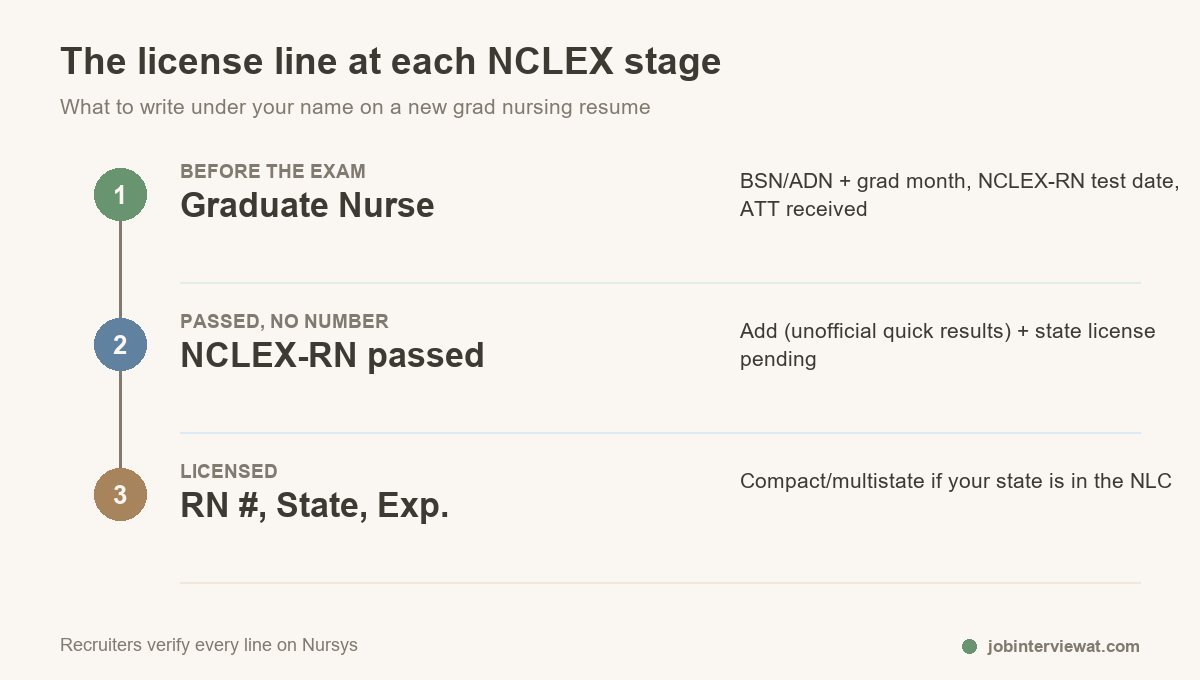
The license line under your name should state exactly where you are in the licensing process: graduate nurse with an NCLEX date, NCLEX passed with license pending, or licensed RN with state, number, and expiration. Recruiters will verify whatever you write on Nursys, the NCSBN license lookup, so precision helps you and vagueness hurts.
Use the version that matches your stage and update it the week your status changes:
- Still a student or waiting to test: “Graduate Nurse (BSN, May 2026) | NCLEX-RN scheduled June 12, 2026 | Texas ATT received.” Adding the authorization-to-test line tells the recruiter you can be scheduled into a residency cohort.
- Passed, license not yet issued: “NCLEX-RN passed (unofficial quick results) | Texas RN license pending.” The NCLEX Quick Results service releases unofficial results two business days after the exam; official results come from your state board within six weeks. Say “unofficial” until the number exists.
- Licensed: “Registered Nurse | Texas RN #987654 | Exp. 08/2028.” If your state is one of the 43 jurisdictions in the Nurse Licensure Compact, write “Compact/multistate RN” so out-of-state hospitals know you can start without a second license.
The license number itself is public record on Nursys, so listing it is not a privacy risk. What you should keep out of the header is your street address; city and state are enough, and some hospital systems parse a full address into fields that were never designed for it. Type the header as plain text. One allnurses poster built her header as an image in Paint and pasted it into Word; it looked sharp on screen and would have parsed as a blank line in an applicant tracking system.
Summary or Objective? What a New Grad Should Write Under the Header
Write a two-to-three sentence summary that names your degree, license status, strongest rotation, and the unit type you want; skip the objective. An objective tells the hospital what you want from it. A summary tells the hospital what you bring, which is the only thing a screener is scoring.
A summary for a new graduate has a fixed shape: credential and status, then the clinical setting you are proudest of with one concrete detail, then the target. Two examples that follow it:
- “BSN graduate and Texas-licensed RN with 720 clinical hours across med-surg, ICU step-down, and pediatrics, including a 180-hour capstone on a 32-bed telemetry unit using Epic. Seeking a new-graduate residency in acute care telemetry or progressive care.”
- “ADN graduate, NCLEX-RN passed, license pending, with three years as a patient care technician on an inpatient oncology floor before nursing school. Comfortable with high-acuity workloads and family communication; targeting a med-surg or oncology residency.”
Both name numbers, units, and a system, and both change for each application: swap the target unit to match the posting and move the matching rotation into the second sentence. If a residency portal has a separate objective field, put the target sentence there.
Clinical Rotations on the Resume: Facility, Unit, Hours, and the Bullets That Follow
List each rotation as an entry with the facility, unit, dates, and hours, then two or three bullets describing what you did with patients, not what the course covered. Capstone or preceptorship goes first, with the most detail; the rest follow in reverse order or grouped by specialty.
The entry format that reads cleanly:
- Line one: unit and facility (“Telemetry Unit, Riverside General Hospital”).
- Line two: role, dates, hours (“Senior Practicum, Jan–Apr 2026, 180 hours, 1:1 with RN preceptor”).
- Bullets: patient load and acuity, skills performed, systems used, one thing you owned. “Managed a 4-patient assignment by week six under preceptor supervision, including cardiac drips, telemetry interpretation, and discharge teaching; charted in Epic.”
Hours per rotation are optional but useful, because programs vary and a recruiter cannot assume how much time you spent on a unit. One nurse educator on the allnurses resume-review thread said her program has students list specific hours for exactly that reason. The same thread’s most repeated advice was to name the electronic health record on every entry: Epic, Cerner (now Oracle Health), Meditech.
Terminology counts here. Reviewers on that thread corrected a student’s “psychiatric rotation” to “mental health,” “nursing home” to “skilled nursing facility,” and “skin day assessments” to “skin assessments using the Braden Scale.” Write the words a nurse manager uses.
Once your rotations are on the page, cut the class list. Every BSN and ADN graduate took pharmacology and pathophysiology, so listing them tells the hospital only that you graduated. Keep the capstone; a reviewer on the same thread put it well: to an employer, a capstone on their unit type is close to a head start on orientation.
Skills, Certifications, Education, and What to Do With No Work Experience
Skills for a nursing resume: a list you can pull from
A skills section for a new grad RN should be 10 to 15 items, mostly hard clinical skills you performed during rotations, written in the exact terms a job posting uses. Pick from this list only what you have done:
| Group | Skills to list (only if performed) |
|---|---|
| Assessment and monitoring | Head-to-toe assessment, vital signs, telemetry/ECG rhythm interpretation, pain assessment, neuro checks, Braden and Morse fall scoring |
| Medications and lines | Medication administration (PO, IM, SubQ, IV push), IV insertion and site care, IV pump programming, insulin and heparin protocols, blood glucose monitoring, safe dosage calculation |
| Procedures | Foley catheter insertion and removal, NG tube care, wound care and dressing changes, tracheostomy care, sterile technique, specimen collection, blood draws |
| Systems and documentation | Epic, Cerner/Oracle Health, Meditech, barcode medication administration, SBAR handoff, care planning, discharge teaching |
| Interpersonal | Patient and family education, de-escalation, interdisciplinary rounds, Spanish or other language proficiency (state the level) |
Skip “compassion,” “hardworking,” and “fast learner.” Those belong in the interview, where you can prove them with a story.
BLS, ACLS, PALS, and other certifications
List each certification with the issuing body and expiration month. Nearly every hospital requires BLS for Healthcare Providers from the American Heart Association before day one; ACLS and PALS are usually taught during orientation for the units that need them, so having them early is a plus, not a requirement. Do not list an expired card. Renew it or leave it off; a student on the allnurses thread pulled her BLS from the resume when it lapsed, which was the right call. Other cards that belong here: NIH Stroke Scale, CNA or PCT certification if still active, and any state medication aide credential.
Education
Degree, school, city, graduation month and year, and GPA if it is 3.5 or above. Add honors, Sigma Theta Tau membership, or a scholarship on one line. If you are still finishing, write “Expected May 2026.” Do not list high school once you hold a nursing degree.
Work and volunteer experience when you have none in healthcare
Any job you held during school goes on the resume, described in terms a charge nurse would recognize: shift work, customer conflict, safety compliance, training new hires. A restaurant server who worked doubles through nursing school has stamina and prioritization evidence; write it as “Managed 8 to 12 tables per shift during peak hours while completing a BSN full time.” Volunteer work in a hospital, hospice, free clinic, or a nursing student association counts as experience, and a leadership role in that association is one of the few things that reliably distinguishes new grads with identical rotations. If you truly have no employment history, expand the clinical section by one bullet per rotation and drop this heading entirely instead of writing “N/A.”
Full Example: New Grad RN Resume (BSN, Licensed)
The example below is a complete one-page resume for a fictional BSN graduate. Names, facilities, and numbers are invented; the structure, bullet style, and level of detail are what to copy.
| Header | MAYA TORRES, BSN, RN Austin, TX | (512) 555-0142 | maya.torres.rn@email.com | linkedin.com/in/mayatorresrn Registered Nurse | Texas RN #987654 (Compact/multistate) | Exp. 08/2028 |
|---|---|
| Summary | BSN graduate and Texas-licensed RN with 720 clinical hours across med-surg, telemetry, ICU step-down, pediatrics, and mental health, including a 180-hour senior practicum on a 32-bed telemetry unit charting in Epic. Managed a 4-patient assignment under preceptor supervision by the final month. Seeking a new-graduate residency in telemetry or progressive care. |
| Licenses & Certifications | Registered Nurse, Texas Board of Nursing, #987654, active, exp. 08/2028 BLS for Healthcare Providers, American Heart Association, exp. 03/2028 ACLS, American Heart Association, exp. 03/2028 NIH Stroke Scale certification, completed 02/2026 |
| Education | Bachelor of Science in Nursing, University of Texas at Austin, May 2026 GPA 3.7 | Dean’s List, 5 semesters | Sigma Theta Tau International Honor Society |
| Clinical Experience | Senior Practicum, Telemetry Unit, Riverside General Hospital, Austin, TX Jan–Apr 2026 | 180 hours | 1:1 with RN preceptor • Progressed to a 4-patient assignment including post-cardiac-cath and heart-failure patients; titrated cardiac drips per protocol under supervision • Interpreted telemetry rhythms and escalated two arrhythmia changes using SBAR • Completed admissions, discharge teaching, and barcode medication administration in Epic Pediatrics, Central Children’s Hospital | Aug–Dec 2025 | 90 hours ICU Step-Down and Med-Surg, Riverside General Hospital | Jan–May 2025 | 270 hours Mental Health, Hill Country Behavioral Health | Aug–Dec 2024 | 90 hours Community and Long-Term Care | Jan–May 2024 | 90 hours |
| Work Experience | Patient Care Technician (PRN), Riverside General Hospital | Jun 2025–present • Provide vital signs, blood glucose checks, and ADL support for up to 12 patients per shift on a med-surg unit Server, Salt Lick Kitchen, Austin, TX | 2022–2025 |
| Skills | Head-to-toe assessment · Telemetry interpretation · IV insertion and pump programming · Medication administration (PO/IM/SubQ/IV push) · Foley and NG tube care · Wound care · SBAR handoff · Epic, Meditech · Discharge teaching · Conversational Spanish |
Read it as a recruiter would: license status in line three, three certifications, five clinical entries with hours, one healthcare job, one non-healthcare job translated into unit language, and a skills line that repeats what the bullets proved.
Shorter Variant: ADN New Grad, Career Changer, License Pending
The second version fits someone who came to nursing from another field and has not yet received a license number. The changes are in the license line, the summary, and how prior work is framed.
| Header | DANIEL OKAFOR, ADN Columbus, OH | (614) 555-0177 | d.okafor.rn@email.com NCLEX-RN passed 07/2026 (unofficial quick results) | Ohio RN license pending |
|---|---|
| Summary | ADN graduate and former logistics supervisor with 560 clinical hours, including a 144-hour preceptorship on a 28-bed medical-surgical unit charting in Cerner. Eight years managing shift teams of 15 in a distribution center. Targeting a med-surg new-graduate program with a path to ICU. |
| Licenses & Certifications | NCLEX-RN passed 07/2026; Ohio RN license application submitted 07/2026 BLS for Healthcare Providers, American Heart Association, exp. 01/2028 |
| Education | Associate Degree in Nursing, Columbus State Community College, May 2026 | GPA 3.6 Bachelor of Business Administration, Ohio University, 2016 |
| Clinical Experience | Preceptorship, Medical-Surgical Unit, Grant Regional Medical Center | Feb–May 2026 | 144 hours • Carried a 5-patient assignment by final week under RN preceptor; performed wound care, IV medication administration, and post-op assessments; documented in Cerner Maternal-Newborn, Pediatrics, Mental Health, Long-Term Care rotations | 2024–2026 | 416 hours combined |
| Work Experience | Shift Supervisor, Midwest Freight Logistics | 2016–2024 • Led teams of 15 across 24-hour operations; owned safety compliance and incident reporting; trained new hires • Left to complete nursing prerequisites and ADN full time |
| Skills | Assessment · Medication administration · IV therapy · Wound care · Cerner · SBAR · Team leadership · Incident documentation |
Career changers should resist the urge to shrink the old career to one line. Eight years of shift leadership is a hiring signal on any unit; the trick is naming the transferable parts (staffing, safety, training) instead of listing freight metrics.
Template Formatting, ATS Parsing, and How Long a New Grad Nurse Resume Should Be
One page, single column, standard headings, PDF unless the portal demands Word. Hospital systems mostly run applications through Workday, Oracle Taleo, iCIMS, or a vendor like HealthcareSource, and all of them parse text into fields before a human sees it. Anything that defeats the parser defeats you: two-column layouts, text boxes, tables used for layout, icons in place of words, contact details in the document header, and headings renamed to something creative. (The two examples above sit in tables only for web display; in your Word or Google Docs file, use plain headings and bullets.)
Use the posting’s own vocabulary. If the listing says “progressive care,” your summary says progressive care, not step-down. If it lists Epic, Epic appears in your clinical bullets. Section headings should be the boring ones parsers expect: Licenses and Certifications, Education, Clinical Experience, Work Experience, Skills. Fonts: Calibri, Arial, or Georgia at 10.5 to 12 point, margins no tighter than 0.6 inch.
On length, new grads and the nurses who review their resumes agree more than on almost any other point.
“When I was going through it, no one showed their resume layout, so I’m uploading how my resume layout looked like just to help some people get started. I live in NYC so it was pretty difficult to land a job but I reached out to someone I knew and she helped me. Please just use this a layout. I’m not saying this is foolproof. This is more just a guide for anyone having trouble creating their resume. NEW GRADS/NEW NURSES KEEP YOUR RESUME TO 1 PAGE!!! 2+ pages is only acceptable if you’ve worked a…”
– r/newgradnurse, June 2026 (257 upvotes)
The one defensible exception came from a nurse educator on allnurses: keep the capstone and the most job-relevant rotation on page one, and if the remaining rotations will not fit, put them on a clearly labeled second page with a note at the bottom of page one. That is a fallback for six or seven rotations, not a license to add a second page of adjectives.
Mistakes New Grads Keep Making, According to the People Reviewing Their Resumes
The same handful of errors show up in nearly every resume posted for critique on r/newgradnurse, r/nursing, and allnurses. Each is easy to fix once you know a nurse manager will notice it:
- Invented metrics. One resume listed “95%, 96%, 97% patient satisfaction” for clinical rotations; a reviewer immediately asked where those numbers came from. Students do not receive satisfaction scores. Use counts you can defend (patients per assignment, hours, procedures performed) and no percentages you cannot source.
- Listing coursework instead of rotations. Pharmacology, Pathophysiology, and Nursing Fundamentals appear on every transcript. Rotations with units and hours are the differentiator; the class list is filler.
- Vague license status. “RN” on the header of someone who has not sat for the NCLEX gets caught on Nursys and reads as misrepresentation. Write the stage you are in.
- Expired or absent BLS. Renew before you apply; a residency start date is often conditional on it.
- Design over parsing. Image headers, colored sidebars, and skill-rating bars look polished on a laptop and disappear in Workday.
- Layperson terminology. “Nursing home,” “psych rotation,” and “gave shots” all have clinical equivalents that signal you speak the language of the floor.
- The same resume for every unit. Applying to a pediatric residency with a summary that targets telemetry tells the manager you did not read the posting. Change the target sentence and reorder the rotations for each application; it takes five minutes.
How the Resume Feeds the Interview
Every bullet on a new grad resume is a prompt the panel can turn into an interview question, so write only bullets you can expand into a two-minute story. “Escalated two arrhythmia changes using SBAR” will produce “tell me about a time you noticed a change in a patient’s condition,” and you should have the patient, the rhythm, who you called, and what happened next ready before you walk in.
The prompts to expect are collected in our list of the most common interview questions and answers; the method for converting each resume line into a situation-action-result answer is in how to turn your resume into interview answers.
Bring the resume you submitted for that specific posting, because a nurse manager who asks about your telemetry practicum and hears a pediatrics story is checking whether you tailored it. If you can talk through the practicum entry line by line without looking down, the resume did its job.
New Grad Nursing Resume FAQ
What should a new grad RN resume look like?
A new grad RN resume is one page, single column, with a header that states license status, a three-sentence summary, then licenses and certifications, education, clinical rotations with hours and units, any work or volunteer experience, and a skills list. Clinical rotations get the most space and the most specific bullets. Plain fonts, standard headings, and a PDF export keep it readable in hospital applicant tracking systems.
What should I include on my resume as a fresh grad nurse?
Include your degree and graduation date, NCLEX or license status with the number once issued, current certifications such as BLS, and every clinical rotation with facility, unit, dates, and hours. Then add two or three skill bullets per rotation, healthcare and non-healthcare jobs described in clinical terms, volunteer or leadership roles, GPA if 3.5 or higher, and a skills list matched to the posting. Leave out coursework, high school, an objective statement, and any metric you cannot source.
How long should a new grad nurse’s resume be?
One page. Recruiters, nurse educators, and the most-upvoted advice on r/newgradnurse all land on a single page for anyone whose experience is school plus rotations. The only accepted exception is a labeled second page listing additional rotations when the capstone and job-relevant clinicals fill page one.
What is a good summary for a nursing resume for freshers?
A good fresher summary names your credential and license status, your total clinical hours with the strongest rotation and the EHR you used, and the unit you are targeting, in two or three sentences. Example: “BSN graduate, RN license pending, with 700 clinical hours including a 160-hour med-surg preceptorship in Epic; carried a 4-patient assignment under supervision. Seeking a med-surg or telemetry new-graduate residency.” Change the target line for each posting.
How do you write a new grad nursing resume with no work experience?
Treat clinical rotations as your experience section and give each one the detail a job would get: unit, hours, patient load, procedures, and the charting system. Add volunteer work, student nursing association roles, and any non-healthcare job translated into shift, safety, and communication language. Drop the “Work Experience” heading instead of writing “none” under it.