
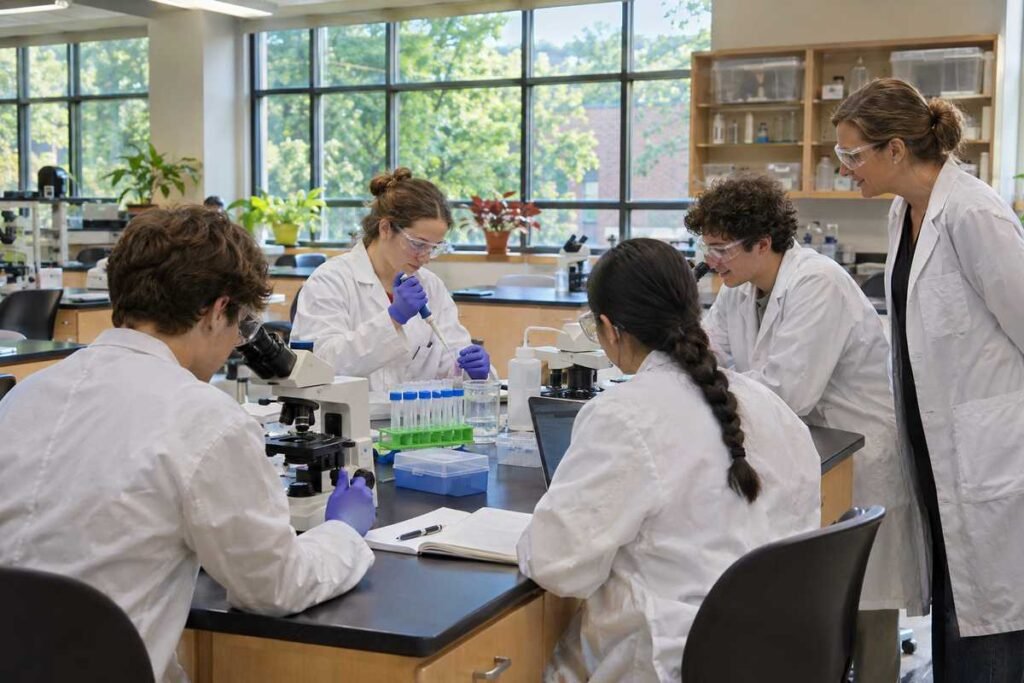
12 Best Colleges for Biology in Massachusetts (2027 Rankings)
Massachusetts runs biology programs at almost every scale. You can sit in a lab section of 16 at a public college in the Berkshires, or share a research building with doctoral students at a flagship university in Amherst. The best colleges for biology in Massachusetts split on one measure that outlasts any ranking: how much bench work you get before you graduate. The twelve below were picked with that in mind, along with a named pre-professional track if you need one and a short route from coursework to a first job.
That last part is where most college lists stop, and it’s the part that matters after you graduate. A biology degree decides which techniques you’ll have run with your own hands by the time you apply for a lab technician, research assistant or clinical research job, so each entry below says what the program actually gives you. The sections after the list turn to hiring and interviews in Massachusetts.
We compared twelve accredited programs on published track options, stated class caps, undergraduate research access, and how close each campus sits to biotech, hospital and teaching employers. All twelve will get a capable student somewhere. The difference is in what happens during your first two years, and that’s what the order below reflects.
The best colleges for biology in Massachusetts, side by side
| College | Degree | Where it stands out |
|---|---|---|
| Massachusetts College of Liberal Arts | B.S. in Biology | Labs capped at 16, five tracks, pre-med and pre-vet concentrations |
| UMass Amherst | B.S. in Biology | Large research university with graduate-level lab infrastructure |
| Boston University | B.S. in Biology | Boston’s hospital and biomedical employers within reach |
| Northeastern University | B.S. in Biology | Co-op placements built into the degree |
| Boston College | B.S. in Biology | Selective private university with pre-health advising |
| College of the Holy Cross | B.S. in Biology | Small Jesuit college with a long pre-med tradition |
| Clark University | B.S. in Biology | Research culture and an accelerated B.A./M.A. |
| Salem State University | B.S. in Biology | Public tuition near Greater Boston employers |
| Worcester State University | B.S. in Biology | Pre-health focus in Worcester’s medical cluster |
| Framingham State University | B.S. in Biology | Public program between two job markets |
| Assumption University | B.S. in Biology | Small Catholic university with close faculty contact |
| Fitchburg State University | B.S. in Biology | Teaching licensure track at public tuition |
1. Massachusetts College of Liberal Arts: B.S. in Biology
MCLA is a small public liberal arts college in North Adams, and its biology degree in Massachusetts is organized into five options: General Biology, Pre-Medical Professions, Pre-Veterinary, a Secondary Education licensure track, and a minor. That range matters if you’re unsure about medical school, because you can change direction without transferring.
Lecture sections are capped at 32 students and labs at 16, and those are caps rather than averages. You’ll feel that in your first two years, when introductory courses at larger schools are often the least personal part of the degree. Undergraduates also join faculty research early, since there’s no doctoral program competing for the same bench space.
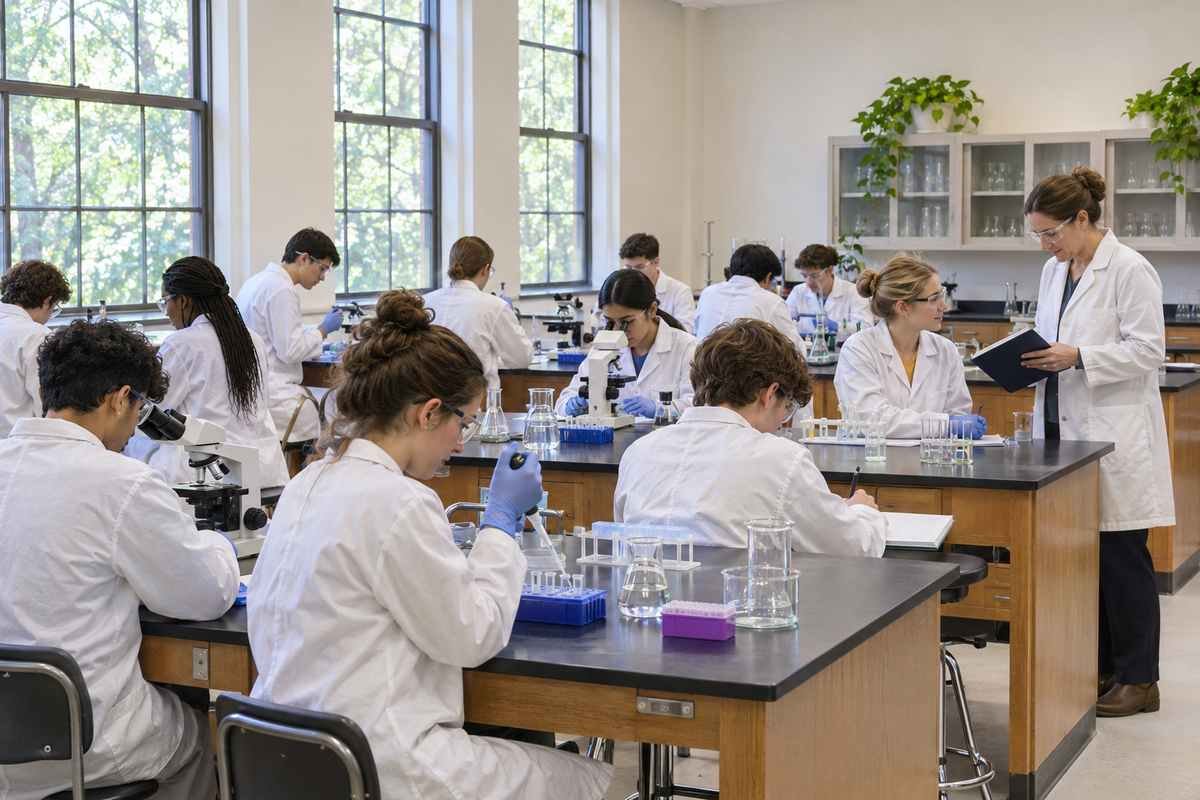
The Pre-Medical Professions concentration is the college’s strongest pitch. MCLA describes it as supported by a pre-medical advisory committee, physician shadowing, emergency room scribe training, and preparation material for the MCAT, DAT and PCAT. It doesn’t publish medical school acceptance rates, and you shouldn’t assume one. Pre-Veterinary is a named concentration too, though it’s a preparation pathway rather than a guaranteed seat.
MCLA also holds an articulation agreement with the New York College of Podiatric Medicine, which it presents as a seven-year path: qualified students finish the B.S. while starting the first year of a D.P.M., with the senior year at MCLA running alongside the first year at NYCPM. That’s a podiatry route rather than a medical one, and admission is selective rather than automatic. As a public college, MCLA charges Massachusetts residents the state rate, which is unusual next to this much small-cohort support. Is that worth four years in the Berkshires? For a student who wants a small teaching lab, it’s the trade most of these schools can’t offer.
2. UMass Amherst: B.S. in Biology
The flagship public research university in Massachusetts runs a large, research-intensive department with access to extensive laboratory facilities and faculty who hold national funding across ecology, molecular biology and neuroscience. Undergraduates get equipment and infrastructure that smaller colleges can’t match, including work alongside graduate students.
That scale is also the tradeoff. Introductory lecture sections are large, and a student who wants a professor to know their name has to build that relationship deliberately. If you’re aiming at a research career or a Ph.D., the access is worth the size. If you need a small room and a professor who notices when you’re behind, it isn’t. Which of those are you, honestly?
3. Boston University: B.S. in Biology
BU runs biology inside a large private research university in the middle of Boston, which puts a dense concentration of hospitals, research institutes and biomedical employers within a short trip from campus. For a pre-medical student, that network is the real resource: internships, shadowing and research placements sit close enough to hold during a semester rather than only over a summer.
The program is large and competitive, though. Pre-professional advising and research positions are available, but both reward the student who asks early and repeatedly. Nobody assigns you a mentor in a class of several hundred. Would you go find one anyway? That’s the honest test of fit here.
4. Northeastern University: B.S. in Biology
Northeastern builds co-op into the degree, which means one or more full-time professional placements as part of the undergraduate program rather than a summer internship you have to find yourself. The university’s Boston employer relationships reach into biomedical research, pharmaceutical companies, hospitals and life sciences firms, and those are exactly where biology students want placements.
Why does that matter for hiring? Because a biology graduate’s first interview usually turns on what they’ve actually done at a bench or in a clinic, and co-op is the most direct way to have a specific, verifiable answer before you graduate. The trade is scheduling flexibility, which suits some students and frustrates others.
5. Boston College: B.S. in Biology
Boston College runs biology at a selective private university in Chestnut Hill, combining a rigorous science curriculum with the broader liberal arts load that Jesuit education requires. Advising and medical school preparation are strengths here, and the alumni network in medicine and the life sciences is a genuine recruiting resource when you apply to professional school.
Admission is selective and the student body is academically competitive. Research comes through core science faculty rather than a large graduate school, so opportunities grow out of faculty relationships you build deliberately.
6. College of the Holy Cross: B.S. in Biology
Holy Cross is a small Jesuit liberal arts college in Worcester with a biology program inside a close-knit academic community. Class sizes are small relative to the universities on this list, and the faculty-to-student ratio supports the kind of relationships that turn into research placements and detailed recommendation letters.
The college has a long pre-medical tradition, and its professional school advising works through those faculty relationships across all four years rather than through a single office visit. If you want a small college experience with serious pre-health support, this is the clearest version of it in the state.
7. Clark University: B.S. in Biology
Clark, also in Worcester, runs biology with a research-oriented culture and a student body drawn to inquiry-based learning. The size of the program makes undergraduate research involvement realistic rather than exceptional, which is the main reason to consider a smaller university over a flagship.
Clark also offers an accelerated B.A./M.A. path that lets some students earn both degrees in five years. If you already know you want graduate study in biology, that’s worth asking about on a visit.
8. Salem State University: B.S. in Biology
Salem State is a public university in Salem, north of Boston, offering biology inside the Massachusetts state university system. Greater Boston’s healthcare and research employers are within commuting distance, and the public tuition rate makes the degree affordable for state residents.
That combination is the point: a public program close enough to the Boston job market that a part-time clinical or lab job during the school year is realistic. If you’re paying your own way, that schedule matters as much as the curriculum. How many of these campuses can you reach after a shift? Fewer than you’d think.
9. Worcester State University: B.S. in Biology
Worcester State runs a public biology program with a pre-health focus, in a city with an unusually dense medical and research community for its size. Students are within reach of UMass Memorial Medical Center and the pharmaceutical and biomedical employers clustered around Worcester.
For a pre-health student, that proximity supports shadowing and clinical exposure without a move. It’s an affordable route to the same hospitals a private university would bus students to.
10. Framingham State University: B.S. in Biology
Framingham State is a public university positioned between Boston and Worcester, which means two employment markets within reach rather than one. The curriculum covers the standard biology sequence, and pre-health advising runs through the university’s academic support services.
That last detail is worth knowing. Advising here is something you seek out, not something that finds you. Are you the student who asks in your first year, or the one who waits until junior year? The students who do best here are the first kind.
11. Assumption University: B.S. in Biology
Assumption is a small Catholic university in Worcester offering biology within a liberal arts framework. Pre-health students get advising and coursework in a setting where faculty know them individually, and the Worcester location supports clinical exposure through local healthcare partners.
If you want a small, values-driven college with pre-health support rather than a research university, this is the option on the list. The tradeoff is the same one every small program offers: less equipment, more attention.
12. Fitchburg State University: B.S. in Biology
Fitchburg State is a public university in north-central Massachusetts with a biology program that includes a track for students who want to teach. The secondary education option lets you combine science training with teacher preparation, which leads to a different job market than the lab, and public tuition keeps the cost of that combination low.
It suits students who want to teach biology in a Massachusetts secondary school, or who want a public program close to home outside the Boston orbit. Check whether the licensure track fits your target district before you commit, because the requirements are set by the state rather than the college.
Where biology graduates in Massachusetts actually get hired
The state’s biology job market is wider than the two or three employer names everyone already knows, and entry-level openings for bachelor’s graduates cluster in five places you can plan around before you pick a college.
- Biotech and pharmaceutical companies. Cambridge, Boston’s Seaport, Worcester and the Route 128 corridor in Bedford and Lexington hold most of the state’s research associate and quality control openings.
- Hospital and academic research. Research assistant roles in hospital labs and university departments, often on grant-funded studies with fixed terms.
- Clinical research. Research coordinator positions at hospitals and contract research organizations, which hire biology graduates and train the regulatory side on the job.
- Public health and environmental testing. State and municipal labs, water and wastewater authorities, and food and cannabis testing labs, all of which need people who can follow a written method exactly.
- Teaching. Secondary science positions, which require the licensure track rather than just the biology major.
Most of those postings ask for a bachelor’s in biology or a related field and then list specific techniques. That list is what your program needs to give you, and it’s the first thing to check when you compare two colleges that look identical on paper. Which of these five employers is within reach of the campus you’re considering?

What a biology interview actually tests
Hiring managers for lab and research roles rarely start with your GPA. They start with what you’ve done at a bench, because a technique you’ve run is a technique they don’t have to teach. The usual question types line up with what a good program gives you:
| Question | What they’re checking | Where to draw the answer from |
|---|---|---|
| “Which techniques have you run yourself?” | Hands-on experience versus observation | Lab courses and research projects: PCR, gel electrophoresis, cell culture, microscopy, titrations, aseptic technique |
| “Walk me through how you record data.” | Whether your notes can be trusted | Notebook practice, lab reports, how you’d catch an error in your own records |
| “Tell me about an experiment that failed.” | Judgment and honesty | One failed run, why it failed, what you changed next |
| “What safety procedures did you follow?” | Whether you’ve worked in a regulated lab | PPE, waste handling, contamination control, biosafety levels |
| “Explain a concept from your coursework.” | Whether the degree stuck | Genetics, biochemistry, cell biology, statistics |
A failed experiment comes up more often than students expect, and a calm account of one earns more credit than a flawless story. If you’re heading toward clinical work instead of a lab, the questions shift toward patients and judgment. Our guide to showing patient safety awareness in healthcare interviews covers that side, and comparing overlapping healthcare careers helps if you’re still deciding between clinical and lab paths.
Five questions that separate these programs
Ask these on a campus visit or in an email to the department, and the differences between schools become obvious fast:
- Are the class sizes caps or averages? A cap of 16 is a guarantee, while an average of 16 can still mean a lecture hall in year one.
- What share of undergraduates join a research project, and by which year? “Opportunities exist” isn’t an answer.
- Which employers took interns or co-op students last year? If the department can’t name them, the pipeline is theoretical.
- Is pre-health advising a named office with staff, or an informal arrangement with one professor?
- What’s the net cost after aid at your residency rate, and does it change after year two?
If cost is the deciding factor, our list of affordable biology degrees in the Midwest shows how the same questions play out in another region, and the logic carries over.
Frequently Asked Questions
What are the best colleges for biology in Massachusetts?
It depends on what you need from the program. MCLA leads this list because of labs capped at 16, research access from the first year, five tracks, and a podiatry articulation at public tuition. UMass Amherst leads for research depth, Northeastern for co-op, Holy Cross and Assumption for small-college pre-health support, and the state universities for cost.
Does MCLA have a pre-med program?
Yes. MCLA offers a Pre-Medical Professions concentration within the B.S. in Biology. The college describes it as supported by a pre-medical advisory committee, physician shadowing, emergency room scribe training, and preparation material for the MCAT, DAT and PCAT.
Does MCLA have a pre-vet track?
Yes. Pre-Veterinary is a named concentration inside the B.S. in Biology. It prepares students to apply to veterinary school, and it isn’t a guaranteed admission route.
What is MCLA’s podiatry pathway?
MCLA has an articulation agreement with the New York College of Podiatric Medicine. Qualified students complete the B.S. in Biology and a Doctor of Podiatric Medicine in seven years, with the senior year at MCLA running alongside the first year at NYCPM. It’s a D.P.M. pathway rather than an M.D. one.
How large are biology classes at MCLA?
Lecture sections are capped at 32 students and labs at 16. Those are caps, not averages, so the lab section you’re promised is the one you’ll get.
Is MCLA a public college?
Yes. Massachusetts College of Liberal Arts is a public liberal arts college in North Adams, so Massachusetts residents pay the state tuition rate rather than a private one.